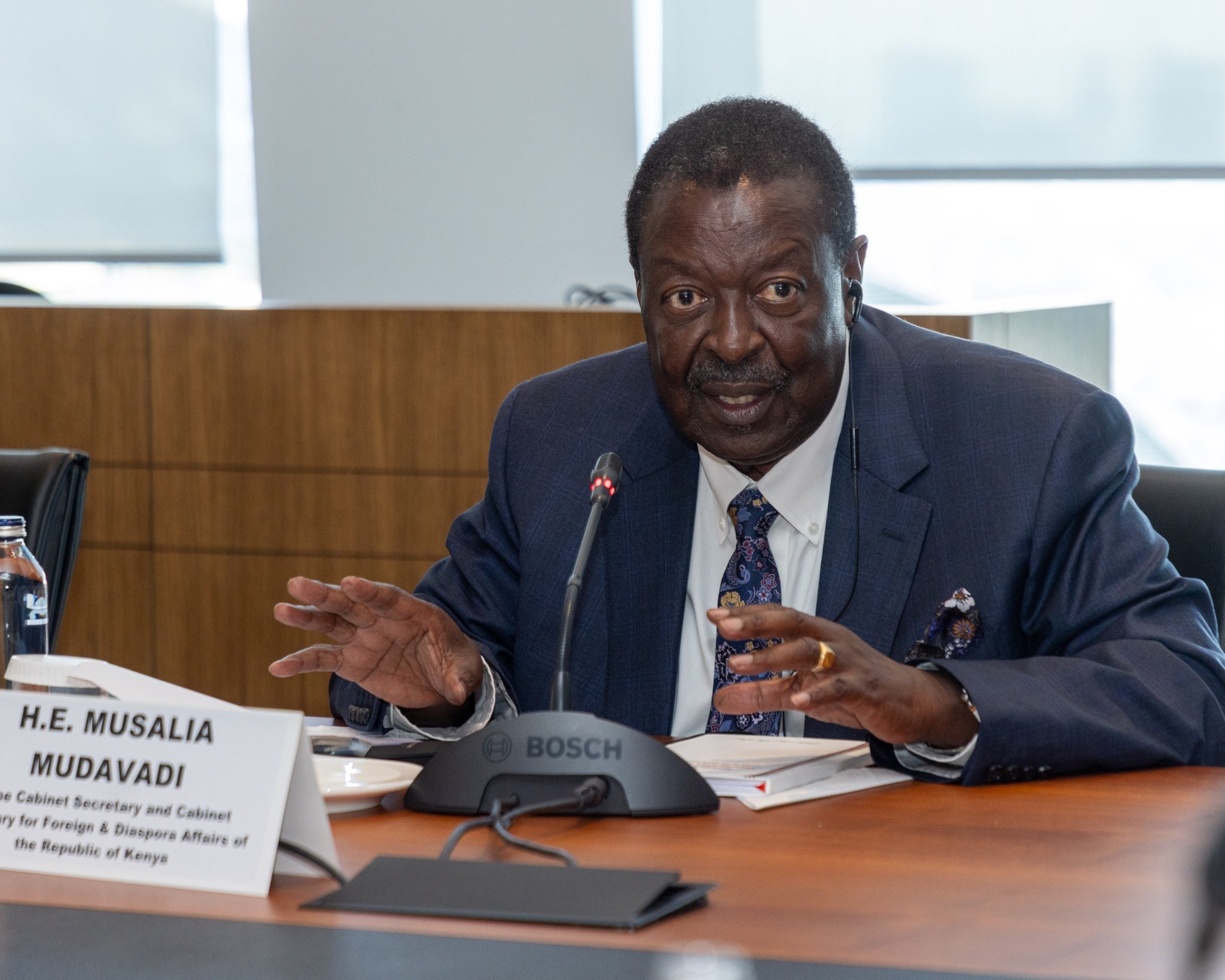
Prime Cabinet Secretary Musalia Mudavadi, once the de facto kingpin of Western Kenya politics, faces a political litmus test as the clock ticks down to the 2027 polls.
Once a formidable political force in Western Kenya, Mudavadi now finds himself facing multiple threats from within and outside the Kenya Kwanza coalition.
Mudavadi is also the Minister of Foreign Affairs and is skilled in economics and administration.
His status, enjoyed for almost two decades, is threatened by dissolution of his Amani National Congress, popular with the Luhya people, and its merger with President William Ruto’s UDA party. He is also squeezed by Ruto’s close association with Raila Odinga in the broad-based government incorporating Raila allies.
Then there is the rise of populist rabble-rousers such as Trans Nzoia Governor George Natembeya.
Strategic missteps have left him vulnerable and created a vacuum others clamour to fill.
Mudavadi’s elevation to the national government has limited his grassroots engagement, increasing his vulnerability and casting grave doubt on his once-presumed kingpin position.
Political observers, including from Kenya Kwanza, say Mudavadi's "ill-advised" dissolution of the ANC and its merger with UDA has significantly eroded his political reach and limited his ambitions.
Now, as part of government, he takes his cues from new party boss, Ruto, and depends on UDA's power plans instead of his own instincts.
The ANC was officially dissolved on March 7 this year following a resolution at the Special National Delegates Congress.
This move, while potentially strengthening Ruto's UDA, left Mudavadi, without his own political vehicle, a critical asset for any politician with national aspirations. Now he is beholden to the will and whims of the UDA hierarchy.
Mudavadi’s position is in stark contrast to that of his Western Kenya counterpart, National Assembly Speaker Moses Wetang'ula, who remains comfortably rooted at the top of Ford-Kenya.
“When you dissolve your party, you lose your bargaining power. That is why we said we won’t dissolve Ford-Kenya,” Tongaren MP John Chikati said about the disadvantages of folding a party to join a bigger political machine.
Chikati, the Ford-Kenya secretary general, said, “When you are absorbed into another party, you become weak. The stake in another party is not as strong as with your own.”
Wetang'ula's grip on Ford-K provides him with organisational structure, grassroots networks, and bargaining power within the Kenya Kwanza alliance. It also gives him a constituency from which he derives considerable power.
For Chikati, there is no disharmony in the broad-based government involving Raila, but he emphasised it has engendered competition, which may make some people uncomfortable.
“Old members may feel that their space is being taken away. That is how Mudavadi comes out – feeling the threat of losing his position,” the MP said.
Mudavadi must rely on Ruto's goodwill rather than his own political acumen and surrender to the vicissitudes of ever-shifting political alliances.
Whether Mudavadi will contest future elections under the UDA banner remains a matter of conjecture, creating uncertainty and a vacuum that quickly allows new players to emerge and Mudavadi’s past achievements to be ignored or minimised.
NATEMBEYA FACTOR
Perhaps the most immediate threat to Mudavadi's Western Kenya stomping ground is Governor Natembeya, whose rising political star threatens to disrupt the region's established order. He could steal the thunder of more experienced and well-known regional figures.
Natembeya, a former Rift Valley regional commissioner, enjoys very high ratings in his county and he has positioned himself as the bearer of a new ambitious vision for the Luhya nation. He promises unity as his agenda and is making the right noises that voters yearn to hear.
Ford-Kenya figures call Natembeya a demagogue only out for his personal survival as a governor seeking a second term. His background and daring to take on the Luhya establishment, however, are earning him dividends and motivating him to attack relentlessly.
“Natembeya can potentially erode Ruto’s support in Trans Nzoia and parts of Bungoma – that is the Bukusu vote,” political commentator Prof Charles Nyambuga said.
“But he faces serious challengers on the lower parts of Western (Kakamega, Busia and Vihiga).”
For the Maseno University don, Mudavadi’s popularity and even his stature have plummeted not only nationally but also in his backyard. This decline has fuelled the hopes of politicians such as Godfrey Osotsi (Vihiga Senator), Caleb Amisi (Saboti MP) and Cooperatives CS Wycliffe Oparanya.
“Mudavadi is seen as a not-so-serious politician. His handling of the Foreign Affairs ministry, as we saw recently in the Tanzania debacle, has made things worse,” Prof Nyambuga said.
The Foreign Affairs portfolio keeps him largely in Nairobi and overseas, practically exiled from his own grassroots and seen by many as out of touch.
The Prime Cabinet Secretary’s assignment as Foreign minister, while prestigious, creates significant obstacles to maintaining political relevance at home.
“The demands of international diplomacy limit his ability to regularly engage with constituents in Western Kenya, allowing rivals to fill the vacuum,” Ben Ombima, a politician from Western, said.
As MP for Sabatia, Mudavadi established health centres, eye hospitals and microcredit schemes that directly benefited his constituents.
Ken Omulo Jnr, a former ANC political affairs director, said it’s too early to write off Mudavadi.
“Mudavadi is a national leader, hence, not interested in regional segregation and ethnic politics,” he said.
“We are trying to change our political landscape and conversation from ethnic politics to issue-based or agenda-based politics.”
“Musalia, therefore, remains the Luyha supremo despite the noises being made by some leaders in the region,” the former ANC official said.
Omulo said Mudavadi's political strategy is “a calculated alignment with Ruto, while quietly eyeing the presidency in 2032.”
“His achievements at MFA not only enhance Ruto’s 2027 campaign but also lay the groundwork for Mudavadi’s own presidential narrative,” he said.
RUTO’S RAILA GAMBIT
President Ruto's close association with opposition leader Raila introduces another layer of complexity to Mudavadi's predicament.
Raila commands a significant following in Kakamega, Busia, and Vihiga counties — areas that overlap with Mudavadi's traditional support base.
Perhaps more ominously, Ruto has the options of propping up Oparanya as an alternative power centre with which to bolster the President’s standing in the region.
The former Kakamega governor, a Raila ally, could serve as a viable alternative power broker in Western Kenya.
The emergence of a coalition comprising former Deputy President Rigathi Gachagua, Wiper leader Kalonzo Musyoka and DAP-K's Eugene Wamalwa further complicates the landscape, potentially splitting votes and influence in ways that could marginalise Mudavadi.
POTENTIAL WAY OUT
For pundits, Mudavadi must, in the face of prevailing challenges, carefully navigate the remaining years before the 2027 elections.
“His options appear limited but not exhausted,” political commentator Herman Manyora said.
Among alternatives, according to Prof Nyambuga, is for the Prime Cabinet Secretary to fill the vacuum that his challengers are trying to occupy.
“The rise of the likes of Amisi shows there is a vacuum created by Mudavadi’s absence,” he said.
Nyambuga said Mudavadi has to rebuild grassroots connections and intensify tours of Western, despite ministerial constraints.
“He could also leverage his Prime Cabinet Secretary role to deliver development projects and shore up support,” Ombima said.
Some quarters suggest Mudavadi could push for prominent placement of his allies in UDA's leadership structures to maintain some organisational control.
“Given Kenya's volatile politics, maintaining loyalty to Ruto while positioning himself as a potential compromise candidate in future succession politics could pay dividends,” Omulo said.
Recent closed-door meetings among Western Kenya leaders, including bipartisan groups of MPs, suggest recognition of the need for strategic realignment.
While details of the engagements remain confidential, such consultations indicate efforts to assess the evolving political landscape.
“They [the Sirisia MP John Waluke-led Western caucus] can potentially forge new alliances that could benefit or further isolate Mudavadi,” political analyst Javas Bigambo said.
The long and short of it is that Mudavadi stands at a critical juncture in his long political career.
The dissolution of ANC, the emergence of Natembeya, constraints of high office, and Ruto's shifting alliances collectively threaten to diminish his influence when he needs it the most.
It is commonly agreed that he remains politically exposed in a landscape where personal political vehicles are essential for survival.
Whether Mudavadi can adapt to these challenges will determine if the ‘earthquake’ can once again define the 2027 race or mark the decline of one of Western Kenya's most enduring political figures.
The coming months will be crucial as Mudavadi attempts to navigate these turbulent political waters while maintaining his relevance in Kenya's rapidly evolving political arena.