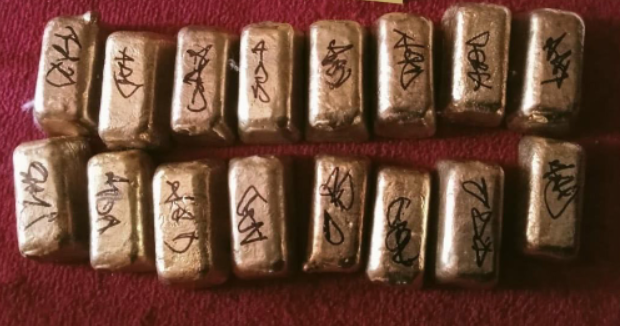
Kenya’s political elite is at the centre of gold smuggling in the region, making Nairobi a transit hub for the mineral smuggled from neighbouring and nearby countries, a new report has shown.
The latest publication from SWISSAID on gold flows in Kenya (2014-2023) says some of the gold that is smuggled out of South Sudan, the DRC and to a lesser extent, Ethiopia, and Sudan passes through Kenya before being ultimately being reexported.
The report said smuggling networks shipping gold out of the country enjoy the backing of “politicians”.
The mysterious disappearance of three tonnes of gold from the DRC at JKIA on its way to Dubai suggests that high-ranking state officials in Kenya are involved in smuggling schemes, the study says.
This is because such large volumes of precious metal rarely ever disappear without a trace unless under the powerful influence of politicians, SWISSAID said.
“Undeclared production from Kenyan artisanal and small-scale mining is smuggled out of the country and reaches mainly the United Arab Emirates, possibly also Uganda and Tanzania,” the report published on May 26 says.
Smuggling of gold from Kenya could reach a low two-digit figure in tonnes per year, it adds.
For most years since 2019, declared imports of gold from Kenya into other countries were higher than domestic production and declared imports, pointing to inbound illicit gold flows.
“What official figures do not show is that significant quantities of gold are being smuggled every year into Kenya from neighbouring and nearby countries, more particularly South Sudan, the DRC (in some cases through Tanzania), Ethiopia and possibly Sudan. This gold does not remain in Kenya; it is re-exported to destinations such as the UAE and India,” the report says.
It further argues that most of the trade gap in gold between Kenya and the UAE gold could be due to Kenya’s role as a transit country for illicit gold flows from the DRC.
SWISSAID's finding of gold smuggling from South Sudan is backed by the 2021 Global Initiative against Transnational Organized Crime (GI-TOC) report. The GI-TOC said most of the gold produced in South Sudan is smuggled out of the country and the main supply chains run into Uganda, Kenya, the DRC and Sudan.
“The direction which gold moves is largely determined by the proximity of the closest border. The main border posts used for this purpose are Nimule-Elegu and Kaya [Uganda] and Nakodok (Kenya),” the GI-TOC report said.
The smuggling starts with local buyers in South Sudan acquiring gold from miners and selling it to larger buyers in regional towns, such as Kapoeta or Yei.
From there, dealers transport the gold to Juba or over the border to Uganda or Kenya.
Somali traders seem to play a leading role in this traffic, GI-TOC said, but Kenyan and South Sudanese businessmen are also involved.
“From Kapoeta, gold is smuggled into Kenya through the Nadapal-Lokichogio border post. Some traders will sell gold at the Lokichogio border with Kenya, while others will transport the gold all the way to Nairobi. Eastleigh, a predominantly Somali neighbourhood in Nairobi known to be a gold hub, was specifically referenced by interviewees,” GI-TOC said.
While most of the Congolese gold is smuggled out via Burundi, Rwanda and Uganda, Kenya was found to play major role in the regional illicit gold trade and with Kenyans routinely being been named in UN sanctions reports.
In December 2011, a UN report named four Kenyans involved in gold smuggling from the DRC. The three were businessman Paul Kobia, John Karimi and Robert alias Dr Roba.
In December last year, Kenyan businessman and politician Kamlesh Pattni was among 28 individuals sanctioned by US and the UK for involvement in global gold smuggling and money laundering.
A Kenyan smuggler interviewed by GI-TOC said about 100 to 200kg of illicit gold from the DRC leaks into the Kenyan secondary market every month.
The report adds that an expert on ASM in Kenya they consulted in early 2025 confirmed gold was “smuggled from Congo and South Sudan through Kenya to Dubai and Abu Dhabi in UAE through JKIA” and added that “this business is mostly dominated by Indians and Somalis (of Kenyan origin) and their wholesale shops are in Eastleigh in Nairobi".
Kenya may also have become a transit hub for gold from Sudan, a country where civil war has been raging since April 2023.
The warring parties —the Rapid Support Forces (RSF) and the Sudanese Armed Forces (SAR) — have been found to use gold to finance their war effort.
At the same time, the junta government in Sudan has accused President William Ruto of having commercial interest with the RSF — claims he has denied. His former deputy, Rigathi Gachagua, has, however, also claimed his former boss is involved in gold smuggling with RSF leader Hamdan Dagalo alias Hemedti.
A recent report by the UN Panel of Experts on Sudan revealed significant gold smuggling particularly within the RSF-controlled areas in Darfur. The report estimated that in 2024, RSF controlled areas produced nearly 10 tonnes of gold, valued at USD 860 million.
This gold production is linked to the Sudanese war, with the RSF using the profits to finance its operations and military activities. The report also highlighted the UAE's involvement, suggesting they have been helping the RSF receive smuggled gold.
At the global level, gold is smuggled from Kenya to the UAE, India, South Africa and perhaps China.
The report says Nairobi and the JKIA play a key role in this traffic, and that “gold trading also takes place in the Nairobi Central Business District and Karen neighbourhoods”.