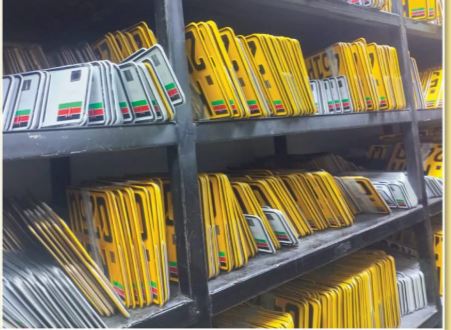
The government has now directed all ministries and agencies to comply with a directive requiring official vehicles to be fitted with second-generation number plates by August 29, 2025.
In a circular dated May 21, 2025, Head of Public Service Felix Koskei ordered the immediate rollout of the high-security plates across all government fleets.
Koskei warned that any government vehicle not compliant by the deadline would be impounded.
The second-generation plates, rolled out in 2022, feature advanced security enhancements, including digital tracking elements, and are designed to meet international vehicle identification standards.
According to Koskei, the upgraded design is part of a broader government strategy to combat vehicle-related crime, improve road safety, and ensure greater transparency in the management of public assets.
“It has come to the attention of this office that, despite the New Generation Number Plates being a critical security and road safety initiative, the majority of County Governments, Ministries, Departments, and State Agencies (SAGAs) have yet to replace the old number plates,” Koskei stated.
The transition to new number plates is not just about aesthetics; it’s a crucial step towards ensuring road safety and improving vehicle identification.
Whether you are a vehicle owner or a dealer, understanding the new number plate application process, requirements, and costs is essential.
What are the new generation number plates?
Digital number plates in Kenya, also known as new-generation number plates, are a security-enhanced version of traditional license plates.
They incorporate microchip technology, anti-counterfeit features, and a unique serial number linked to the vehicle's chassis number. The plates also include an imprinted Kenyan flag, a hologram, a QR code and a watermark.
The plates use the FE-Schrift typeface, which is a sans serif typeface introduced in the late 1970s for use on licence plates.
Its monospaced letters and numbers are slightly disproportionate to prevent easy modification and to improve machine readability.
The new plates will incorporate microchip technology and several anti-counterfeit security features that will render them practically impossible to imitate.
They have laser-etched serial numbers and NTSA traceability systems.
They are designed to make vehicle identification more accurate and reduce cloning or logbook fraud.
They also have unique and different serial numbers – for both the rear and front plates – that are linked to the vehicle’s chassis number.
The smart plates are easily identifiable to law enforcement officers and will also store key motor vehicle information such as year of manufacture, type and colour of vehicle, engine number, transmission type, date and place of manufacture, and insurance details.
New number plates are part of the Kenyan government’s initiative to standardise vehicle registration and enhance security.
These plates are designed to be more reflective, durable, and harder to tamper with, making it easier for law enforcement to track vehicles.
The new number plates were launched on August 30, 2022, by former Cabinet Secretary Fred Matiangi, with Kenyans then given 18 months to apply for the new digital plates.
Why you need to apply for the digital number plate
If you own a vehicle in Kenya, applying for new number plates is mandatory.
The government has not set August 29, 2025, as the deadline yet for all vehicles to have these new plates.
Having updated number plates not only complies with the law but also enhances your vehicle’s visibility and safety on the road.
How to apply using eCitizen
Access the eCitizen Portal: Go to the eCitizen platform and log in to your account or create one if you don’t have an account yet.
Navigate to the NTSA Services: Select the National Transport and Safety Authority (NTSA) section and choose the New Number Plate Registration option.
Fill in Your Details: Complete the application form with your vehicle’s details, including the registration number and personal identification information.
Pay the Application Fee: The standard application fee for new number plates is Ksh 3,050, which includes the cost of the plates and processing fees. Make your payment securely through the eCitizen platform.
Submit Your Application: After completing the form and making the payment, submit your application.
How to receive your plates
Once your application is approved, you will be notified when to pick up your new number plates or have them delivered to your preferred address.
Costs and charges
Application Fee: Sh 3,050 for NTSA.
Additional Charges: There may be extra charges for personalised plates or specific features, depending on your preferences.
Requirements for new number plates
To successfully apply for new number plates, you need to meet the following requirements:
Valid ID: A Kenyan National ID or passport.
Vehicle Registration Details: Original vehicle logbook and registration certificate.
Payment Receipt: Proof of payment for the application fee.
Checking application status
After submitting your application, you can easily check the status through the eCitizen portal. Simply log in to your account and navigate to your applications section to see updates on your new number plate request.
They begin with three letters, three numbers, then one letter (e.g KDK 123A)
The physical plate includes a QR code on the left side
NTSA records will show the new plate format with embedded digital details
If unsure, do a vehicle search via NTSA TIMS.
Security and fraud protection
New number plates make it easier for lenders to:
Confirm ownership using NTSA data
Detect duplicate or fake logbooks
Avoid financing stolen or cloned vehicles
This gives both the borrower and lender added protection during the loan term.