
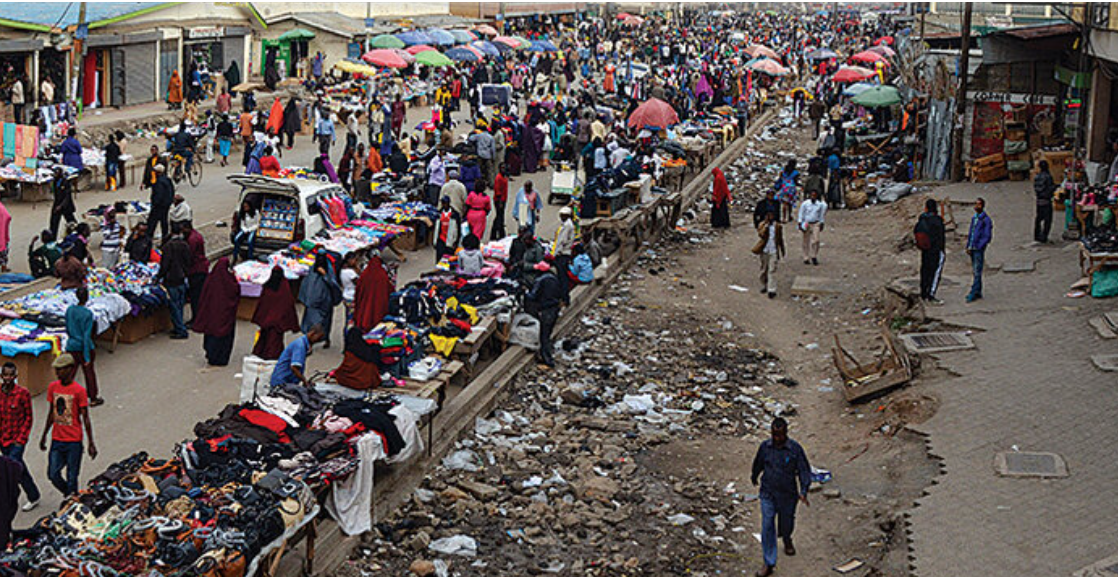
Nairobi’s vibrant Eastleigh neighbourhood has emerged as a critical waypoint in the smuggling of undocumented migrants along the Southern Route, according to a new report by the Regional Migrant Response Plan.
The area, known for its large Ethiopian and Somali communities, serves as a temporary hideout where smugglers gather migrants before arranging their perilous journeys toward Tanzania and onward to southern Africa.
“Migrants in transit typically find accommodation in the Eastleigh neighbourhood and its outskirts. This area hosts substantial Ethiopian and Somali diaspora communities and serves as an effective hiding place for migrants until smugglers group them for the next leg of their journey,” the MRP says.
Kenya’s strategic position and relative economic stability make it both a destination and a major transit hub for migrants fleeing environmental crises and instability in the Horn of Africa.
The MRP—a collaborative effort involving 45 humanitarian organisations—highlights that 85 per cent of these migrants are Ethiopian, while 15 per cent are Somali, with most driven by severe droughts that have crippled rural livelihoods.
Despite a bilateral agreement allowing free movement between Ethiopia and Kenya, authorities arrested 1,455 undocumented migrants between September 2023 and August 2024—a sharp increase from the previous year.
Most were Ethiopians, apprehended while attempting to move south. The surge is linked to environmental degradation, particularly droughts in home countries that adversely affect rural livelihoods, the framework says.
They mainly cross into Kenya through Moyale in Marsabit county, Mandera and Wajir.
Last November, the annual security report said between September 2023 and August 2024, 1,455 undocumented migrants were arrested, marking an increase from 1,219 during the previous year.
At the time, Ethiopia was the largest source of the migrants with 1,140 Ethiopians arrested. This is despite a bilateral deal allowing unrestricted movement between Ethiopia and Kenya.
The smuggling trade has reshaped border towns like Moyale, where an estimated 60 per cent of local income stems from illicit activities, including human trafficking.
Migrants passing through rely on informal networks for transport, food and lodging, fuelling an underground economy on both sides of the Kenya-Ethiopia border.
From Moyale, migrants select the routes down south based on security, ethnic ties, contacts along the route and the availability of safe houses, the MRP says.
The smuggler's ethnicity plays a crucial role in route choice and affects journey outcomes, such as access to safe houses and interactions with law enforcement authorities.
“Sharing the same ethnicity with law enforcement officials allows smugglers to communicate in the same language or reference familial or community connections, thereby gaining trust and increased leniency, the report reads.
It cited the route passing through Marsabit to Isiolo as often favoured for its infrastructure and paved road, and primarily used by non-Somali-speaking smugglers.
The route that goes through Wajir mostly consists of rough gravel roads, is mainly utilised by smugglers of Somali ethnicity.
From Isiolo, migrants head to Nairobi either through Meru and Embu or along the Nanyuki-Nyeri highway. For those travelling via Wajir, the path leads through Garissa and Mwingi towards Thika.
Somali migrants enter Kenya through overland routes via Mandera or Liboi, and then head to Dadaab and Garissa.
“Indeed, many have social connections in northeastern Kenya or near the Dadaab refugee camps, where they may spend a few days before continuing their journey either toward Nairobi or to Kenya’s southern border via Malindi and Mombasa,” MRP says.
To reach the Kenyan-Tanzanian border, migrants use four distinct land routes.
The primary route leads towards the southern Coast, where smugglers utilise land and coastal paths to reach the porous border crossings into Tanzania near Lunga Lunga or by boat.
The second route goes through Athi River towards unmonitored entry points near the Namanga border, while the third heads toward Oloitokitok in Kilimanjaro. The fourth route goes through the Taita-Taveta border, where migrants face increased risks as they are guided through the Tsavo National Park. Additionally, maritime routes across the Indian Ocean between Kenya and Tanzania are used to bypass mainland checkpoints.