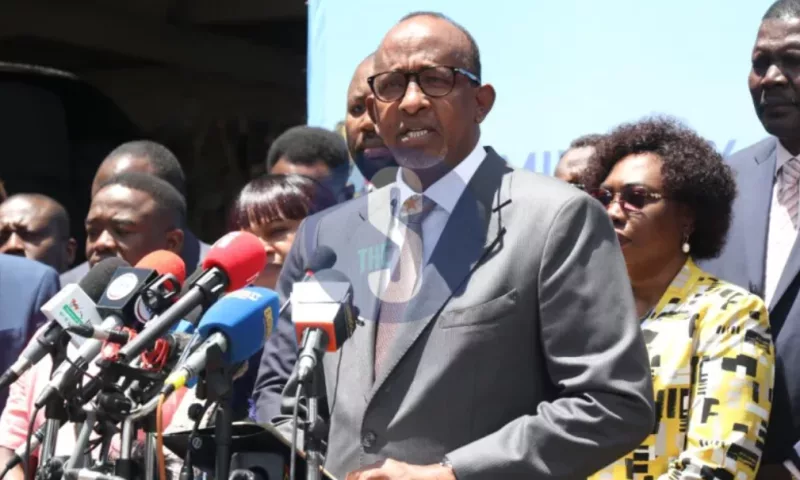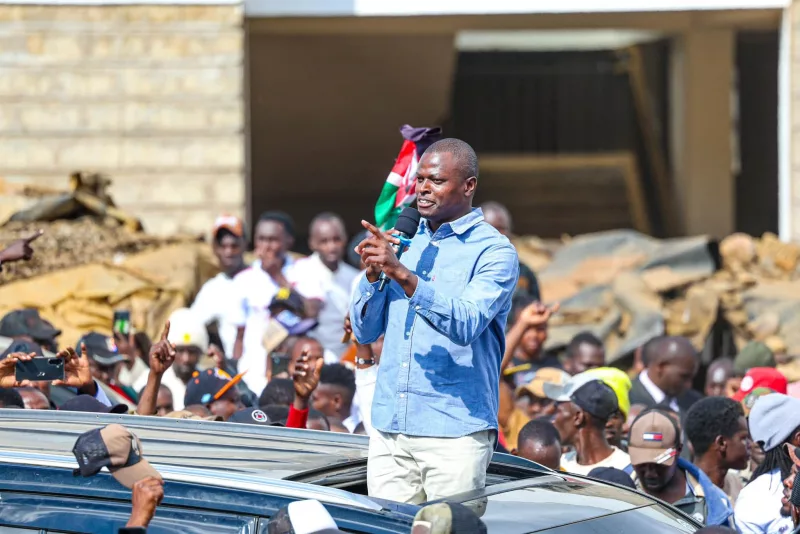
Former Deputy President Rigathi Gachagua has dropped his legal bid to return to office and is now seeking compensation and retirement benefits from the State, arguing that his impeachment last year was unconstitutional.
The former DP has abandoned his initial push for reinstatement to office following his impeachment and replacement by Kithure Kindiki in October last year.
Details of Gachagua’s new approach emerged on May 29, 2025, when his lawyers appeared before a three-judge bench constituted to hear his case at the Milimani High Court.
Gachagua’s lawyer, Paul Muite, argued that his client would now focus on constitutional redress rather than returning to his former position.
Muite told the court that Gachagua intends to challenge the legality of his removal from office and seek damages for a term he claims was unjustly cut short.
“The petitioner wishes to vigorously challenge the legality and constitutionality of his impeachment and will be seeking to persuade this Honourable Court to grant him a monument he would have earned had he served for the entire five years for which he had been elected by the Kenyan people,” Muite said.
He further confirmed that all prayers seeking reinstatement would be dropped, calling them irrelevant under the new legal approach.
“These are the prayers of declaration, E565 in its current form; those are prayers, a declaration that the petitioner wishes to be abandoned,” he explained.
This means Gachagua is seeking hefty benefits from the State, including preferential treatment accorded to former presidents, retired deputies, and ex-prime ministers.
Should the courts agree with Gachagua, then the former DP will enjoy benefits reserved for retired state officers under the Retirement Benefits (Deputy President and Designated State Officers) Act, 2015.
Section 4 of the Act outlines circumstances under which a former State officer may be denied retirement benefits, including impeachment.
This means that for Gachagua to be treated as a former DP under the law, he must first overturn his impeachment and have his removal from office declared null and void.
However, the National Assembly must also pass a motion supported by more than half of its members to block the benefits.
Circumstances under which benefits may not be paid
Section 4(1) states that, despite the provisions of Section 3, the National Assembly may, by a motion supported by at least half of its members, resolve that an entitled person, surviving spouse, or children shall not receive any benefits conferred by the Act.
This can happen if the individual ceased to hold office due to a willful violation of the Constitution or was guilty of gross misconduct.
Other grounds include if the person, after leaving office, has been convicted of an offence and sentenced to imprisonment for a term of three years or more without the option of a fine.
The law also bars anyone who, after leaving office, holds office in or actively engages in the activities of any political party from receiving the benefits.
Where a designated officer has willfully violated the Constitution, the lifetime perks and pay are revoked.
This means that if Gachagua loses his court battle against his impeachment, he will be blocked from accessing state benefits, as his removal from office would be upheld.
He was removed from office on the grounds of violating the Constitution, which, if confirmed by the courts, would disqualify him from state benefits.
Benefits entitled to a former Deputy President
The biggest benefit for a former Deputy President is a pension pegged at 80 per cent of their last monthly salary.
For example, former Vice President Kalonzo Musyoka, who served between 2008 and 2013, was allocated Sh81.36 million in the 2024/25 financial year.
Former Vice President Moody Awori, who served from 2002 to 2007, was allocated Sh74.2 million in the same period.
The law provides that a retired Deputy President or Vice President is entitled to a monthly pension equal to 80 per cent of their last monthly salary while in office.
They are also entitled to a lump sum payment on retirement, equal to one year's salary for each term served.
In addition, they are entitled to two saloon vehicles (engine capacity not exceeding 2000cc), replaceable every four years, and one four-wheel drive vehicle (engine capacity not exceeding 3000cc), also replaceable every four years.
Other entitlements include a fuel allowance equal to 15 per cent of their current monthly salary and full medical cover—local and overseas—for the retiree and their spouse.
The Act also provides additional allowances for official functions assigned by the government.
Beyond these benefits, the retiree is also entitled to two drivers, one personal assistant, one accountant, one secretary, two housekeepers, two senior support staff, two cooks, two gardeners, two cleaners and armed security guards on request.
The retired DP and their spouse are also entitled to diplomatic passports, an office with equipment, vehicle maintenance, and access to VIP Lounge II at all airports within Kenya.
Death
The Retirement Benefits (Deputy President and Designated State Officers) Act, 2015, also covers death benefits.
Upon the death of the entitled person, the surviving spouse is eligible for 50 per cent of the pension previously payable.
In cases with more than one spouse, the benefits are divided equally.
Children are also entitled to a portion of the benefits.
If there is only one child, they receive 25 per cent of the entitled person’s pension.
If there are two or more children, 50 per cent of the pension is divided equally among them.