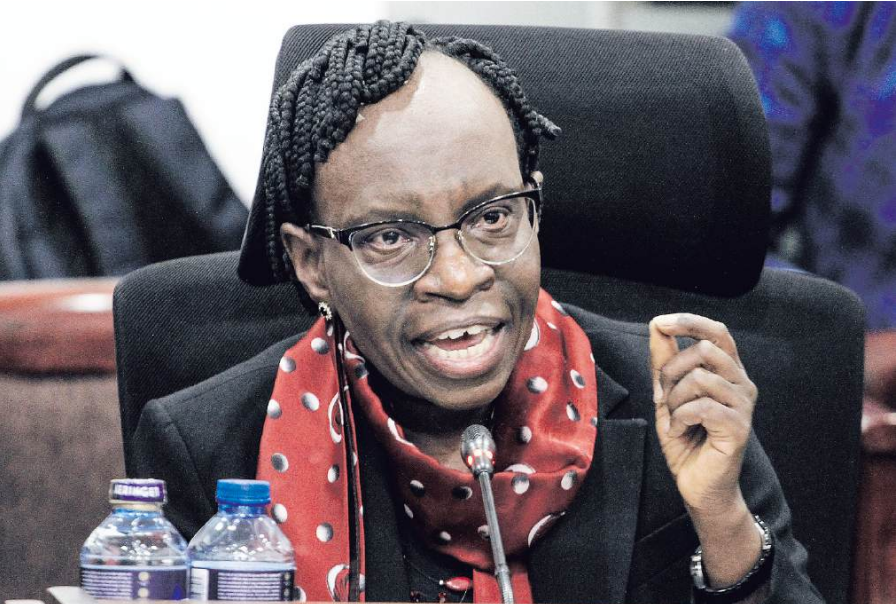
Auditor General Nancy Gathungu has delivered a bold assessment on the 2025-26 budget proposals, warning that mismanagement, unrealistic revenue targets and chronic underperformance in development risk plunging the country deeper into debt.
She said aspects characterising President William Ruto’s administration’s second budget also risk undermining critical public services.
In a 24-page presentation to Parliament’s Budget and Appropriations Committee, Gathungu said a pattern of fiscal indiscipline casts doubt on the government’s ability to achieve Ruto’s much-touted “economic transformation” agenda.
At the heart of Gathungu’s critique before the Alego Usonga MP Sam Atandi-led committee is the National Treasury’s over-optimistic revenue strategy.
The proposed budget projects ordinary revenue at Sh2.76 trillion up from Sh2.58 trillion in financial year 2024-25.
However, the amount falls short of the World Bank’s recommended 15 per cent tax-to-GDP threshold.
The auditor general linked the gap to weak enforcement, evasion and poor forecasting.
Historical data shared by the auditor general reveals a five-year trend of missed targets.
In the fiscal year 2023-24 alone, revenue collections fell short by Sh170 billion (6.9 per cent), while tax arrears ballooned to Sh2.33 trillion by June 20 last year, translating to a 133 per cent spike from 2023.
“The KRA’s targets are disconnected from reality,” Gathungu said, noting that uncollected arrears for 2023-24 alone amounted to 91.8 per cent of total Treasury revenue.
“When projections are inflated, borrowing becomes inevitable.”
The consequences are dire. With public debt already at Sh11.1 trillion, Gathungu warned that persistent revenue gaps could force Kenya to take on costly loans to fund the Sh4.24 trillion budget, further straining taxpayers.
She urged the Treasury to adopt “cautious, evidence-based forecasts” and modernise tax systems to curb evasion. While the budget allocates Sh643.9 billion to development—25.8 per cent of national expenditure—Gathungu revealed that poor execution and delayed funding have rendered such allocations largely symbolic.
Audits show Kenya has consistently failed to meet the legal requirement of dedicating 30 per cent of budgets to development, with absorption rates worsening yearly.
In the year 2023-24, only Sh500.2 billion of Sh708.8 billion (29 per cent) was spent, leaving projects half-built and objectives unmet, while some have pending bills.
Donor-funded initiatives fared no better.
Fourteen projects worth Sh515 billion had Sh304 billion (59 per cent) unused by mid last year, triggering a penalty charge of Sh6.57 billion for undrawn loans since 2020.
“Some of the projects have clauses where they attract commitment fees for any undrawn amounts leading to wastage of funds and lack of value for money,” the auditor said.
Among the worst performers include the Mombasa Gate Bridge which had 98 per cent undrawn funds. The project has consumed Sh938 million.