 Ngũgĩ wa Thiong’o
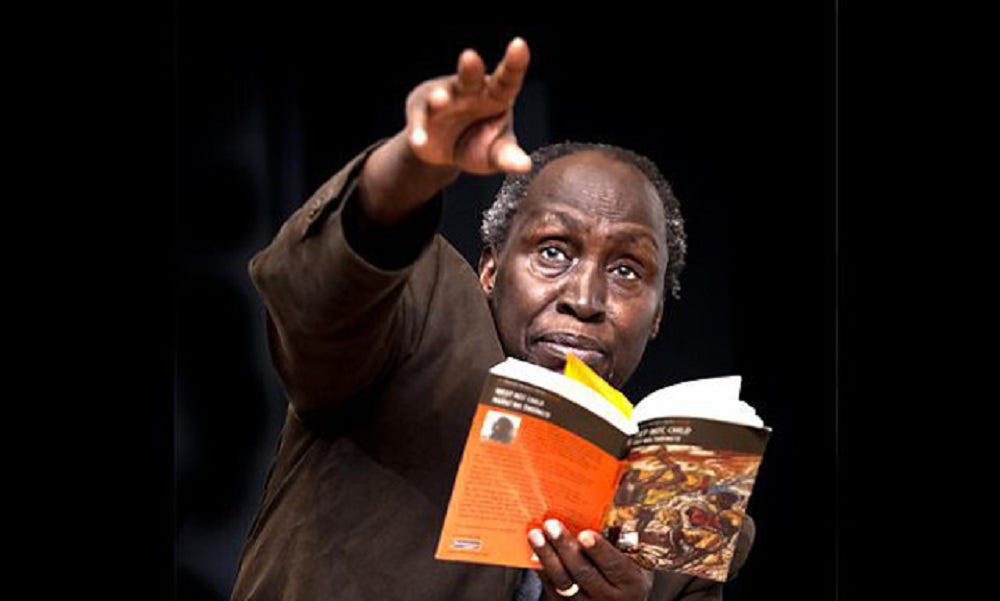
Ngugi wa Thiong’o, one of Africa’s most celebrated literary figures, lived a life marked not only by his prolific writing but also by political persecution and exile.
The celebrated Kenyan novelist and playwright, whose sharp criticisms of post-independence elites led to his jailing and two decades in exile, died at the age of 87.
His journey from a rural Kenyan village to international recognition as a writer, and eventually into forced exile, is a powerful narrative of resistance, repression, and return.
Born in 1938 in Kamĩrĩthũ, central Kenya, Ngugi rose to prominence in the 1960s and 70s as a novelist, playwright, and academic.
His early works, such as Weep Not, Child and The River Between, were written in English and explored themes of colonialism and post-independence struggles.
However, by the mid-1970s, Ngugi had grown disillusioned with the failures of Kenya’s post-independence elite.
He turned to writing in Gikuyu—his mother tongue—as a way of reclaiming indigenous languages and confronting what he saw as neocolonial structures in both literature and politics.
His political awakening intensified with the production of the play Ngaahika Ndeenda (I Will Marry When I Want), co-written with Ngũgĩ wa Mĩriĩ and staged in 1977 at an open-air theatre in his hometown of Kamĩrĩthũ.
The play, written in Gikuyu and performed by local peasants and workers, was a direct critique of land dispossession, class inequality, and political repression under the regime of President Daniel arap Moi.
The impact of Ngaahika Ndeenda was immediate and electric, drawing thousands of viewers. But it also attracted the wrath of the state.
In December 1977, Ngugi was arrested and detained without trial by the government.
Ngugi spent a year in the Kamiti Maximum Security Prison, during which he famously wrote his first novel in Gikuyu, Caitaani Mũtharaba-Inĩ (Devil on the Cross), on prison-issued toilet paper.
His incarceration sparked outrage among human rights groups, writers, and academics around the world, who demanded his release.
After his release in December 1978, Ngũgĩ found himself increasingly under surveillance and pressure.
The Kamĩrĩthũ theatre was razed to the ground by government agents, and he faced repeated threats. In 1982, during a trip to Britain to launch Devil on the Cross, Ngũgĩ learned that his return to Kenya could mean re-arrest—or worse.
The government had intensified its crackdown on dissidents, especially after the failed 1982 coup attempt. He chose exile.
Ngugi spent the next two decades abroad, living in the United Kingdom and later the United States, where he took up academic positions at prestigious institutions such as Yale and the University of California, Irvine.
While in exile, he remained a vocal critic of the Moi regime and continued to write essays, novels, and theoretical works advocating for linguistic decolonisation and social justice.
Thiong'o ended his exile in 2004 after Moi left office following more than two decades in power marked by widespread arrests, killings and torture of political opponents.
The atmosphere became more conducive for exiled dissidents to return home.
In August 2004, after 22 years in exile, Ngugi and his wife, Njeeri wa Ngũgĩ, returned to Nairobi.
However, the return was not without trauma. Just days after their arrival, they were attacked in their Nairobi apartment.
Ngugi was beaten, and his wife was sexually assaulted. The attack was widely condemned, and while the assailants were never conclusively identified, the incident raised concerns about whether elements loyal to the old regime were still at large and resisting reform.
Despite the violence, Ngugi declared he would not be deterred. His return marked a symbolic moment in Kenya’s democratic journey, representing the resilience of intellectual freedom over tyranny.
Although Ngugi said upon returning to Kenya in 2004 that he bore no grudge against Moi, he told Reuters then in an interview three years later that Kenyans should not forget the abuses of the era.
"The consequences of 22 years of dictatorship are going to be with us for a long time, and I don't like to see us returning to that period," he said.
He returned to the US, where he had held professorships at universities including Yale, New York and California, Irvine.
In academia and beyond, Ngũgĩ became known as one of the foremost advocates of literature written in African languages.
Throughout his career - and to this day - African literature was dominated by books written in English or French, the official languages in most countries on the continent.
Thiong'o's best-known works included his debut novel "Weep Not Child", which chronicled the Mau Mau struggle and "Devil on the Cross", which he wrote on toilet paper while in prison.
In the 1980s, he abandoned English to write in his mother tongue, Gikuyu, saying he was bidding farewell to the imported language of Kenya's former colonial master.
His works—Matigari, Moving the Centre, Decolonising the Mind—became rallying texts for African intellectuals and activists resisting authoritarian rule and Western cultural dominance.