WHEN Elvis Tuyizere left Burundi in 2023, he was not aware of what the world outside his country held for him.
His mind was however set, he was going to Kenya’s capital Nairobi which according to him, is regionally known as a city of opportunities.
It took him about five days with several stopovers in Tanzania and the Western region of the country before he finally arrived in Nairobi, where he had a cousin who had moved a few months earlier.
He was introduced into the hawking business with the help of his fellow Burundians who assisted him with an initial capital of Sh3,000, that enabled him get his first batch of merchandise (shoes) from Gikomba Market.
Today, he has built enough capital and made profit, as he explained, enabling him to support his siblings back home.
“I send at least Sh10,000 back home every month to my family. Unemployment is high in Burundi but coming to Kenya has given me an opportunity to earn a decent life. Kenyans are good spenders and the shilling is stronger,” Tuyizere told the Star.
At a barbershop in Umoja, we met a Rwandese nicknamed Kagame. He also moved to Kenya last year. He has so far brought in his cousin who works in the same shop and a brother who is now a boda boda operator plying the CBD-Upper Hill route.
These are just but a few of the hundreds of citizens from the regional countries who have taken advantage of the East African Community (EAC) free movement of goods and people, including workers.
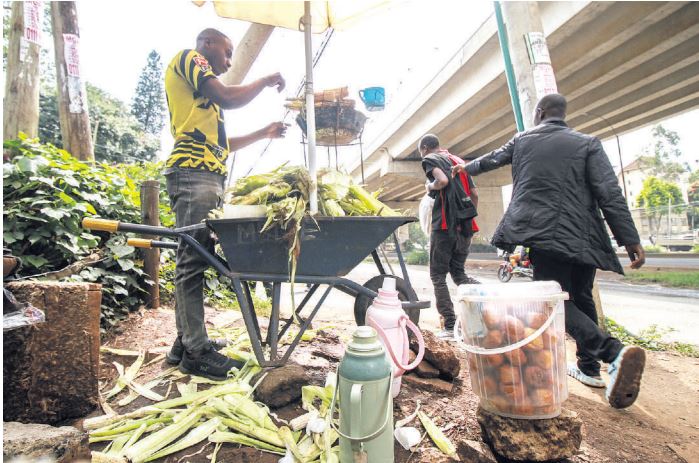
Most of the youths from neighbouring countries have gone into small businesses such as barber shops, mitumba hawking, tea and mandazi vending and boda boda operations as the informal sector continues to remain the biggest employer in the country.
According to the Economic Survey 2025 by the Kenya National Bureau of Statistics (KNBS), the informal sector created 703,700 new jobs, of the total 782,300 jobs created last year.
“The informal sector new jobs constituted 90 per cent of all new jobs created with the exclusion of small-scale agriculture. Further, the total number of self-employed and unpaid family workers within the modern sector was estimated to have increased by 1.8 per cent to 175.5 thousand in 2024,” KNBS notes in its report.
There are also nationalities from Asia who are engaging in semi-skilled jobs that, legally, should be reserved for Kenyans, as unemployment remains high in the country.
According to the World Bank, Kenya's unemployment rate stood at 5.6 per cent in 2023, reflecting a modest increase from 5.4 per cent the previous year.
Youth unemployment remains a pressing concern, with 8.4 per cent of Kenyans aged 18–24 jobless.
“While the overall rate appears relatively low, the quality of employment is a significant issue—only 10 per cent of the workforce holds formal jobs, leaving many in unstable, low-paying informal roles,” a recent report notes.
The Federation of Kenya Employers (FKE) has since acknowledged the growing concern around joblessness among Kenyan youth, juxtaposed with the increasing visibility of foreign nationals, particularly from neighbouring countries and Asia, engaging in small-scale trade, informal services and semi-skilled occupations.
“This conversation is not just about foreign workers but about the labour market efficiency, policy enforcement and the structure of our economy,” executive director and CEO, Jaqueline Mugo, told the Star.
The matter is so worrying that senators want the executive to clarify the legal status of foreign nationals involved in local business activities.
Consequently, lawmakers have summoned the Interior ministry officials and the Immigration department to explain the issue. MPs also want to establish whether the foreigners’ presence is in line with the existing labour and immigration policies.
According to Machakos Senator, Agnes Kavindu, immigrants are working in salons, barbershops, small-scale enterprises and hawking, jobs that Kenyans should not compete for with foreigners.
“There is an increase in the number of foreign nationals working in Kenya informally. This has raised concern about their legal status and the impact on employment opportunities for locals,'' she said.
At the core, Kenya’s job creation challenge is structural, according to FKE, where each year, over 800,000 young people enter the labour market, yet the formal sector, both public and private, creates few new jobs annually.
The gap has left many young people to seek livelihoods in the informal economy, which now employs over 80 per cent of the national workforce.
On foreign nationals occupying jobs such as hawking, operating boda bodas, or running kiosks and salons, FKE said the country must differentiate between legal migration and informal or undocumented activities.
“Kenya’s laws are clear. Semi-skilled and low-skilled jobs are reserved for Kenyans, and work permits should only be issued to foreigners whose skills are not readily available locally. Where enforcement is lax, this creates unfair competition and undermines local enterprise,” Mugo said.
FKE has since called for stronger inter-agency coordination, particularly between immigration, labour and trade departments, to uphold the integrity of the labour market regulations.
The Mitumba Consortium Association of Kenya has said youths from neighbouring countries have seen a business opportunity.
“Not just mitumba but all cheap items. In mitumba, we have millions of jobs that can be started with as little as Sh1,000. We need young men who are ready to work no matter what. You only need to have a concept of buy and sell,” association chairperson Teresia Wairimu told the Star.
According to Gathoni Mbugua, a clinical psychologist at AAR Hospital, rising economic pressures and high unemployment have pushed many Kenyans to vices such as gambling that has seen millions become addicted.
Thousands are also migrating to foreign countries mainly Middle East in search of employment, including house jobs.
While employment opportunities remain low, FKE has also blamed skills mismatch, lack of entrepreneurial support and limited access to capital.
“Many young people are willing to work but lack either the resources, business skills, or enabling environment to thrive, especially in informal sectors now crowded and highly competitive,” Mugo said.
Additionally, economic survivals drives some foreign nationals to take up work in sectors that locals may avoid due to low returns or poor working conditions.
“This should be a wake-up call for policy reforms that make such jobs more decent, structured and scalable for Kenyan youth,” Mugo said.
To address unemployment meaningfully, Kenya must adopt a multi-pronged approach she noted, which includes strengthening enforcement of labour and immigration laws to prevent illegal occupation of jobs reserved for citizens.
FKE has also called for up skilling and reskilling programmes, including vocational and digital skills training, to align with evolving market demands, investment in youth-led enterprise development, with access to affordable capital and market linkages.
The country must also improve the quality and dignity of informal jobs, transforming them into sustainable livelihoods through formalisation and social protection, and foster national work ethic transformation, promoting values of hard work, productivity and responsibility.
The government has in recent years invested in Technical and Vocational Education and Training (Tvets) to equip the youth with technical skills for the different sectors of the economy, while also enabling them to be self-employed.
According to Prime Cabinet Secretary Musalia Mudavadi, Tvet institutions should enhance their capability and relevance in responding to manpower needs.
Mudavadi said the government is in the process of undertaking progressive reforms in realising the productivity of the institutions.
"As part of the reforms, the Cabinet approved the dual training policy, which formalises integration of theoretical learning and hands-on training in industries," he said.
“This decision is a game changer since it will ensure trainees who have been constrained by skills mismatch with the needs of our industries, can now graduate with cutting edge skills for entrepreneurship or local and international labour markets.”
Kenya's boda boda and tuk tuk sectors can also help create more jobs and improve livelihoods if proper structures are put in place to boost operators' income levels, according to global research firm — Global Network for Popular Transportation.
"If government can support them organise themselves better under Saccos and get subsidies and proper operating environment including infrastructure, it is a big opportunity for job creation,” executive director Andrea San Gil León said.
The Kenyan boda boda sector is estimated to have around 1.5 to 2.4 million operators.
A study by Car & General (C&G) suggests there are approximately 1.2 million boda boda operators, providing one million direct jobs.