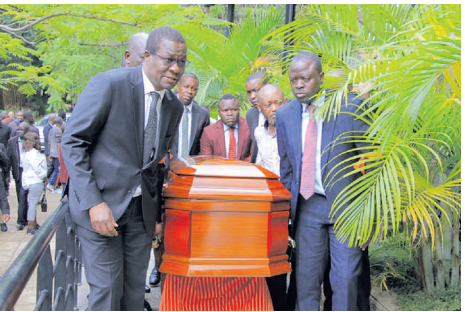
The brutal assassination of Kasipul MP Ong’ondo Were, gunned down in his car at a Nairobi traffic stop, is a grotesque stain on Kenya’s conscience. Such violence against a sitting lawmaker demands not only outrage but collective introspection.
Yet even as the nation reels, Homa Bay Governor Gladys Wanga, chairperson on ODM, chose a path of division, declaring that members of President William Ruto’s UDA would be barred from the MP’s funeral.
This reaction, though perhaps born of grief, is a betrayal of leadership. In moments of horror, leaders are called to unite, to model empathy and to prioritise healing over political vendettas.
Wanga’s outburst, alongside Siaya Governor James Orengo’s recent ideological rigidity, exposes a troubling disconnect between some leaders and the shifting priorities of the people they serve.
Kenya’s challenges demand stewardship that balances moral clarity with pragmatic action, a lesson the two leaders must urgently heed.
The murder of MP Were is a chilling reminder of the insecurity plaguing ordinary Kenyans. For a leader to weaponise this grief, as Wanga did, to exclude political adversaries from communal mourning is not just tactless, it is dangerously inflammatory.
Funerals in Kenya are sacred spaces of reconciliation, where even rivals traditionally share grief. To politicise burial rites risks deepening the very divisions that fuel instability.
Governor Wanga’s stance mirrors a broader failure among some opposition leaders to recognise that Kenyans today crave solutions, not performative antagonism.
This moment calls for leaders who channel anger into accountability, demanding investigations and advocating for security reforms, not those stoking tribal or partisan animus.
Ruto’s administration bears responsibility for addressing this security crisis, but Wanga’s response undermines constructive critique. By framing UDA as “unwelcome” at a funeral, she reduces a national tragedy to petty factionalism, alienating citizens who straddle political lines.
By prematurely assigning blame even as competent agencies are still seized of the case is careless, irresponsible and may actually undermine badly needed justice for the late Were and his family and supporters. Leadership, in times of crisis, must rise above such divisiveness.
Governor Wanga’s misstep is symptomatic of a wider struggle within ODM: The tension between ideological purity and the pragmatic demands of governance. Siaya Governor James Orengo eloquently exemplifies this clash.
A veteran activist steeped in the tradition of resistance, Orengo has criticised the Ruto-Raila dialogue as a betrayal of ODM’s “principles.” Yet, like Wanga, he risks prioritising abstract ideals over the immediate needs of his constituents.
Orengo’s idealism echoes Platonic philosophy, which elevates moral principles — justice, equity — above earthly compromise. But Aristotle, the father of political realism, reminds us that governance exists not merely to contemplate ideals but to deliver tangible progress.
In Siaya, where hospitals lack drugs and schools crumble, Orengo’s duty is to collaborate, even with adversaries, to secure resources. The Luo proverb —“One does not insult the person who helps bury their dead”— captures this pragmatism; gratitude and cooperation, not hostility.
The biblical narrative of Jesus feeding the 5,000 (John 6:1–14) offers parallel wisdom. Before preaching spiritual truths, Christ addressed physical hunger.
Similarly, Kenya’s leaders cannot ignore the “body” of the nation, the cries for jobs, healthcare and security, while fixating on the “soul” of political ideals. As the Book of James warns, faith without action is dead (James 2:15–16).
For Orengo, this means governing Siaya requires engaging Ruto’s administration to unlock funds, not boycotting systems his people rely on.
Kenya’s history underscores the power of pragmatism. The 2002 NARC coalition, which united opposition factions to end KANU’s rule, and the 2008 Grand Coalition, which halted post-election violence, succeeded because leaders prioritised stability over dogma.
Raila Odinga’s own legacy hinges on such moments: his 2018 “handshake” with Uhuru Kenyatta averted crisis, just as his current dialogue with Ruto seeks economic recovery.
Wanga and Orengo, as ODM stalwarts, should inherit this tradition. Yet their rhetoric risks reviving the sterile politics of the 1990s, where “activism” often meant intransigence.
The Luo community, which both leaders hail from, knows too well the cost of isolation. The 2000s showed that alliances, however uneasy, can yield progress: the Grand Coalition revived devolution, while the Kibaki-era “Nusu Mkate” government expanded infrastructure.
The killing of Were is a test of Kenya’s moral and political fabric. Wanga’s attempt to bar UDA from his funeral fails this test spectacularly. So too does Orengo’s refusal to reconcile idealism with the gritty work of governance.
Leaders must recognise that Kenyans today are exhausted by theatrics. They demand leaders who deliver roads, not rhetoric; who build hospitals, not hostilities.
Philosophy and faith alike teach that humanity thrives when leaders nurture both body and soul.
Wanga and Orengo must shed the comfort of old scripts and embrace adaptive leadership, one that fights for justice while forging alliances, condemns violence without vilifying opponents, and honors the dead by serving the living.
The grave is no place for grandstanding. Let this moment instead unite us in demanding better from our government, and from those who aspire to lead.
The writer is the MP for Gem.