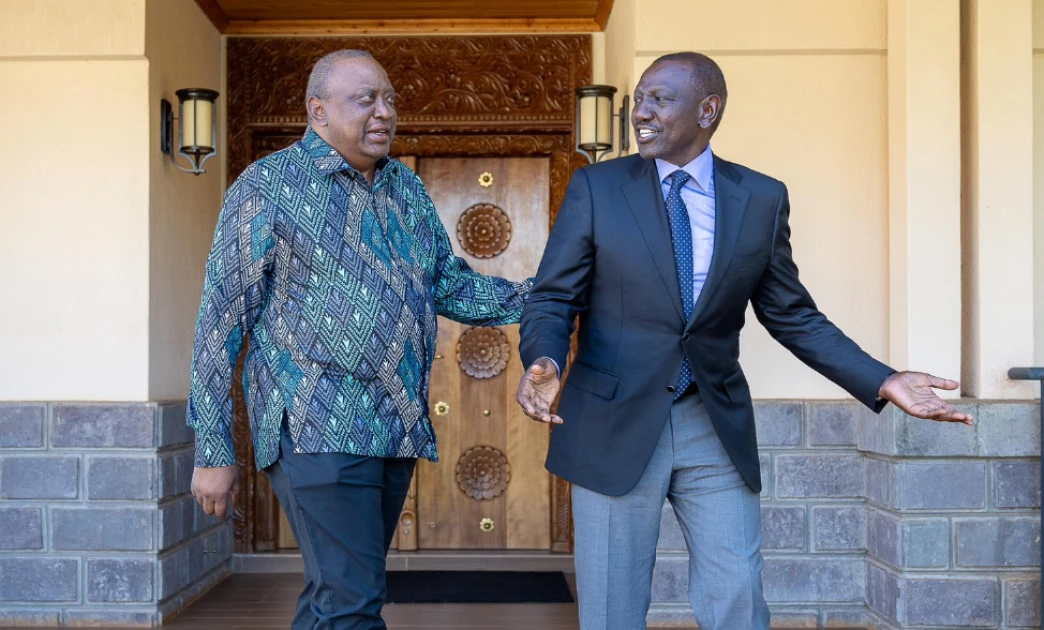
The 2027 presidential race is shaping up to be a high-stakes political rematch between President William Ruto and his predecessor and former boss, Uhuru Kenyatta.
Although constitutionally barred from running again, Uhuru's political influence remains significant, and there are growing signs he will play a central role in shaping opposition politics.
“Uhuru has a big hand in the opposition politics. Most of those people [in the opposition] are his people. He is exerting his influence through the money and the networks,” political observer Martin Andati said.
Tensions between the two leaders have simmered since the aftermath of the 2017 elections, when Uhuru ‘sidelined’ then-deputy Ruto by forging a surprise alliance with opposition leader Raila Odinga in the famous ‘handshake’ deal.
In 2022, Ruto not only defeated Raila — Uhuru’s chosen successor for whom he campaigned — but also dismantled Uhuru’s dominance in the Mt Kenya region.
For Uhuru, orchestrating Ruto’s downfall would be sweet revenge. For Ruto, defeating his former boss’s camp once again would cement a double victory — and his dominance in Kenyan politics.
In a move signaling clear intent, Uhuru’s Jubilee Party has settled on former Interior Cabinet Secretary Fred Matiang’i — a close ally of the former President — as its presidential flagbearer for 2027. There’s no love lost between Ruto and Matiang’i who took over key duties of the Deputy President, including overseeing and commissioning projects.
“We’ve settled on Matiang’i as our candidate,” Jubilee Party secretary general Jeremiah Kioni announced in February, with Uhuru's blessing giving Matiangi's candidature a national profile.
Matiang’i, the no-nonsense former “Mr Fix It” of the former Jubilee administration, is emerging as a formidable contender in the effort to unite a fragmented opposition.
Critics, however, call the former CS a “project” whose leadership is meant to bring Uhuru back to the apex of the executive by proxy. He also faces allegations of tolerating serious human rights abuses by security forces as well as claims of corruption, which he denies.
Uhuru appears to be regaining political ground in the Mt Kenya region, especially after the fallout between the area and Ruto following the impeachment of Deputy President Rigathi Gachagua from Nyeri county in the Mountain region
Once a loyal aide to Uhuru before switching allegiance to Ruto in the last election, Gachagua has since returned to defend his former boss, whom he publicly reviled on Ruto’s behalf.
“You have sent people to attack our leader, the fourth President of the Republic of Kenya, Uhuru Kenyatta. Stop sending your puppets — do it yourself,” Gachagua recently charged in a broadside at Ruto’s camp. He was impeached as DP in October last year.
Before the 2022 election, Uhuru was widely seen as Mt Kenya’s political kingpin, commanding overwhelming support in the 2013 and 2017 elections.
If he manages to rebuild that base and successfully rally it behind Matiang’i – or whoever he supports – Ruto could face a significant challenge in his re-election bid.
Uhuru may also leverage his longstanding relationship with Raila Odinga to reshape the opposition landscape.
Despite Raila signing a cooperation agreement with Ruto, the former PM and ex-President have historical ties, including Uhuru’s support for Raila in the 2022 race. Their bond remains strong.
Insiders suggest Uhuru could use their friendship to pull Raila out of his current broad-based government arrangement with Ruto.
Makueni Senator Dan Maanzo recently hinted that Raila’s alignment with Ruto is temporary – only meant to stabilise the troubled Kenyan Kwanza administration when Kenya was teetering on a precipice.
“If Gen Zs had stormed the State House [instead of Parliament], most probably he would have run away, and today we would not be having a government. So, ODM went to stabilise only up to 2027,” he said.
Backed by deep financial resources and robust political networks both locally and internationally, Uhuru is well-positioned to elevate any candidate he chooses.
Signs of Uhuru’s political revival are already visible. Last week, former Nyeri Town MP Ngunjiri Wambugu ditched Gachagua for Uhuru.
Uhuru has also become a thorn in the flesh of Ruto, with his increasingly vocal stance at public events, frequently criticising the Ruto administration — provoking fierce responses from the President’s allies.
National Assembly Majority leader Kimani Ichung’wah, Majority Whip Sylvanus Osoro, and Ruto’s aide Farouk Kibet have led the counter-attacks.
Speaking at the 2025 Second Annual Guild Leaders’ Summit at Makerere University in Uganda, Uhuru delivered a passionate address to young leaders: he urged the youth to embrace their role as modern-day freedom fighters — a message his critics quickly labelled as incitement.
Just last week, Uhuru’s brother, Muhoho Kenyatta, encouraged youth to stand up and challenge the status quo in the country by taking over leadership positions.
"It is their time now to grasp and take over the mantle of leadership, and as such, the stewardship of our continent with their passion, innovation, and energy," he stated.
“You have the numbers, you have the time, and you have the energy to get involved and stay involved in governance discussions until you effect the changes you wish to see.”
Speaking on May 3 at the wedding of Kanu chairman Gideon Moi’s son, Uhuru remarked:
“I also had a political father (former President Moi), and you know he wasn't scared of young people like some people around here today. When young people talk, they panic.”
The remarks triggered fierce attacks from Ruto’s allies, who accused the former head of state of meddling and inciting the youth against Ruto’s administration.
“You had your time as President, and you did your part. Let Ruto govern the country in peace. We have respected you as the former President, but we will come for you if you continue criticising the government,” Osoro said.
Kimilili MP Didmus Barasa challenged Uhuru to showcase what he did for young people when he served as President.
“If you really care for the youths as you claim now, show us what you did for them. If you had an opportunity to serve and you have retired, let the current leaders work in peace,” Barasa said.
This back-and-forth is unfolding against the backdrop of rising youth discontent.
In 2024, the so-called Gen Z movement led a wave of nationwide protests against Ruto’s government, culminating in the storming of Parliament and the deaths of a number of unarmed protesters.
Since then, chants of “Ruto Must Go” have become a regular fixture at football matches, entertainment venues, and across online platforms — signalling widespread frustration with the administration’s leadership and direction.
As 2027 approaches, the stage is set for a fierce political battle. And while Uhuru may be out of office, he is clearly not out of the game.