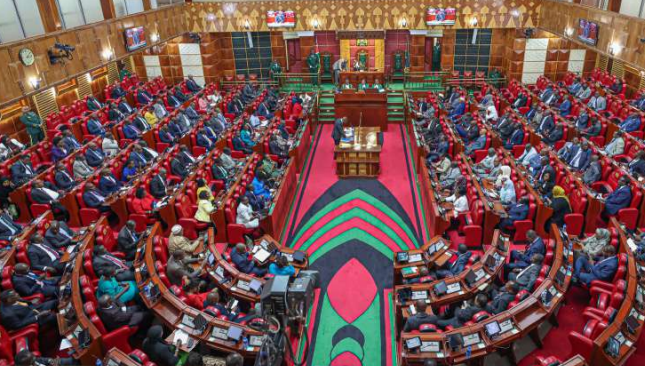
Panic has gripped Members of Parliament following the shocking murder of Kasipul MP Charles Were and fresh revelations of growing tensions with their bodyguards.
National Assembly Speaker Moses Wetang’ula has now ordered the vetting of all MPs' security personnel, citing the need to reassess their loyalty and suitability.
The move comes after Were was gunned down at the City Mortuary roundabout along Ngong Road last Wednesday, a brazen act that has sent shockwaves through the political class.
His bodyguard and driver are among 10 people currently in police custody in connection with the killing.
Speaking during Were’s requiem mass at the Consolata Shrine in Nairobi, Wetang’ula called for urgent action to review the personal security arrangements of legislators.
“Going forward, I want to encourage each one of you to submit your security details for vetting,” he said.
Quoting a Swahili proverb, he added, “Kikulacho ki nguoni mwako,” loosely meaning “what eats you is inside your clothing,” alluding to the possibility of betrayal from within.
The vetting order comes amid emerging reports of strained relationships between a section of MPs, their bodyguards and drivers, largely over financial disputes.
Multiple aides have accused some lawmakers of pocketing allowances meant for them — allegations that Parliament has strongly denied.
National Assembly Clerk Samuel Njoroge attributed the tension to budget cuts that followed the collapse of the Finance Bill, 2024.
“It would be unfair to accuse the commission or MPs of not paying money that is simply not available,” Njoroge told the Star.
“That allowance was paid in the first quarter of financial year 2023–24, but after the fall of the bill in June, we lost that funding in Supplementary Budget 1.”
Njoroge said the claims by MPs’ aides that they had not received the money stem from a misunderstanding, adding that neither the commission nor the MPs had received the money to pay them.
Parliament lost approximately Sh4 billion in that budget cut, including money allocated for drivers and bodyguards.
The clerk explained the funds were reinstated in the last supplementary budget in March - for the third and fourth quarters of the fiscal year - but Treasury was yet to release it.
While the allowances had been approved by the Parliamentary Service Commission, disbursements stalled as the Treasury is yet to release the revised funds.
The PSC, in collaboration with the National Police Service, will carry out the upcoming vetting exercise.
Although the specifics remain undisclosed, clerk Njoroge said the commission would soon release guidelines on how the process will be conducted.
“In the fullness of time, the PSC will advise on the modalities,” he said.
When contacted, PSC secretary Jeremiah Nyegenye declined to comment on the nature of the planned vetting, instead referring us to Wetang'ula.
Efforts by the PSC in the past to centrally vet and assign security aides have been met with resistance from MPs, who currently select their own guards and submit names to the Sergeant-at-Arms for processing.
A memo dated May 9, 2024 revealed that the PSC’s Committee on Security and Development had already initiated an audit of all police officers assigned to MPs and receiving top-up allowances.
The first phase of this audit took place between April 22 and April 26.
In interviews with the Star, several aides painted a grim picture of their working conditions, citing financial exploitation and retaliation.
The driver of a Kiambu MP said he was suspended for refusing to surrender his allowances.
“I was told to take the entire amount to Mheshimiwa. I refused and I was suspended for 90 days,” he said.
In Nyeri, a driver claimed he quit after his MP demanded half of his quarterly payments.
In Kisii, a first-time MP allegedly dismissed two drivers and a bodyguard after they requested full payment of their entitled allowances.
One said he was owed Sh327,000 but was only offered Sh120,000, with the rest was supposedly diverted to the MP.
A Rift Valley MP allegedly fired his driver despite the aide previously saving his life during an ambush.
An August 2023 circular from the clerk clarified that aides are entitled to a night-out allowance of Sh4,200 per night for a maximum of three nights per week, when accompanying MPs on official travel outside Nairobi.
Payments are made quarterly and administered through constituency or county offices.
However, some aides claim the system is flawed, with constituency managers — who are tasked with fund disbursement — allegedly delaying or mismanaging the payments.
Aides serving nominated MPs are paid through the mileage office, but they too have reported delays and inconsistent disbursement.
Last year, Parliament publicly dismissed reports that MPs were misappropriating the allowances.
“At the outset, we wish to note that the allegations are false, inaccurate, and sensational,” clerk Njoroge said.
"The statement attributed to the Speaker is entirely untrue and a fictitious creation of the publication’s author.”
Nonetheless, the controversy underscores the urgent need for transparency and reform in how MPs' support staff are managed and compensated.
They claim that after being issued with cheques on their name – sometimes of as high as Sh320,000 - they are asked to take the money to the MP to decide how much they get paid.
Even for those who are not experiencing the troubles, delays are commonplace.
Some are yet to get their money for the last four quarters – July 2023 to July 2024.
Stephen Omwansa, the aides union leader, told the Star that his team has cases of workers being fired and delayed payments.
“It is true there are some of our colleagues who have been sacked for refusing to part with cash. Some have also not been paid for many quarters,” he said.
MPs are arguably the best-paid state officers in the country, earning almost more than a Cabinet Secretary.
According to the August 2023 Gazette Notice, MPs receive Sh725,502 in gross pay, comprising a basic salary of Sh435,301, a house allowance of Sh150,000 and a salary market adjustment of Sh140,201.
The majority and minority leaders of the bicameral Parliament earn much more, having a gross salary of Sh784,768.
This is boosted by different allowances and can add up to nearly Sh1.7 million monthly.
The pay could go up to Sh1.9 million, depending on different parliamentary responsibilities.
Earning this has, however, not prevented the legislators from using every available opportunity to revise the pay upwards.
In 2018, they awarded themselves a Sh250,000 house allowance, a move the Salaries and Remuneration Commission strongly opposed.
INSTANT ANALYSIS
Last year, a team was set up to audit all police bodyguards attached to Members of Parliament. The officers draw allowances from the Parliamentary Service Commission. A memo dated May 9, 2024, said the Commission Committee on Security and Development, during its meeting held on April 9, 2024, resolved that an audit of all police officers attached to Parliament and drawing police top-up allowance be done. The first phase of the headcount was carried out between April 22 and April 26, 2024.