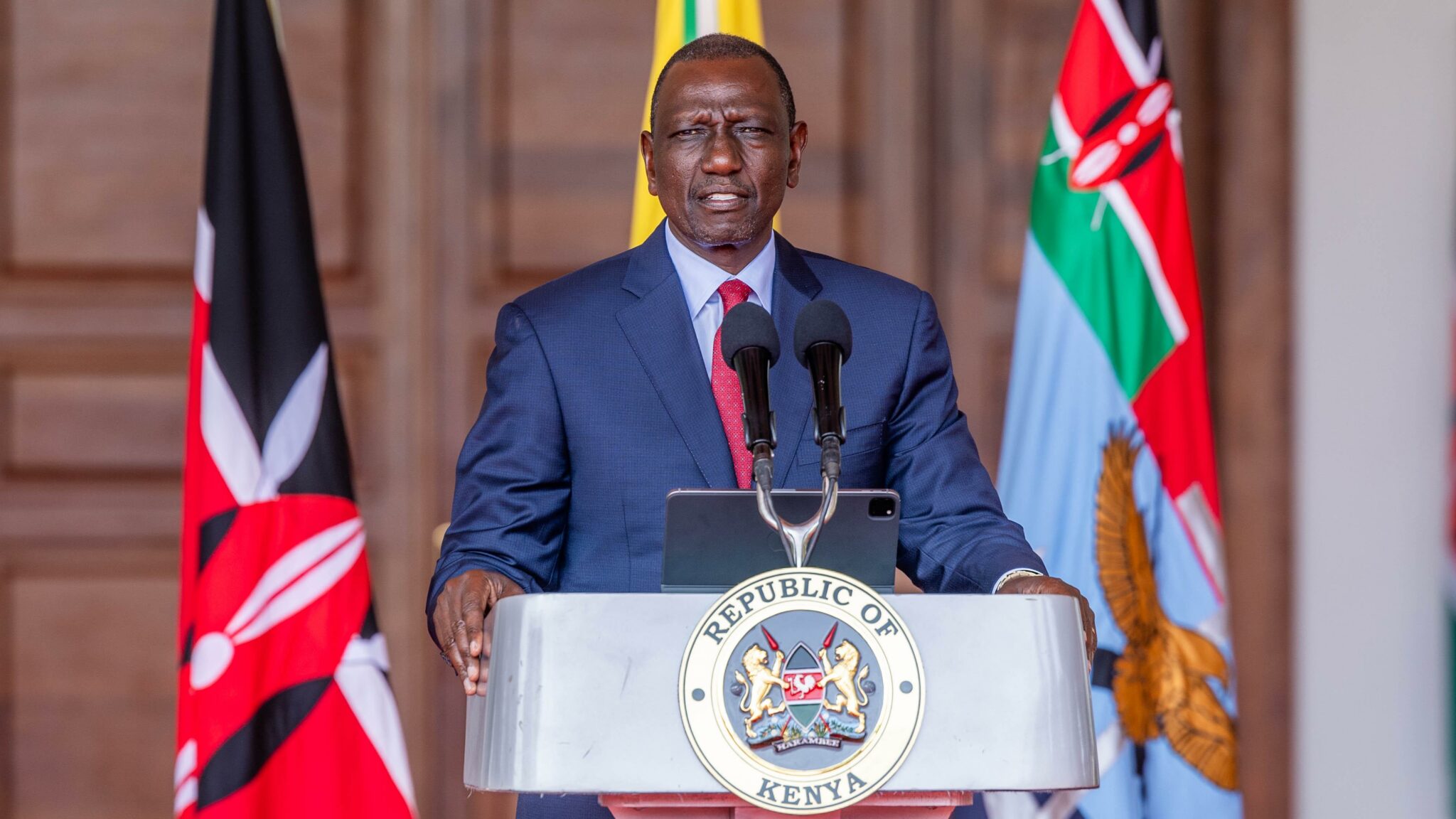
President William Ruto has declined to sign the Conflict of Interest Bill, 2025, citing the need to strengthen Kenya's anti-corruption framework.
Instead, he has returned it to Parliament with a list of substantial amendments tightening ethical standards for public officials.
His memorandum to the National Assembly and Senate identifies critical weaknesses in the legislation passed earlier this year.
In his note, Ruto is demanding tougher ethical safeguards for public officials.
At the heart of the President's concerns is that MPs allowed public officers to circumvent the law's intentions through technical loopholes.
One of the most notable deficiencies addressed in the memorandum is the absence of precise definitions for key terms.
The President has insisted on defining "family," "relative," and "undeclared asset" better to eliminate ambiguities that public officers might exploit.
He wants "family" to include spouses, dependent children, parents, and even parents of a spouse, while "relative" is to cover anyone related by birth, marriage or adoption.
The administration of the proposed law also came under scrutiny amid concerns there would be accountability gaps in the manner in which MPs passed the bill.
“Public officers may conceal assets acquired through conflict of interest by failing to declare or explain such assets,” the memorandum reads.
The bill had assigned implementation responsibilities to both the Ethics and Anti-Corruption Commission (EACC) and unspecified "reporting authorities," setting the stage for overlaps in roles.
President Ruto has recommended the EACC be given exclusive authority, given that its mandate is to enforce ethical standards among public officers.
Among the most significant proposed changes involves strengthening the EACC's enforcement capabilities.
The President has directed that the commission be explicitly empowered to initiate forfeiture proceedings against unexplained or undeclared assets.
“It is imperative to empower the commission to institute forfeiture proceedings against public officers, who fail to declare or explain assets,” Ruto said.
He argued the proposed law, as approved, would have posed a major loophole in the assets recovery bid.
The memorandum also aims to remove provisions that could have weakened the law's effectiveness.
Notably, the President has called for the removal of a "good faith" exception.
It is viewed that it would have allowed public officers to avoid penalties for granting preferential treatment if they claimed honest intentions.
“The exception gives room for a public officer to justify unlawful conduct through subjective claims.”
Gift regulations is another area receiving heightened scrutiny in the President’s veto.
The amendments would require public officers to declare not only gifts they receive personally, but also those accepted by family members or relatives.
The expansion is designed to prevent the circumvention of anti-bribery measures through third parties.
Additionally, reporting entities would need to maintain comprehensive gift registers covering all recipients, not just public officers.
“To prevent abuse of gifting by reporting entities, there is a need to provide for an accountability framework that covers gifts given to all persons,” Ruto said.
The President's recommendations also seek to broaden restrictions on government contracting.
While the original bill barred public officers from holding interests in entities doing business with their agencies, the amended version would extend this prohibition to any entity contracting with the government, significantly reducing opportunities for insider dealings.
In a move that may prove controversial among legislators, the President has removed an exemption that would have allowed members of Parliament and county assemblies to participate in debates where they had conflicts of interest.
This change subjects lawmakers to the same recusal requirements as other public officials.
To ensure greater transparency in asset declarations, the memorandum introduces a detailed definition of "material change" that officials must report.
This includes significant fluctuations in asset values, acquisitions or disposals of property, and changes in marital status or organisational memberships.
The President's intervention comes at a time when his administration has been emphasising anti-corruption measures, including lifestyle audits for public officials and increased funding for anti-graft agencies.
MPs triggered uproar with their initial bid to give elected leaders, parastatal chiefs, and other state officers the leeway to bag state tenders.
This was before a House team seized the matter and strengthened the proposed law to make it bite public servants caught up in graft probes.
Senators had expunged key proposals that Ruto had proposed to the chagrin of the EACC and the President.
Among the radical proposals senators put forth was to excuse persons accused and charged with graft from stepping down.
A mediation committee rolled back the Senate amendments, which also included allowing public officers to engage in other jobs while serving in a public body.
In his last State of the Nation address, Ruto lashed out at the lawmakers and anti-graft agencies for their lethargy in the graft fight.
While the changes have been hailed as welcome, the true test will lie in consistent enforcement once the law is enacted.
Lawmakers can either adopt the changes or attempt to override the President's objections, but they have to raise a two-thirds majority vote.
Given the past challenges with raising the two-thirds, Ruto’s memorandum is likely to sail through with ease.
![Hamisi Mwaguya [in coulored baseball cap] at the Kings Arena at Khadija estate in Nyali subcounty on Tuesday / BRIAN OTIENO](https://cdn.radioafrica.digital/image/2026/10/340e650a-21d8-475b-b658-a429e82e9367.jfif)