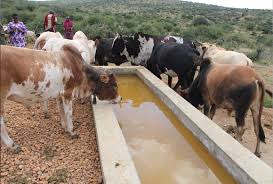
A small winding road from Isiolo town might deceive one into imagining there is no development in Kibiru, Tigania West, in Meru county.
But a 30 minutes drive reveals a new project residents say is a game changer.
The Kibiru Community Beef Feedlot was established by the government to boost livestock production by providing farmers with better opportunities in the local and export market.
It was commissioned on April 2 by President William Ruto and can host 400 cattle every cycle. The project stands on eight acres of community land.
Tigania West deputy county commissioner Faith Murage said the feedlot seeks to alleviate poverty in the area.
“The farmers around here are supposed to be assisted with restocking, especially when drought comes and wipes away all their animals,” she said.
“The objective is to ensure each one of them has a cow or a bull that is brought here for about three to four months for fattening; once it's fattened enough, they are sold, either locally or for export.”
Murage said the project helps cushion herders whose animals are killed by drought through a restocking programme.
She said the proceeds from the sale are given to the livestock owners to either restock or use the money in other ways.
To repulse cattle rustling, which is common, Murage said the animals are guarded by the National Police Reservists.
She said there are plans to set up a police station nearby.
The Ministry of Agriculture works with the county government to provide livestock specialists, who ensure animals are healthy and well fed.
The contractor, who is running the project, will hand it over to the community.
Murage said fattening of the livestock, especially during the drought, will not be a problem, as most residents are livestock keepers.
Statistics from the government show Meru has 173,000 indigenous cattle.
The data shows Tigania West has 29,201, Igembe North (26,790), Igembe Central (20,042) and Tigania East (12,428).
Murage said the community is supportive and they are excited about the project.
She said the project has partnered with Safaricom to provide microchips for identification purposes.
Murage said the community-based organisation comprising 156 groups will run the project once the contractor exits.
Murage said the project has started benefiting the community.
Dorcas Kawira, 22, is among the young people who secured a job at the feedlot.
“When the project was launched, I got information they would need people to work, and I immediately applied through the Meru county government,” she said.
Kawira’s work involves ensuring the area where the animals are being fattened is clean.
She also ensures the livestock are in good shape and the records in order.
“The animals that are weak are quarantined,” Kawira said. They are treated and monitored.
Beneficiary Timothy Muriuki, 22, ensures the livestock have enough food and water.
Mary Mwendwa said the project will not only help the youth to secure jobs but also women who already have groups.
Mwendwa, a member of Gageni Kibiru women’s group that has 65 members, said the fortunes of the members will be boosted by the project.