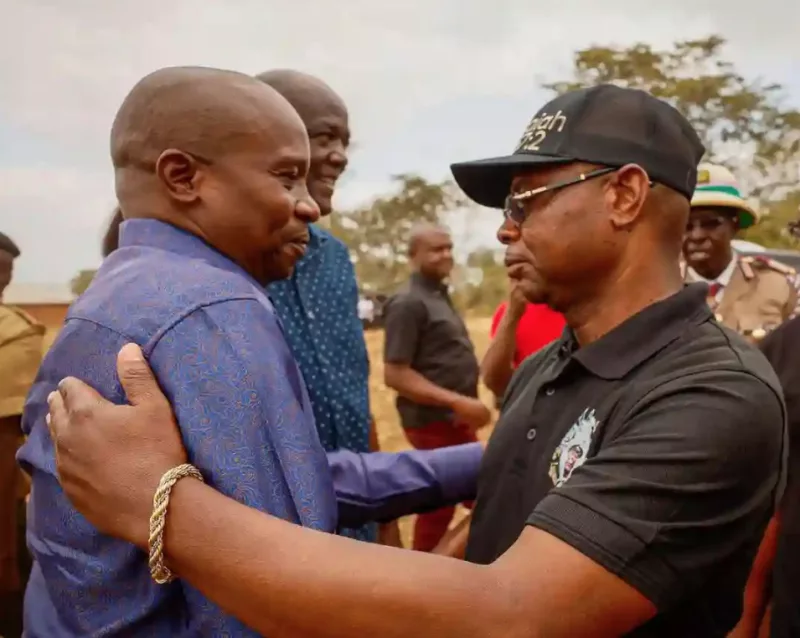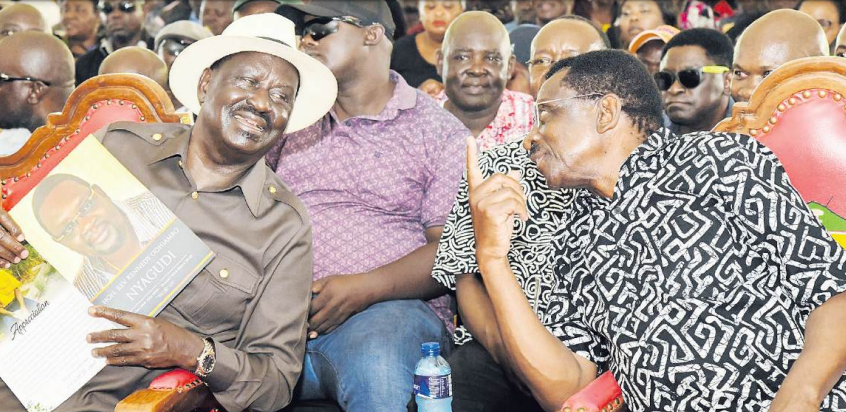
Siaya Governor James Orengo’s recent outburst against the broad-based government in front of President William Ruto has ignited a huge debate about his age-old on-and-off relationship with Raila Odinga.
The events have cast a spotlight, with pundits pointing out that the grand question is whether the uneasy alliance has been for political convenience or genuine kinship.
Raila and Orengo’s paths first diverged sharply following the death of Jaramogi Oginga Odinga in 1994.
One of the most dramatic moments in their turbulent relationship was when Orengo, along with former Rangwe MP Shem Ochuodho and others, formed the Mageuzi movement.
At that time, the succession battles within Ford Kenya exposed fundamental differences in their political approaches.
The 1997 election marked the first major public divergence between the two politicians. This faction, which advocated for radical reforms within the opposition, was viewed as a rebellion against Raila’s leadership.
The tension peaked during the infamous Ugunja showdown, where Orengo and Raila supporters clashed violently, underscoring the deep divisions between the two camps.
While Raila would eventually break away to form the Liberal Democratic Party, Orengo, alongside Anyang’ Nyong’o, supported Charity Ngilu’s presidential bid against Raila’s candidacy.
The 2002 elections also lay bare what can now be summed as their transactional nature of their relationship. At that time, while Raila played kingmaker in Narc’s victory, Orengo ran for president on the Social Democratic Party ticket, finishing a distant fourth with just 0.4 per cent of the vote.
Political analyst Herman Manyora reflects on this history: “It is possible they have fallen out completely... can’t tell whether it is a strategy,” he says.
“As to whether we are back to the 90s, absolutely. And he can have a following out of this...across the country and in Raila’s backyard.”
The formation of ODM in 2005 presented another chapter in this complex relationship. Orengo’s late entry into the party – evidenced by his membership number in the 900s compared to Raila’s Life Member No. 2 – speaks volumes about his position within the party hierarchy.
In the 2007 post-election crisis, for instance, Orengo only joined the negotiation team at a later stage, suggesting he wasn’t Raila’s first choice for such crucial political engagements.
The 2013 Supreme Court petition following Raila’s presidential loss further highlighted the conditional nature of their alliance.
Raila went to the Supreme Court without Orengo, the latter only came in 2017. Even then, he was only a last resort after a Queen’s Counsel failed to show up. The differing political philosophies between the two men help explain this tension.
“Orengo has been more of an idealist – albeit he took a break at some stage. We have the slightly more self-seeking Raila Odinga who thinks he can embrace both values,” former ODM political affairs secretary Wafula Buke observes.
The recent political developments surrounding the Ruto-Raila rapprochement have brought these differences into sharp relief.
“These are the two personalities we have ... some may call it pragmatism for the case of one and another who has more time for selfless politics,” Buke adds.
Some quarters, and insiders in Orengo camp, Raila’s support for the Siaya governor has always been conditional and tactical.
They argue that the 2007 intervention in Ugenya’s parliamentary race, where Raila threw his weight behind Orengo against Steve Mwanga, was less about affection and more about maintaining influence in the region.
Similarly, they hold that the former Prime Minister’s backing of Orengo’s 2022 gubernatorial bid also came with strings attached.
The question of whether Orengo can or should break from Raila at this late stage in their careers has sparked considerable debate among political observers.
Tana River Senator Danson Mungatana offers a sceptical view: “It won’t be easy for Orengo to undermine Raila’s influence. He has been surviving on Raila’s coat tails. Can he win Siaya without Raila’s support in 2027? The reality will dawn on him.”
This perspective suggests that despite their differences, Orengo may have little choice but to maintain the alliance for practical political reasons.
However, political scientist Oscar Omondi takes a more critical stance toward Orengo’s potential rebellion.
“Orengo should not take us back to the days when children were dying because of the struggle. Who is he? It is Raila we know, and he should let the former Prime Minister show us the way.”
This view reflects the enduring loyalty that many still feel toward Raila within opposition circles, suggesting that any break by Orengo could face significant resistance.
The cyclical pattern in their relationship, defined by periods of alliance followed by tension and potential break, appears to be repeating itself as both men contemplate their political futures.
The historical parallels are striking, as Buke notes: “Have we gone back to the 90s? I think so. The choices were the same. Raila was faced with the choice of being a reformer or a bourgeois. Orengo says what has taken them this far is the reform road...” The emergence of new political factors, particularly the so-called “Gen Z factor,” adds another layer of complexity to this dynamic.
Who will win? Buke says the answer can’t be the same as it was in the 90s. However, Buke also acknowledges the enduring reality of Raila’s political strength.
“Ruto’s actions won’t be looked at well as something people can work with...I see him carry the Luos, but Orengo will carry the nation,” he said.
As the 2027 election approaches, the Orengo-Raila relationship faces its most severe test yet. The fundamental question remains whether their alliance, built more on convenience than conviction, can survive the current political realignments.
As both men approach the twilight of their political careers, their competing visions for their place in history are becoming increasingly apparent. This divergence explains Orengo’s recent criticisms of the Ruto-Raila rapprochement, forcing the former Prime Minister to issue a rebuttal.
Where Raila sees the political realignment as necessary, Orengo has viewed it as another betrayal of opposition principles.
At the height of the polity, the question of whether Orengo can mount a meaningful challenge to Raila’s dominance in Luo Nyanza remains open.
Omondi, the political scientist, cautions against overestimating Orengo’s appeal: “Let’s be honest - outside political circles, how many young Kenyans know Orengo’s track record? Raila remains the only opposition figure with true national name recognition,” he says.
He argues that Raila’s Nyanza backyard is not keen on the old style of politics that the region has played for decades.
Ultimately, the duo’s
strained partnership may survive
not because of mutual affection, but
because neither has better options.