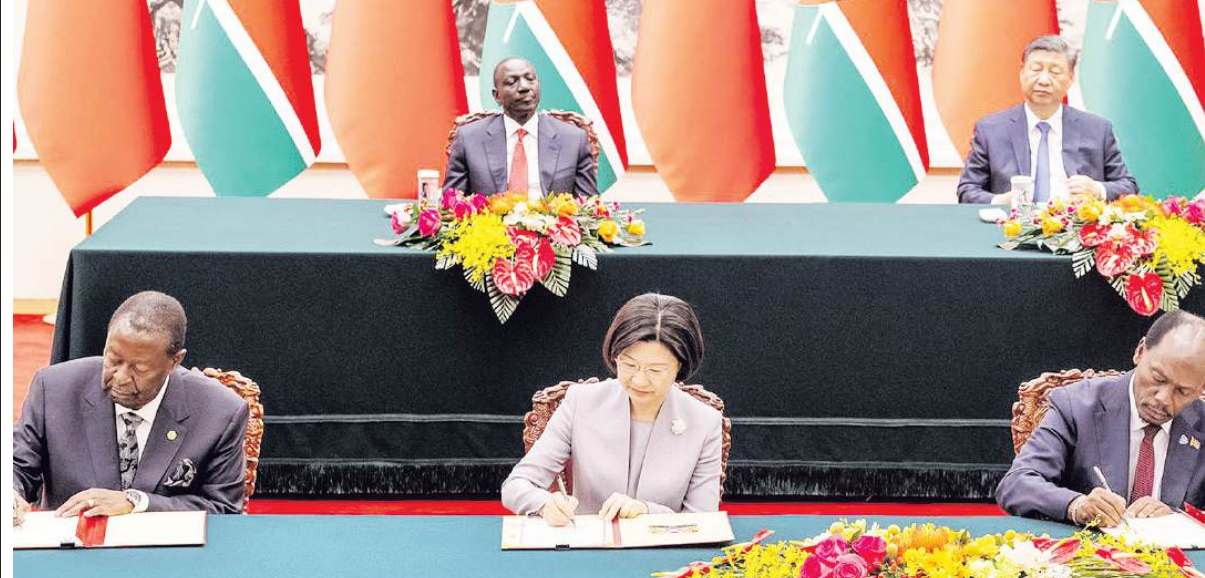
Kenya is gearing up to start construction of the Naivasha-Malaba Standard Gauge Railway as early as July, following an agreement between President William Ruto and Chinese President Xi Jinping.
The two leaders met to discuss a new funding model for the new railway line, which will connect Naivasha to Malaba, passing through several counties including Narok, Bomet, Kericho and Kisumu.
President Ruto was on a four-day state visit to China, where he discussed various funding options for the railway project, which has a budget of Sh654 billion. This project is part of Kenya's broader strategy to enhance transportation infrastructure and connectivity within the region.
The Naivasha-Kisumu section, known as Phase 2B of the SGR, will stretch 262.3km and will include an 8.9km branch line leading to the proposed Kisumu port. Transport Cabinet Secretary Davis Chirchir announced that the railway will feature 25 stations, including 15 that will be opened initially, while 10 will be reserved for future use.
The construction contract for this section was signed in March 2016 between Kenya Railways Corporation and China Communications Construction Company. The contract includes civil works, the provision of 35 locomotives, 724 wagons, and 64 passenger coaches. Additionally, the project will cover the costs of building the new Kisumu port, estimated to cost Sh17.8 billion.
The Kisumu-Malaba route, designated as Phase 2C of the SGR, will cover 107.27km. The construction contract for this segment was also signed in March 2016, with a budget of Sh1.5 billion. Completion of this line is expected within 36 to 54 months.
The new Kisumu port will be strategically located about 7km west of Kisumu International Airport, on the north side of Winam Bay. It will feature two multipurpose berths capable of handling 3,000 tons each and will include facilities for production and accommodation. The port is designed to eventually accommodate 1,000-ton break-bulk cargo ships. The SGR is considered a vital regional project under the Belt and Road Initiative, aimed at improving connectivity across East Africa. This project is a priority for Kenya, as it seeks to secure funding from China and enhance its transportation infrastructure. Uganda has already signed a contract for its part of the railway and has requested Kenya Railways to facilitate the transportation of construction materials, especially rails, from the port of Mombasa to Kampala. The collaboration is part of a broader agreement among Uganda, Ethiopia, South Sudan, and Djibouti to develop the proposed Djibouti-Ethiopia-South Sudan-Uganda (DESSU) Corridor. Kenya is aware of the competition from neighbouring countries. Tanzania is making significant progress with its own SGR projects to Tabora and Mwanza, as well as to Rwanda and Burundi. If these projects are completed before the Naivasha-Malaba-Kampala sections, they could negatively impact the attractiveness of Kenya's Northern Corridor. To expedite planning and preparation for the SGR, the Kenyan government has conducted feasibility studies and submitted commercial and logistics hub reports to the Chinese Embassy. State experts have also proposed a financial model and completed preliminary designs for the route alignment. Kenya and Uganda have harmonised technical specifications and construction schedules in preparation for construction to start in July 2025. The procurement process for the Resettlement Action Plan and Environmental and Social Impact Assessment studies is expected to be finalised before June. Documents from the Ministry of Transport reveal that Kenya has engaged potential financiers, including Stanbic Bank, Agricultural Bank of China, China Construction Bank, Standard Chartered Bank and China Exim Bank. These banks are expected to provide syndicated financing to cover 40 per cent of the total project cost. The Kenyan government will contribute 30 per cent directly from the Railway Development Fund, while the remaining 30 per cent will come from China Exim Bank as a concessional loan. The Kenya Commercial Bank has expressed interest in being the main banker for the public sector. The China Communications Construction Group and KCB are being considered as potential sponsors for a Special Purpose Vehicle that will manage financing and payments related to the project. The National Treasury has also approached the Asian Infrastructure Investment Bank (AIIB), which has shown willingness to participate in the syndicate financing. The Trade and Development Bank (TDB) has been proposed as the transaction advisor to help structure the financing arrangements.