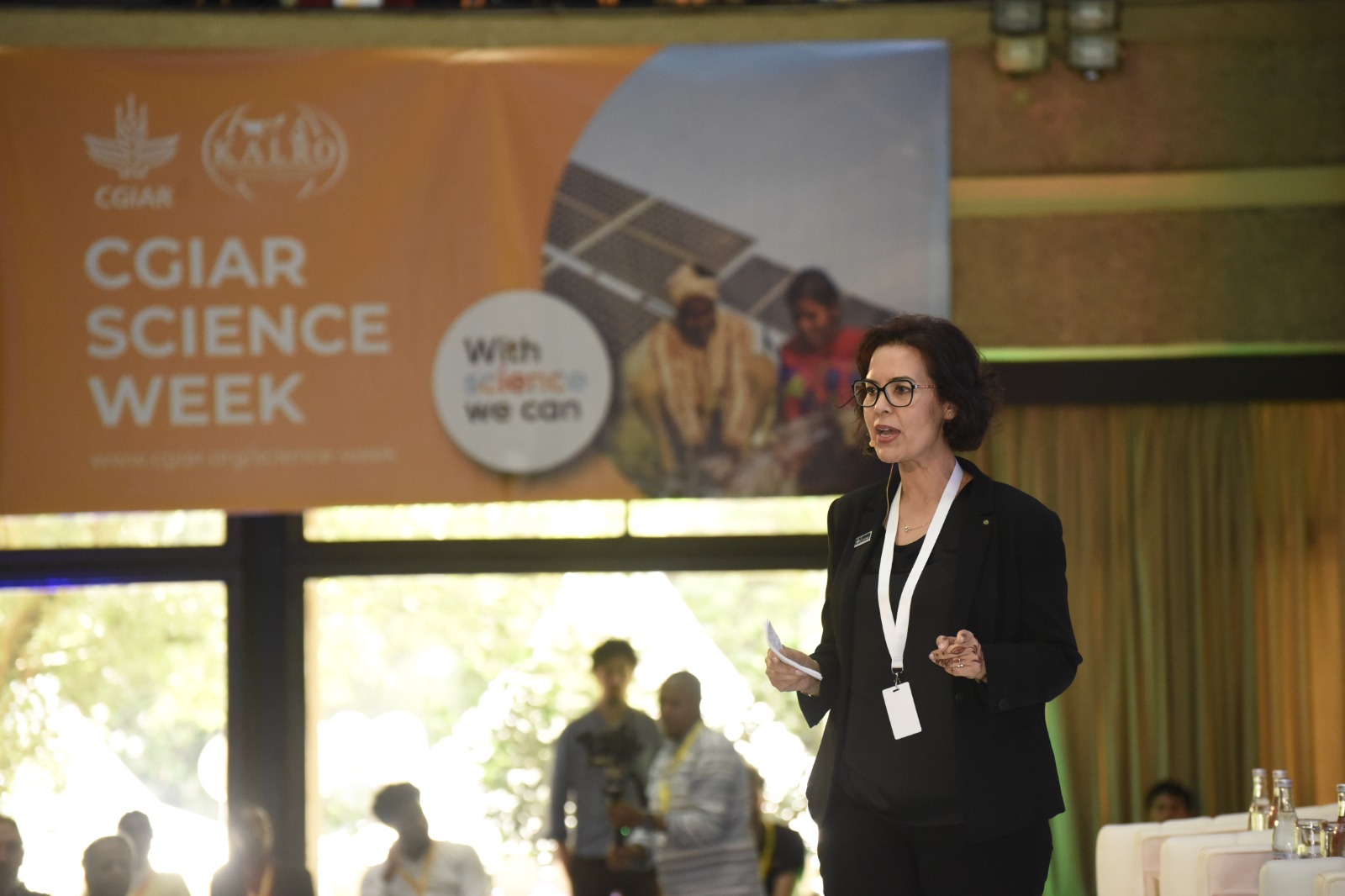
 Dr. Ismahane Elouafi, executive managing director of the Consultative Group on International Agricultural Research (CGIAR) addresses delegates at the CGIAR science week at the UN headquarters in Nairobi
Researchers have introduced a new plan to tackle major agricultural challenges worldwide.
Dr Ismahane Elouafi, executive managing director of the Consultative Group on International Agricultural Research (CGIAR), said science and innovation are key to achieving global food security.
"Food security cannot happen without science, research, data, analysis, innovation, and intelligence," Elouafi said during the launch of the new research programme.
The CGIAR Science Week is taking place at the UN headquaters in Nairobi.
Elouafi said the new plan is a strategic pivot designed to tackle the world’s evolving challenges while ensuring long-term sustainability in food production.
She said it represents a shift from merely increasing agricultural productivity to achieving sustainable productivity at scale, which integrates nutrition, climate adaptation and enhanced livelihoods for small-scale producers.
"This portfolio is not just a research initiative but a reflection of the direction CGIAR is headed over the next six, 10, 20 or even 30 years," Elouafi said. "It personifies what CGIAR will be in the future, as we continue our partnerships and expand our expertise into diverse knowledge systems to offer context-specific, effective solutions."
A key feature of this new approach is the integration of CGIAR’s programmes, which Elouafi referred to as a "silent revolution." This shift, she said, will streamline operations across the organisation, ensuring the most effective, scalable solutions are deployed in the field.
"The most important work happens in the countries, in the field, in the laboratories, where our scientists and partners come together," she said.
The portfolio will require an estimated investment of Sh776.7 billion to Sh1.6 trillion by 2030. While CGIAR will provide the solutions, Elouafi said the success will depend on collaboration with farmers, scientists and partners.
"The work gets done by you and by many people in the field. It’s crucial that we engage at the personal level to ensure we deliver on our commitments,” she said, citing the focus on hands-on, locally driven solutions to global challenges.
Dr Sandra Milah, CGIAR chief scientist, elaborated on the scope of the initiative, aimed at tackling hunger, climate change and biodiversity loss by 2030. "Building on decades of success in improving food production and economic development, this initiative will target five key areas including nutrition, livelihoods, gender, climate and biodiversity," she explained.
Milah noted CGIAR’s evolution is critical to meeting the new and intensifying challenges the world faces, particularly in developing countries impacted by climate change, biodiversity loss and geopolitical conflicts.
“The CGIAR network is evolving to meet these challenges. By 2030, we aim to reduce extreme hunger by 26 per cent, lift 31 million people out of extreme poverty and create 92 million jobs,” Milah said, adding that the initiative would ensure the benefits of these advancements are shared equitably, particularly with women and youth.
"Central to the strategy is the promotion of innovations in sustainable food production. These include breeding biofortified crops, empowering livestock and aquatic food producers, and reducing climate impacts by mitigating emissions equivalent to the carbon sequestration of nine billion trees over the next decade."
The focus on protecting biodiversity will drive efforts to safeguard ecosystems and implement land-use practices that prevent deforestation.
“By leveraging cutting-edge digital technologies, including AI and large language models, the initiative aims to provide scalable, data-driven solutions for smallholder farmers in vulnerable regions,” Milah said.