

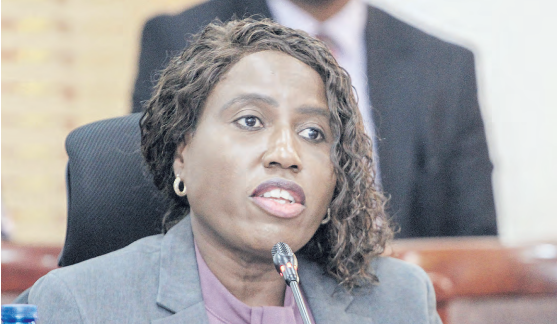
The government has, for the first time, owned up to the challenges facing the new university funding model, whose implementation has been halted by the courts.
Higher Education PS Beatrice Inyangala said the model ran into financial problems soon after it was rolled out. In addition, the students who applied for the funding gave inaccurate data, making it difficult to place them in the correct bands.
“The ministry conducted a survey to collect the data and found 53 per cent had left their forms in the cybercafés to be filled by the staff,” Inyangala said.
This, she said, led to a piece of near-generic information, thus compromising the data they were collecting to place the students in the right bands.
The PS said bribery claims also rocked the programmes, with chiefs who were required to certify students’ economic status, often receiving kickbacks to classify them as “most vulnerable”.
The assumption by the ministry that students who went to national schools were able to pay for their university education failed to yield credible data.
“There was an assumption that students who attended national schools would be placed in band three. This got a challenge as some students were studying on bursaries,” she said.
President William Ruto launched the new model called the Variable Scholarship and Loan Funding (VSLF) in May 2023.
It categorised students into five bands, with those from vulnerable and extremely needy households eligible for full funding, while less needy students could receive up to 90 per cent funding.
However, High Court judge Chacha Mwita ruled last December the new model is unconstitutional and discriminatory.
“It should have been subjected to the public so the public comments before its implementation,” the court noted.
The court further said it’s the government’s responsibility to fund public universities and passing the responsibility to parents is a violation of the constitution.
Inyangala, who appeared before the Senate Education Committee on Thursday, was at pains to convince the committee that the new university funding model is a solution to higher education in the country. The senators pressed the PS to explain how the ministry collected the students’ data.
“How was the collection of the data done, and why couldn’t the ministry use chiefs to establish the vulnerability of the students?” Laikipia Senator John Kinyua asked.
Nyandarua Senator John Methu demanded to know why the model has made university education unaffordable. He said under the old funding programme, students would pay a paltry Sh16,000, while under the new model, a similar student would part with Sh90,000.







