In a world where internet access is almost synonymous with technological advancement, one Kenyan innovator, Morgan Mwangi, is proving that connectivity is not the only way to access artificial intelligence.
While everyone is obsessed with streaming, scrolling, and swiping, Mwangi decided to take a step backwards—straight into the era of text messaging.
While the rest of the globe was busy upgrading to 5G and debating whether ChatGPT could write their wedding vows, Morgan was busy inventing an AI that rural folks could engage with.
Mwangi’s RuralLink AI allows users to access AI-powered assistance through simple SMS, making cutting-edge technology available to millions who lack reliable internet access. Yes, you read that right. SMS.
The same technology your auntie uses to forward you “blessings” at 3 a.m. For Mwangi and his team, the inspiration behind RuralLink AI stemmed from a realisation that while the world accelerates towards online solutions, many rural communities are left behind due to poor internet infrastructure and lack of access to a smartphone.
“We wanted to ensure that cutting edge AI benefits weren’t reserved for those with smartphones or broadband connections,” Mwangi explains.
“By leveraging the simple, ubiquitous SMS channel, we aim to empower everyone—even those in remote areas—to access reliable AI-driven assistance.”
But before you dismiss Mwangi as a techie stuck in 2005, his invention, RuralLink AI, is quietly revolutionizing access to information in Kenya—and soon, the rest of Africa.
According to data from the Communications Authority, as at January 2025, out of the 68.1 million, which is the total number of mobile phone devices connected to mobile networks, 30.7 million are feature phones.
This essentially means that other than those using the devices as their secondary choices, there are millions currently been locked out of the AI revolution.
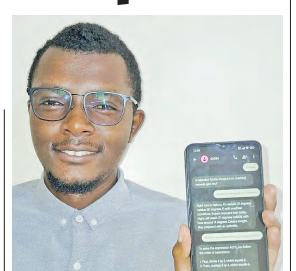
Mwangi, the soft-spoken but determined developer based in Kasarani, says that the invention dubbed “Kaduda Search” or Tululu Search by its users (a nod to the humble feature phone) allows anyone with a Safaricom line to access real-time information by simply sending an SMS.
“For just one Kenya shilling per message, users can ask anything from ‘What’s the weather in Nairobi?” to ‘How do I stop a bleeding wound?” he says.
“I remember watching people in cities use smartphones to look up everything from weather forecasts to football scores,” he recalls.
This glaring inequality inspired Mwangi to create an AI that didn’t require smartphones, data bundles, or even electricity.
In a world obsessed with the latest gadgets and high internet speeds, Mwangi’s RuralLink AI is a refreshing reminder that innovation doesn’t have to be flashy to be impactful. By leveraging the humble SMS, he’s bridging the digital divide, one text message at a time.
“I wanted to make sure that cutting-edge technology wasn’t just for the elite,” he says.
“So, I thought, why not use the one thing almost everyone has—a basic mobile phone?” RuralLink AI operates through a combination of SMS gateways and cloud-based natural language processing.
When a user sends a query starting with the keyword “AI,” the message is routed to Mwangi’s backend system, where the AI interprets the question, generates a response, and sends it back via SMS—all within seconds.
The platform understands Swahili, English, and even some local dialects, though Mwangi admits there’s still work to be done.
He says Rurallink AI is now designed to compete with the top models and are working to make sure that at least Kenya and Africa at large are not left behind in the AI revolution.
“That being said, the ‘big’ AI
companies are doing an amazing
job, but their products are not tailored for the African market. We
are excited about the advances
and we cheer them, but we will
make our products that will work
for us. We are built in Kenya for
Kenya,” says Mwangi.