

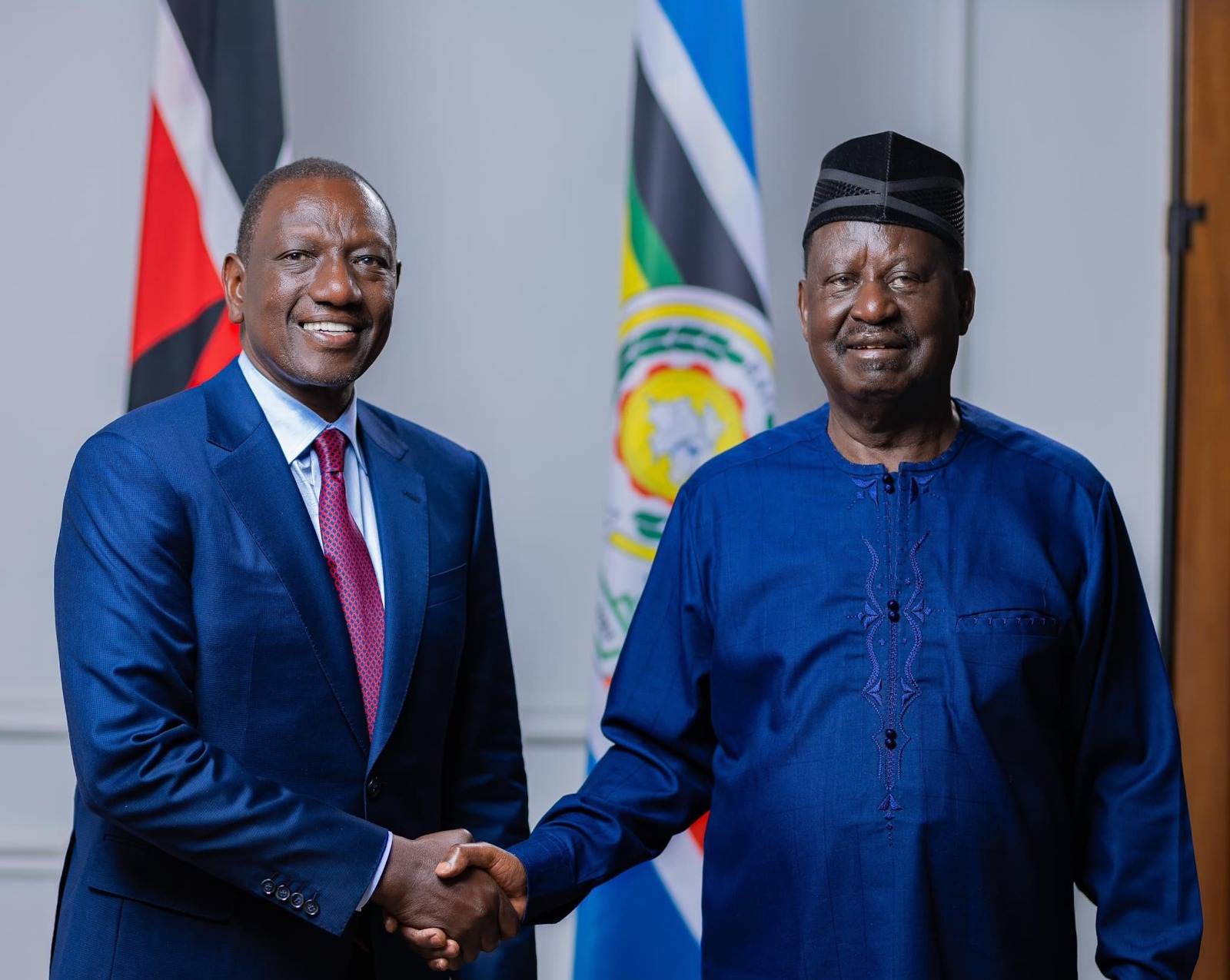
Careful! Whenever William Ruto has appeared weak, he has re-emerged even stronger. When Uhuru Kenyatta abandoned him and sought to cripple his political career, Ruto defied the odds, outmanoeuvred the system and ascended to the presidency.
Now, as critics speculate that his agreement with Raila Odinga signals weakness, they may be in for yet another surprise.
This is classic Ruto — turning adversity into opportunity, leveraging challenges as stepping stones to consolidate power and advance his governance agenda.
In Kenyan politics, pragmatism often trumps ideology. President Ruto understands this reality better than most, and his latest move — securing a working agreement between the ruling United Democratic Alliance and the opposition Orange Democratic Movement — is a testament to his commitment to governance over endless political bickering.
On March 7, UDA and ODM formalised an agreement to collaborate on critical government policies. Both Ruto and Raila emphasised that this was not a power-sharing deal but rather a framework for joint consultations on national matters, aimed at reducing tensions and fostering cooperative governance.
This development has sparked mixed reactions. Critics see it as a betrayal of the opposition’s role, while supporters hail it as a masterstroke in consolidating national unity.
However, beyond the politics, what matters most is governance — how Kenya is run, how services are delivered, and how efficiently institutions function. This is drive where Ruto’s true focus lies, and he initiated it immediately after he took power in 2022.
RE-ENGINEERING THE PUBLIC SERVICE
From the outset of his administration, President Ruto entrusted Chief of Staff and Head of Public Service, Felix Koskei, with one of the most consequential mandates — transforming Kenya’s public service to function efficiently, transparently and with integrity.
Unlike in previous administrations where public service reforms were largely rhetorical, Koskei has been relentless in tackling systemic inefficiencies, wastage, and corruption head-on.
Under Koskei’s leadership, the government has cut down turnaround times for essential services, ensuring Kenyans no longer have to navigate endless bureaucratic red tape to access their rightful entitlements.
Efficiency is no longer just an aspiration — it has become the defining standard of public administration. But Koskei’s impact extends far beyond administrative efficiency. He has been outspoken against corruption and financial mismanagement, and his actions have had real consequences.
The introduction of a zero-fault audit system has placed accounting officers squarely on the hook for any misuse of public funds — whether through negligence or outright theft.
Heads have rolled, and several high-ranking officials have been suspended, sacked, or prosecuted after being caught with their fingers in the cookie jar.
His no-nonsense approach has sent shockwaves through the civil service, forcing a long-overdue culture shift in government accountability. Yet, the fight against corruption has not been without resistance.
Legal battles and bureaucratic pushback have slowed efforts to hold individuals accountable, and some cases remain entangled in court processes.
However, Koskei and the administration have remained undeterred, ensuring that reforms are pursued with the urgency they deserve. The message is clear — public service is no longer a haven for complacency, and those who fail to meet the mark will have no place in government.
UDA-ODM POLICY COLLABORATION
While the Ruto-Raila pact is not about power-sharing, its potential impact on governance is significant. Political stability is a prerequisite for economic progress, and by bringing together the two most influential political forces in the country, Kenya stands to benefit immensely.
When political parties collaborate on policy rather than constantly clashing, reforms are implemented faster. The perpetual tug-of-war that has traditionally derailed progress — in which one side of the political divide seeks to sabotage government efforts — can be neutralised through structured dialogue.
If ODM lends its voice to UDA’s policy agenda, critical reforms in infrastructure, healthcare, education and economic revival can be pursued with national consensus. This is a page straight out of the Mwai Kibaki playbook.
During Kibaki’s presidency, broad-based cooperation, particularly in his first term under the National Rainbow Coalition, Kenya experienced one of its fastest economic growth periods.
Institutions were strengthened, service delivery improved and corruption — though still present — was tackled with a seriousness that yielded results. Kenya must return to such governance, where politics serves development rather than obstructing it.
THE BIRD: RAILA’S POLITICAL EVOLUTION
Those criticising Raila Odinga for aligning with Ruto must acknowledge the realities of political survival. Chinua Achebe’s Things Fall Apart captures this truth through Eneke the bird, who said.
“Since men have learned to shoot without missing, I have learned to fly without perching.”
Raila has been at the threshold of power multiple times — 1997, 2007, 2013, 2017, and 2022 — only to be denied the ultimate prize. Each time he has lost, his supporters have borne the greatest brunt of exclusion from government, leading to significant political and economic frustrations.
Can anyone blame him for adapting? Should he continue leading a section of the country into perpetual opposition without offering them opportunities to participate in governance? Leadership is about securing the best possible outcomes for one’s constituents, and Raila is simply playing the game as it must be played.
HATE THE GAME, NOT THE PLAYER
The lesson here is simple: governance is bigger than individual ambitions. Ruto’s willingness to embrace the enterprise of ideas — whether from his allies or former rivals — is a mark of leadership.
This coalition of policies, rather than positions, is an opportunity to accelerate development and push through long-overdue reforms. The sceptics will talk, the purists will frown, but the country must move forward.
The challenge now is execution. With the ongoing process of transforming the public service under Koskei, Kenya has a real chance at transformation. But for that to happen, all hands must be on deck.
The focus must remain on results. Politics will always be politics, but governance is what will define Kenya’s future. Ruto’s bold gamble: the enterprise of ideas and the urgency of good governance.
The writer
is a political
commentator







