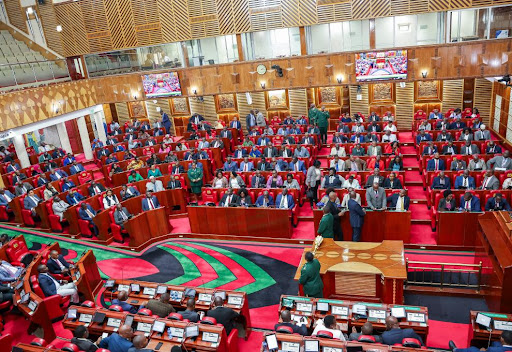
Members of Parliament have formally begun entrenching CDF in the constitution after setbacks in court rulings which declared the fund unconstitutional in its current form.
The lawmakers have sponsored a bill which if enacted, would also hand their counterparts in the Senate an oversight fund.
The bill by Rarieda MP Otiende Amollo and his Ainabkoi counterpart Samuel Chepkonga further seeks to entrench the NGAAF into the supreme law.
“The National Government Constituencies Fund is established to ensure provision of exclusive government functions in each constituency,” the bill reads.
Under the proposed law, CDF budgets would be drawn from the monies appropriated from the national government’s share of revenue as divided by the Division of Revenue Act.
“All funds allocated shall be considered as funds allocated to constituencies to be administered in accordance with the provision of an Act of Parliament,” the proposed law reads.
If the amendment - an inclusion after Article 204 - sails through, Parliament is expected to enact legislation to make further provisions on how the fund would be operated.
Entrenching CDF was among recommendations in the National Dialogue Committee process which President William Ruto wants MPs to fast-track.
The Senate Oversight Fund is for its part established to ensure that the Senate “is adequately resourced and empowered to perform its oversight functions”.
It would consist of monies appropriated from the national governments’ share of revenue as divided in the annual Division of Revenue bill. NGAAF, for its part, is a kitty administered by Woman Representatives and would be “established for the purpose of enhancing measures of the national government on affirmative action”.
“The object of the bill is to entrench the funds in the constitution,” Amollo and Chepkonga said in their memorandum on the proposed law.
“The establishment of NGCF in the constitution would ensure reasonable access to exclusive national government functions in all constituencies,” the memorandum reads in part.
“It would also ensure the participation of the people in the identification and the implementation of priority national government programmes,” the lawmakers said.
A court gave the National Assembly two years to complete CDF projects, deeming the law under which it is anchored as unconstitutional.
High Court justices Kanyi Kimondo, Roselyn Aburili and Mugure Thande said the NGCDF Act 2015, violated the principle of separation of powers.
The bench gave the NGCDF a period of 20 months – lapsing June 26, 2026, to complete the existing projects after which the fund would cease.
The ruling followed a petition by Katiba Institute among other petitioners who challenged the legality of the NG-CDG Act, 2015.