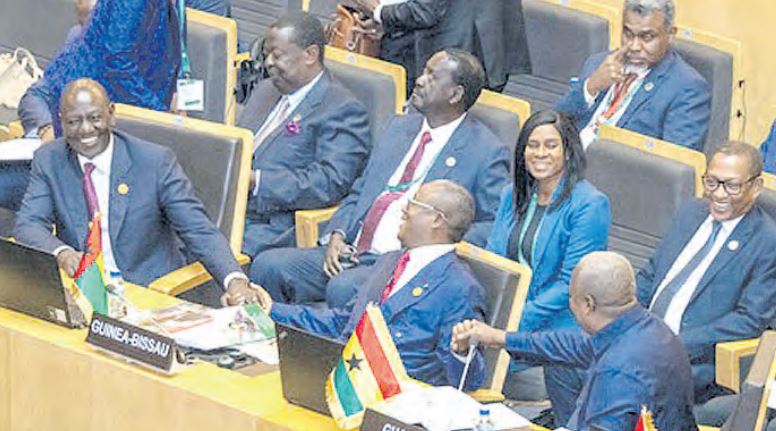
Kenya’s recent bid for the African Union Commission chairmanship may not have ended in victory, but it was far from a diplomatic failure.
The ability of a first-term president with less than three years in office to rally more than 20 African nations behind Kenya’s candidate was a remarkable achievement.
Beyond traditional statecraft, a crucial yet often overlooked factor played a role—intelligence diplomacy.
The presence of Kenya’s National Intelligence Service director general during the AUC election process underscored a paradigm shift in the country’s diplomatic approach.
Intelligence is no longer just an auxiliary tool; it has become an integral component of Kenya’s foreign policy.
The growing relevance of intelligence diplomacy—the use of intelligence agencies to influence international relations through covert negotiations, intelligence sharing, and strategic foresight—is shaping the future of Kenya’s engagement on the global stage.
For instance, Kenya’s intelligence diplomacy has been evident in its approach to global conflicts such as the Israel-Hamas war and the Russia-Ukraine crisis.
When Hamas launched an unprecedented attack on Israel in October 2023, Kenya swiftly condemned the violence and affi rmed Israel’s right to self-defense.
However, as the humanitarian crisis in Gaza escalated, Nairobi faced the delicate task of balancing its diplomatic ties with both the West and the Arab world.
Intelligence diplomacy played a crucial role in navigating these complexities, allowing Kenya to engage in backchannel negotiations while maintaining a neutral yet principled stance. Similarly, in the Russia-Ukraine war, Kenya has taken a measured but firm position.
The country’s UN Security Council statements initially condemned Russia’s invasion, aligning with Western democracies. However, as the global economic landscape shifted, Kenya recalibrated its strategy, leveraging intelligence diplomacy to safeguard national interests while maintaining diplomatic flexibility.
By relying on intelligence assessments, Kenya has been able to navigate geopolitical alliances, energy security concerns, and food supply disruptions without alienating key international partners.
As the rivalry between the United States and China intensifies, Kenya finds itself in a strategic position, balancing economic partnerships with both superpowers.
While China has been a dominant force in Kenya’s infrastructure and telecommunications sectors, the US has warned of potential security risks associated with Chinese technology firms such as Huawei.
Kenya’s intelligence agencies have played a crucial role in assessing cybersecurity vulnerabilities and negotiating discreetly with both Washington and Beijing to protect national interests without taking an explicit side.
Traditional diplomacy alone would struggle to manage these competing pressures.
Intelligence diplomacy, however, provides a subtler mechanism for engagement, allowing Kenya to extract economic and security benefits from both powers while avoiding direct entanglement in their geopolitical rivalry.
Beyond global conflicts, Kenya’s intelligence diplomacy is vital in regional security and counterterrorism efforts. As a frontline state against extremist groups such as al Shabaab, Kenya has long relied on intelligence-led operations to mitigate threats. However, intelligence diplomacy extends beyond military interventions—it fosters deeper intelligence-sharing networks with regional and global allies.
By engaging in intelligence diplomacy, Kenya strengthens counterterrorism coordination, disrupts transnational criminal networks and enhances border security. Intelligence-led engagements in Somalia, South Sudan, and the Democratic Republic of Congo provide alternative diplomatic solutions to conflicts that traditional diplomacy struggles to resolve.
Diplomatic engagements often require discretion, especially in conflict mediation, hostage negotiations, and crisis management. Intelligence diplomacy offers the country a strategic advantage in such sensitive negotiations.
For instance, Kenya’s leadership in the multinational security intervention in Haiti demands intelligence-driven coordination to assess security threats and align diplomatic efforts.
Likewise, Kenya’s engagement with Gulf States and emerging Asian economies benefits from intelligence-led backchannel negotiations, ensuring that diplomatic maneuvers remain agile and effective.
To sustain and enhance its intelligence diplomacy, Kenya must institutionalise this approach within its foreign policy framework. It requires strengthening intelligence agencies’ capacity to engage in diplomatic affairs, integrating intelligence into decision-making processes, and training intelligence officers in international negotiations.
Building strong alliances with global intelligence counterparts will be crucial. Intelligence diplomacy thrives on networks, and Kenya must cultivate relationships that enhance its ability to gather insights, engage in high-level discussions and respond swiftly to emerging challenges. However, intelligence diplomacy must complement, not overshadow, traditional diplomacy.
The two should work in tandem, extending Kenya’s diplomatic reach into domains where conventional engagement may be ineffective.
In conclusion, the AUC elections highlighted Kenya’s growing diplomatic influence and the increasing role of intelligence in foreign policy. Even in defeat, Kenya demonstrated its ability to command regional support and operate within complex diplomatic networks.
This experience underscores a broader lesson: the future of Kenya’s diplomacy will not just be decided in public forums but also in the discreet and strategic world of intelligence diplomacy.
With the right investments in intelligence capacity, strategic alliances, and a clear diplomatic vision, Kenya can position itself as a formidable force—not just in Africa but also on the global stage.
The writer is a lecturer at Jomo Kenyatta University of Agriculture and Technology and a writer focused on global business trends and policies, Kenpanya2016@ gmail.com