In the beginning, God created the heavens and the earth, and then God said, 'Let there be light,' and there was light" (Genesis 1:3).
Most creation itself was spoken into existence, showing that words are not mere sounds but powerful creative forces.
Later, in Genesis 1:26, God says, "Let us make man in our image, after our likeness." If God created the world by speaking and we are made in His image, it follows that our words, too, carry immense power.
What we declare, over ourselves, our nation, and our leaders can shape our reality.
Proverbs 18:21 reinforces this truth: "Death and life are in the power of the tongue, and those who love it will eat its fruit."
This is both a promise and a warning. Our words can bless or curse, build or destroy. Kenyan Christians, therefore, must be vigilant about what they speak over their country, their government, and their fellow citizens.
Reckless criticism, declarations of doom, and careless words can create a spiritual atmosphere that invites chaos rather than blessing.
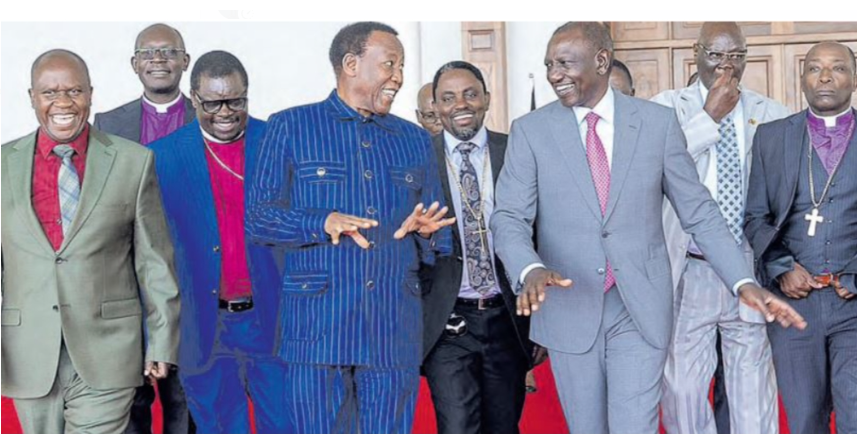
When President William Ruto was campaigning, a vast majority of the Pentecostal church stood with him, not just in word but in intense prayer, fasting, and prophetic declaration.
Many saw his election as an answered prayer, a divine installation.
Yet, curiously, as challenges mount, some of these same Christians have fallen silent or, worse, joined the chorus of naysayers who speak against the government. Have they forgotten their own prayers? Have they abandoned their own declarations?
If we prayed and believed for godly leadership, should we not be the first to stand firm in faith rather than waver like reeds in the wind?
It is God who puts kings in power. Daniel 2:21 states, "He changes times and seasons; he removes kings and sets up kings; he gives wisdom to the wise and knowledge to those who have understanding."
Leadership is ordained by God, and when we dishonor those He has placed in authority, we challenge divine order.
Ecclesiastes 10:20 further warns, "Do not revile the king even in your thoughts, or curse the rich in your bedroom, because a bird in the sky may carry your words, and a bird on the wing may report what you say." A king who is dishonored has the power to bring consequences upon his people. Proverbs 16:14 states, "The king’s wrath is a messenger of death, but the wise will appease it."
Christians must, therefore, be cautious not to undermine their own leadership through reckless words and actions.
At President Ruto’s inauguration at Kasarani Sports Complex, Bishop Mark Kariuki, while leading prayers, likened Ruto to Moses. This biblical comparison carried great significance to those who cared to dig deeper.
In Exodus 17:11-12, the Israelites were victorious in battle as long as Moses held up his hands, but whenever he lowered them, the enemy gained ground. Realising this, Aaron and Hur supported Moses' hands, ensuring the Israelites prevailed.
This underscores the role of Christians, especially evangelicals and Pentecostals, in upholding their leaders in prayer.
Just as Moses needed support, so does the government require sustained intercession to succeed. Christians must actively pray for transformative change, an end to corruption, and the instilling of integrity in the public sector.
Words spoken in faith, coupled with prayer, shape the destiny of a nation, and they shape the destiny of Kenya positively.
Globally, the world is aligning not by ethnicity, but by ideology. The left unites, the right unites, globalists unite, nationalists unite.
The world moves in concert based on shared beliefs, pooling resources and influence to advance their respective causes.
Yet, the Christian community, particularly in Kenya, remains divided, politically, economically, and socially. Where there should be unity, there is fragmentation. Where there should be strategy, there is complacency.
As a result, Christians struggle to influence key spheres of governance, finance, media, and culture owing to this complacency and due to selfish agendas.
Revelation 11:15 declares, "The kingdoms of this world have become the kingdoms of our Lord and of His Christ, and He shall reign forever and ever." However, this does not happen in a vacuum.
The church must rise, take dominion, and govern these spheres before the fullness of Christ’s reign can be realized.
Acts 3:21 also states that "heaven must receive Jesus until the times of restitution of all things," implying that certain conditions must be met before Christ’s return.
If Christians fail to rise in unity, the church delays its divine mandate to reclaim the earth’s systems for God’s kingdom.
If we are to hasten the fulfillment of prophecy, Kenyan Christians must stop undermining their own prayers with careless words. Instead, they must speak life, declare prosperity over the nation, and work together to build a society that reflects godly principles.
Of course there are many Christians praying hard for the government, but we must accompany this with positive and Godly declaration.
The time for neutrality is over. The time for division is over. The time for speaking against what we prayed for is over.
Let those who believe in the God of Heaven stand firm, speak wisely, and labor together for the fulfillment of His will on earth. The church must lead, or it will be led. The choice is ours.
Largely, Christians rallied together to support President Ruto’s election in 2022 and for this reason, we must be the first group across the country to fully support him in all ways possible.
This would not be sycophancy, but living true to scripture which calls for us to support and pray for those in power. We can speak the light that we want to see.