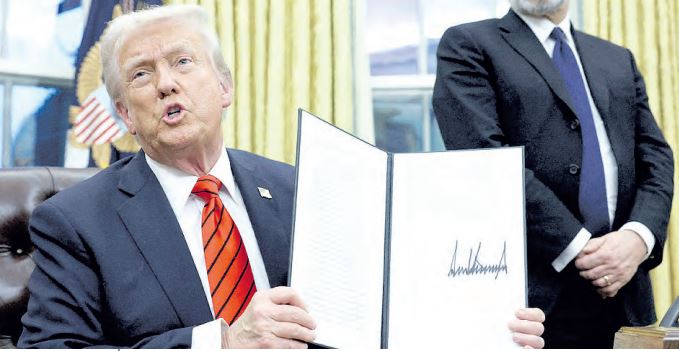
 US President Donald Trump holds a signed executive order on tariffs on aluminum imports in the Oval Office of the White House in Washington, US, on February 10 / XINHUA
Countries must work together to develop effective mechanisms and initiatives to address these ongoing issues. In this era, nations must seek solutions that avoid global disarray, chaos, and conflict while preventing domination by powerful countries over weaker ones.
Challenges such as conflicts, economic regression, and climate change threaten international stability and humanity’s very existence. When these issues escalate, no country is safe, regardless of its military might.
Military power cannot combat global warming or health threats like Mpox, Ebola and Marburg. During the Coronavirus pandemic, even powerful nations were not immune, but global collaboration helped mitigate the crisis.
After chairing the United Nations Security Council high-level meeting themed ‘Practicing Multilateralism, Reforming and Improving Global Governance,’ Chinese Foreign Affairs Minister Wang Yi said the trend of multilateralism is irreversible.
“Unilateralism and protectionism are unpopular. All countries should support a multilateral system with the United Nations at its core, adhere to the basic norms of international relations based on the purposes of the UN Charter, promote the concept of multilateralism, and revive the spirit of multilateralism,” he said.
Unilateralism has failed to create a unified approach to global problems, weakening international cooperation in areas of shared interest.
Multilateralism, however, holds the potential to maintain peace, improve lives and resolve global challenges like climate change and health crises.
Multilateralism fosters inclusivity, equality, and cooperation, creating a more prosperous, secure, and sustainable world—a vision for the future. For decades, the world has been shaped by US hegemony and its political and economic liberalism. However, recent events suggest that Western countries can no longer be relied upon, especially with the return of Trump to the White House.
The global order is changing, and nations must adapt to these shifts. While G7 nations have long presented their model of democracy as a benchmark for others, recent developments show that this model is facing significant challenges.
Although these nations have enjoyed governance stability for decades, their democratic systems are now encountering serious issues that have economic consequences.
Policymakers are starting to consider alternatives to the current model of democracy.
Many G7 governments are grappling with internal political instability, which hinders not only their own economic growth but also the global economy. In 2024, countries like France, Germany, Canada, Japan, and South Korea experienced political turmoil.
In France, the government collapsed after failing to pass a budget, and President Macron is facing increasing pressure to resign before his term ends in 2027.
These internal political crises suggest that the democratic systems of Western nations are no longer as stable as they once appeared.
These developments indicate a shifting world order, with no country remaining unaffected by internal and external pressures. Nations must resist the rise of national populism initiated by Washington and its traditional allies.
The challenges these countries face require a collective, multilateral response to prevent further instability.
As the world faces complex challenges, from the pandemic’s aftermath to rising geopolitical tensions and the climate crisis, international cooperation has never been more critical.
Multilateralism, openness, and mutual benefit should guide global efforts to tackle these issues. The global community must work together to ensure that collective interests take precedence over national self-interest.
Trump’s tariff policies aim to strengthen America’s position, but the global economy is highly interconnected. The resulting damage will extend beyond the US, tarnishing its image as a leader in global cooperation.
Once viewed as a proponent of global good, the US now appears to be pursuing isolationist policies that harm the economies of nations it sees as competitors.
The decision to focus on tariffs and quotas is counterproductive, as it isolates the US and undermines efforts to build cooperative international relationships.
In contrast, China has gained popularity on the global stage due to its commitment to collaboration over protectionism. Beijing has consistently emphasised cooperation, pledging to be a constructive force in addressing global challenges.
China has positioned itself as an advocate for multilateralism, offering an alternative model that prioritises shared responsibility and collective action. Trump’s series of executive orders—such as withdrawing from international organisations like the WHO, pulling out of the Paris Agreement, halting USAID, and imposing tariffs—has led many in the Global South to view Washington as incapable of addressing global challenges.
These actions have eroded the US’s credibility on the global stage and exposed its inconsistent approach to international cooperation.
The US must reconsider its approach and embrace multilateralism, dialogue and openness to create a more stable, equitable and sustainable future for all.
Only through collaboration can the world tackle the pressing issues of our time and build a more resilient global economy. The US should return to a leadership role in addressing climate change, global health issues, and economic development, working alongside other nations to pursue mutual benefits.
By refocusing on multilateralism and cooperation, the U.S. can once again lead in global development, environmental protection, and economic growth.
A stable,
prosperous world requires cooperation over competition, and nations
must prioritise collective good over
isolated self-interest. The path forward demands diplomacy, shared
responsibility, and a commitment to
addressing the world’s most urgent
challenges.