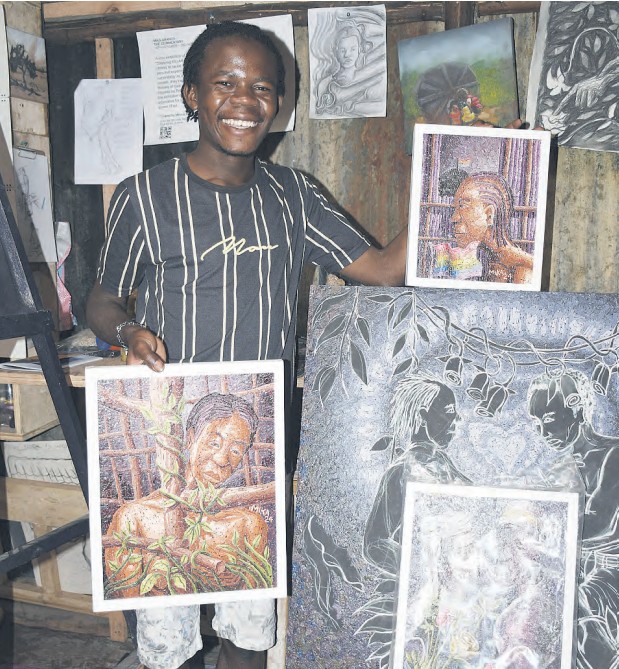
Nothing in an egg excites 25-year-old Mika Obanda than its shell.
Seen as waste, eggshells are his intense fascination and source of livelihood as wells his chosen tool for artistic expression.
Obanda spends his time in his Mukuru kwa Reuben studio, where he produces mosaic art pieces from eggshells sourced from local hotels, egg vendors and farmers.
It is through this unique kind of art that he has been able to speak about taboo topics: femicide, sexual gender based violence, gender identity and sexual harassment among others.
He traces his love for the art to his high school days. As a recovering drug addict, Obanda would peep through the art class window at Eastleigh High School and follow the teachers’ instructions.
He was barred from the class due to his addiction problem.
Nevertheless, he persisted.
In the evenings, Obanda would go to riverbanks, collect eggshells that were dumped by local vendors and carry them home in gunny bags.
He would then sort the shells according to their condition, dry and paint them in various shades of colours.
This hobby redirected him from being a heavy drug user to one of the outspoken artists in the informal settlement.
The most challenging part of the process is carefully cutting precise shapes—mostly triangles—using a scalpel, which he delicately guides over the drawn image on canvas.
Once the shapes are cut, he places them with meticulous care on the main canvas, using a bamboo stick, also a tool he chose to protect the environment.
“I find repurposing the eggshells a good way to protect the environment adding to the fact that they are easily available. Liaising with hotels such as Sarova Hotels in Nairobi, who give me the shells on request, has helped me continue with my craft.”
Another setback is the lack of a bigger space to dry his eggshells, a crucial step in the art process, which takes a while before painting can commence.
Eggshells take up to one year to decompose, even in small shreds.
This can be an eyesore if carelessly discarded, hence the need for a unified approach in taking care of this environmental waste.
The space inhibition also limits the number of art pieces he creates, as he will not have room to place his artwork after completion.
Studies indicate an individual consumes 280 eggs annually, he says, adding that better ways to reinvest this waste into money making ventures should be sought to address this.
“My pieces range from as low as Sh20,000 and can go up to Sh250,000. I am also in the process of raising other artists who are keen to learn this craft and create employment opportunities for them,” Obanda said.
His pieces are themed, with femicide topping the list, knowing first-hand the beatings his mother endured from his father when they were growing up.
Every time this happened, Obanda feared she would be another statistic.
“I remember once, at the height of such a fight, my father asked us to choose which parent we wanted to go with. I shouted my mum’s name. The beating dad gave me was epic. It was my moment of realisation, that as a society, no matter what choice we made, the woman would always be at a disadvantage and looked down on. I still stuck to my mum and watching her rebuild herself after the incident has been a life changing experience,” Obanda said.
The artist documented her journey through a solo art exhibition, dubbed ‘When I think of my mom’ at One Off Contemporary Art Gallery, in 2023.
The pieces, put together with the precision of a puzzle maker, shows his mother’s journey of resilience, selling farm produce to pay their bills.
There are dark scenes of the parents fighting as Obanda and his siblings and him look on helplessly.
In the end, however, the subject is successful, content and smiling.
The look on his mother’s face as she walked through Obanda’s journey through his art, was one of the most “painful and liberating”.
“She told me she never expected the exhibition to be that deep. This includes the conversations that came from it and the people discussing how each piece felt. It opened up very candid conversations with the people who were around there and people felt open to share their experiences,” he added.
The audience’s response sparked a renewed passion, pushing him to create more intricate eggshell art.
Each showcase, which takes a minimum of two months to complete, is a testament to his dedication for this craft.
Obanda is convinced that eggshell art is the future and envisions a time where the waste, often thrown away, becomes an integral part of Kenya’s artistic identity.
“This is the beginning of an art revolution. I feel that this is one of the best portrayals of freedom of expression and is, in essence, a movement waiting to happen” he added.