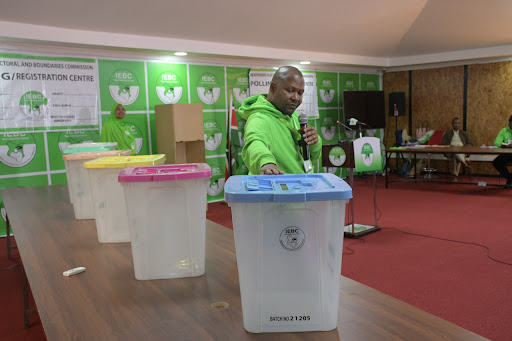
 The Independent Electoral and Boundaries Commission(IEBC) official. FILE
A survey done by Infotrak Research and Consulting has revealed various factors that prevent eligible citizens from registering as voters.
The findings reveal that the most significant obstacle to the registration of citizens is the lack of National Identity documents, 41 per cent of the respondents said.
In many cases, 41 per cent of citizens either do not have the required identification or are excluded from acquiring it, thereby excluding them from the process of voter registration.
This issue gives a call for reform in the documentation system in order to make it more accessible and inclusive for all citizens, especially those in rural or otherwise underserved areas.
The second major barrier that emerged from the survey was the busy schedule of the prospective voters which was cited by 16 per cent of the respondents.
Many people cannot find time to visit the registration centres, especially those whose work schedules are very long and who may have other significant responsibilities such as childcare or caregiving.
This is exacerbated further by the fact that most of the operating hours of registration centres go parallel to working hours.
Consequently, there is a need for extended periods of registration, registration exercises on weekends, and also conduct mobile or decentralized registration points for convenience.
The distance to the centres of registration is also a big challenge, as the research registered a significant 16 per cent who cited it as the reason they had not registered.
In most regions, especially rural or remote, the centres are usually located very far from the places where people reside, making them not easily accessible for people to travel to and register themselves.
This is more critical in cases involving geographical barriers and the marginalization of communities with extra financial or logistical barriers.
The situation could be better if there were increased accessibility of registration centres by establishing more local points or making use of mobile registration units.
Adding to the list is a lack of trust in the electoral process, according to 15 per cent of the respondents.
Many citizens also feel that the electoral system is flawed or their vote will not make any difference, hence a reason for their disinterest in participation.
Last but not least, at the bottom is a lack of sufficient information about voter registration which was cited by 10 per cent of the respondents.
The survey by Infotrak, which questioned 2,400 respondents, was conducted between the 16th to 30th of November 2024.
It underpins extensive reforms needed to promote faith, awareness, and reach toward the process of getting registered as a voter.
This quantitative survey had a margin error of +2 per cent and a probability of 95 per cent confidence rating.
It covered all 47 counties across the country's 8 regions, with data processed and analyzed using SPSS 26 statistical software, known for its high accuracy and reliability.