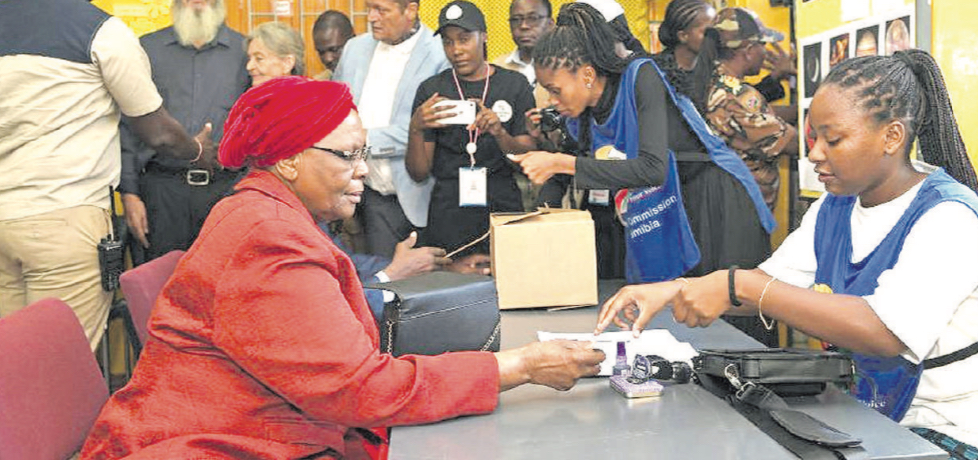
Namibia’s governing party,
Swapo, has retained its hold
on power after more than
30 years, however its grip
has been loosened - the latest African
country where incumbent
According to official results, Ne- tumbo Nandi-Ndaitwah, the Swapo candidate, won the presidential elec- tion with 57% of the vote, becoming the country’s first female leader.
Opposition parties have refused to accept the outcome after the polls were marred by logistical problems and irregularities.
Other important questions that have yet to be answered include how it was possible that Swapo increased its share of the presidential vote when in the parliamentary election it re- corded its worst-ever performance, losing 12 of its 63 seats and only just holding on to its parliamentary majority.
Swapo is not alone in suffering a major electoral setback.
This year has been an “annus horribilis” for those governments in sub-Saharan Africa that have had to face voters at the ballot box.
In almost every election held in the region this year under reasonably democratic conditions, the governing party either lost a significant number of seats or lost power completely.
This trend has been driven by a combination of factors: the economic downturn, growing public intoler- ance of corruption and the emergence of increasingly assertive and well-coordinated opposition parties.
The trend is likely to continue into 2025.
One of the most striking aspect of the elections that have taken place in 2024 is that many have resulted in landslide defeats for governments that have previously appeared to have a strong grip on power - including in countries that have never before experienced a change at the top.
The Botswana Democratic Party (BDP) that had ruled the country since independence in 1966 was crushed in October’s general elections.
As well as losing power, the BDP went from holding 38 seats in the 69-strong parliament to almost being wiped out.
After winning only four seats, the BDP is now one of the smallest parties in parliament, and faces an uphill battle to remain politically relevant.
There was also a landslide defeat for the governing party in Mauritius in November, where the Alliance Lepep coalition, headed by Pravind Jagnauth of the Militant Socialist Movement, won only 27% of the vote and was reduced to just two seats in parliament.
With the opposition Alliance du Changement sweeping 60 of the 66 seats available, Mauritius has expe- rienced one of the most complete political transformations imaginable.
Senegal and the self-declared re- public of Somaliland also saw opposition victories.
In the case of Senegal, the political turnaround was just as striking as in Botswana, albeit in a different way.
Just weeks ahead of the election, the main opposition leaders Bassirou Diomaye Faye and Ousmane Sonko were languishing in jail as the government of President Macky Sall abused its power in a desperate bid to avert defeat.
After growing domestic and international pressure led to Faye and Sonko being released, Faye went on to win the presidency in the first round of voting, with the governments can-didate winning only 36% of the vote.
Even in cases where governments have not lost, their reputation and political control have been severely dented.
Like Swapo, South Africa’s Afri- can National Congress (ANC) retained power but only after a bruising campaign that saw it fall below 50% of the vote in a national election for the first time since the end of white-minority rule in 1994.
This forced President Cyril Rama- phosa to enter into a coalition government, giving up 12 cabinet posts to other parties, including powerful positions such as Home Affairs.
As a result, a region that is known more for governments that manage to hold on to power for decades has seen 12 months of vibrant, intensely contested, multiparty politics.
The only exceptions to this have been countries where elections were seen as neither free nor fair, such as Chad and Rwanda, or in which governments were accused by opposition and rights groups of resorting to a combination of rigging and repression to avert defeat, as in Mozambique.
Three trends have combined to make it a particularly difficult year to be in power. In Botswana, Mauritius and Senegal, growing citizen concern about corruption and the abuse of power eroded government credibility.
Opposition leaders were then able to play on popular anger at nepotism, economic mismanagement and the failure of leaders to uphold the rule of law to expand their support base.
Especially in Mauritius and Sen- egal, the party in power also under- mined its claim to be a government committed to respecting political rights and civil liberties – a dangerous misstep in countries where the vast majority of citizens are committed to democracy, and which have previously seen opposition victories.
The perception that governments were mishandling the economy was particularly important because many people experienced a tough year financially.
High food and fuel prices have increased the cost of living for millions of citizens, increasing their frustration with the status quo.
In addition to underpinning some of the government defeats this year, economic anger was the main driving force that triggered the youth-led protests in Kenya that rocked President William Ruto’s government in July and August.
This is not an African phenomenon, of course, but a global one.
Popular discontent over inflation played a role in the defeat of Rishi Sunak and the Conservative Party in the UK and the victory of Donald Trump and the Republican Party in the United States. What was perhaps more distinctive about the transfers of power in Africa this year was the way that opposition parties learned from the past.
In some cases, such as Mauritius, this meant developing new ways to try and protect the vote by ensuring every stage of the electoral process was carefully watched. In others, it meant forging new coalitions to present the electorate with a united front.
In Botswana, for example, three opposition parties and a number of independent candidates came together- er under the banner of the Umbrella for Democratic Change to comprehensively out-mobilise the BDP