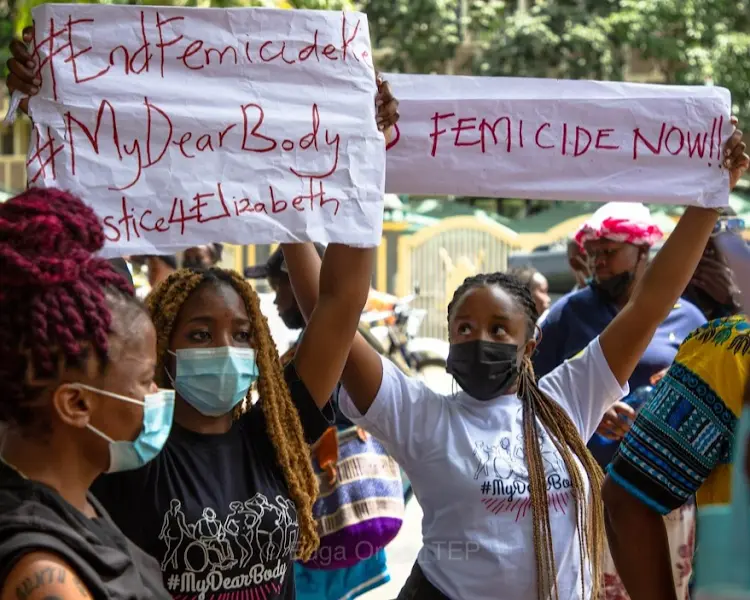
 Protesters against femicide/File
These women, once full of life, have been reduced to mere statistics after being brutally murdered by men they trusted.
In recent months, Kenya has become a chilling stage for a series of brutal killings, predominantly targeting women and young girls.
According to the National Police Service, one death is being reported every 24 hours, as of November 2024.
The year began with the horrific murder of socialite Starlet Wahu. Her body was discovered in an Airbnb in South B, Nairobi, on January 3.
Wahu and the suspected killer were seen entering the Airbnb the previous night.
A postmortem revealed she was strangled and had suffered a deep cut on her thigh, severing a vein.
The suspect, John Matara, was arrested and charged with her murder after a guard at the apartment reported seeing him leave with bloodied clothes the next morning.
After his arrest, several women came forward to share their own experiences of abuse at his hands. Matara remains in remand, awaiting trial.
Another high-profile case is that of Rita Waeni, a third-year student at the Jomo Kenyatta University of Agriculture and Technology.
Waeni’s decapitated body was found in a dustbin in Roysambu, with her head later discovered separately.
An autopsy revealed she was strangled and decapitated.
Despite several arrests of men suspected in the case, Waeni’s killer remains free.
The Kware Murders
On August 20, Collins Jumaisi Khalusha, the prime suspect in the Kware murders, escaped from Gigiri Police Station along with 12 other inmates.
The escape occurred when the suspects cut through a wire mesh and scaled the perimeter wall.
Dismembered bodies placed in sacks were discovered in the Kware dumpsite in Mukuru Kwa Njenga which led to the arrest of Jumaisi.
Jumaisi is said to have admitted to having killed up to 42 women. He denied the charges.
As of November 28, Jumaisi remains at large.
The DCI has confirmed that a fresh manhunt is underway.
Justice for Lucy Njambi
Amid the disturbing trend of femicide, there was a glimmer of justice in April 2024, when former Riruta MCA Samuel Ndungu and two others were sentenced to 30 years in prison for the murder of Ndungu’s ex-wife, Lucy Njambi.
Njambi was subjected to physical and sexual assault before being doused in sulphuric acid, leading to her death.
Judge Joel Ngugi emphasised that the case was one of extreme cruelty, and the sentences were meant to deter similar crimes in the future.
"In order for him to determine the appropriate sentence in which it will be legitimately imposed, it includes to punish the offender to the extent and in a manner that is just in all the circumstances, to deter the offender or other persons from committing offences of the same character, to establish conditions that may facilitate rehabilitation of the offender, to manifest the denunciation by the court of the conduct in question, and to protect the community," he said.
A Call for Action
The gruesome nature of these crimes has ignited nationwide outrage, with many calling for President William Ruto to declare femicide a national disaster.
On January 27, thousands of women and men marched in Nairobi and other major cities, demanding an end to femicide and violence against women.
Protesters carried placards reading “We Are Human Beings”, “Say Their Names”, and “Stop Killing Us!”
According to a report by the United Nations Office on Drugs and Crime and UN Women, intimate partners are the leading perpetrators of femicide, responsible for an average of 55 percent of intimate partner and family-related killings.
The shocking fact that at least 10 women were killed in the first month of 2024 alone has intensified the urgency for action.
Mary Njeri, a gender-based violence analyst at UN Women, stated, "Each loss is a stark indicator of the systemic issues we are striving to dismantle."
As the year progresses, the number of femicide cases continues to rise, spreading fear among women across the country.
On November 25, Acting Interior Cabinet Secretary Musalia Mudavadi directed the police to act swiftly to address the growing number of femicides in the country.
He expressed his solidarity with the global community in condemning violence against women and girls, calling for urgent action to ensure their safety.
Presidential Response
On November 3, President Ruto condemned the rise in femicide cases, expressing his dismay over the killing of women and girls at the hands of men.
“How can it be that our girls, the Kenyan women who expect us to love them, are dying in the hands of men?” he asked
He recognised that Kenya is facing both a criminal and moral crisis and emphasized the need to address both issues.
In a meeting with women leaders on November 20, Ruto reiterated his commitment to ending all forms of violence.
He directed law enforcement and the criminal justice system to ensure that justice is swift and perpetrators of femicide are held fully accountable.
He also called for enhanced gender desks in police stations and the establishment of similar services in hospitals to provide immediate care to victims.
Ruto emphasised the importance of equipping young people with life skills and awareness to navigate societal risks, particularly the dangers of social media, which has become a platform for exploitation.
He urged parents, schools, churches, and community organizations to take responsibility for providing guidance and support to the youth.
Religious leaders were also encouraged to speak positively about women and to foster an environment that promotes women’s rights as human rights.
A National Crisis
The urgency of the situation calls for the state and justice sectors to collaborate and ensure that perpetrators face the law.
The ongoing wave of femicide demands a comprehensive response from both the government and society. Justice must not only be pursued but delivered swiftly to end the senseless violence that continues to plague the country.