Apart from an overwhelming urge to pin one's opponent to the floor of the house, there is no obvious connection between politics and the world of top-level judo.
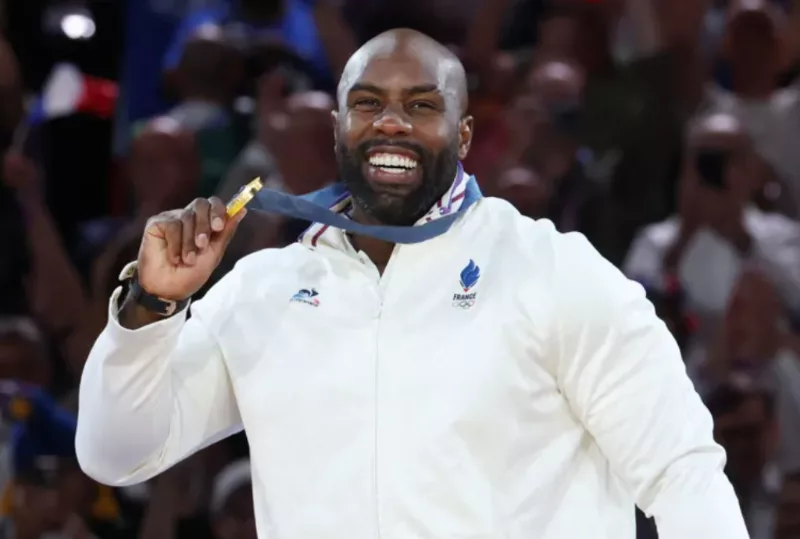
That has not stopped France's much-garlanded world heavyweight champion Teddy Riner from throwing his hat into the ring for next April's presidential race.
The Guadeloupe-born 37-year-old may have no experience of public office, no party behind him, and as yet no manifesto. All so far is a slogan La France qu'on aime (The France we love), a declaration on social media, and a campaign visit to a hospital in the Seine-Saint-Denis suburb of northern Paris.
But it would be a foolhardy pundit who would totally write off his chances.
Riner is, after all, one of the most popular figures in modern-day France, regularly topping the polls for embodying the nation's "values". He is a proven winner, with five Olympic golds and 11 world championships under his belt, as well as a successful career in business.
More than 28 million people have watched his election broadcast on Instagram and X, shot with proper presidential decorum against a backdrop of books and a French flag. Some 22% told an Ifop poll within 24 hours they "could" vote for him.
Actors and television personalities have become presidents in other countries. The ex-leader of Liberia – George Weah – was formerly a professional footballer.
So why not a judoka in the Élysée Palace?
"Anyone who thinks that being out of the political in-crowd disqualifies Riner from running for the Élysée would be very wrong," says Guillaume Tabard of Le Figaro.
"But [Riner] too would be wrong if he thinks not belonging to the in-crowd is all it takes."
For now the whole of the French political world has decided to take the Riner candidacy seriously – or at least to pretend to. That is partly because he is such a popular personality that mocking his political hopes could easily rebound badly.
But it is also because the state of French politics – outside of the burgeoning forces of the hard left and hard right – is one of total disarray.
The centre-ground is floundering, with no candidate yet emerging who can inspire anything like the sense of mission of hard-right leader Marine Le Pen and Jean-Luc Mélenchon on the hard left, who for now look set to face off in the final round of the presidential election in May.
So when a popular figure like Riner enters the race - proclaiming himself "neither left, nor right", wanting to "unite the country" and "put money back in people's pockets", railing equally against "racists" and "yobs who scare people off our streets" – politicians have to take note.
It is perfectly possible, probable even, that Riner's campaign will fizzle out after a brief period of hype, and that the judoka will after all be a joker in the pack. But it is also possible that it won't, in which case the pre-election arithmetic will need a hasty readjustment: and it won't be the centrists who are smiling.
Thus far, Riner has shown himself a master of the codes required for this kind of out-of-nowhere candidacy, the first of which is to press home the message: "Don't Worry! I'm NOT a Politician!"
In this day and age in France, anyone who smacks of the "system" is automatically downgraded in voters' eyes, so it is important to emphasise that you are only running for office because, one, you have experienced real life (unlike those loafers in Paris); and two, you have discovered that there are solutions out there for the country's many problems. Solutions that are invisible to those same blinkered apparatchiks.
All this Riner was able to express in last Monday's social media broadcast by using sophisticated rhetorical devices.
"People say I am a fool for wanting to run for the presidency," he said.
"Am I a fool? Well, if refusing to see France sink under the weight of debt; refusing to see mothers and fathers grit their teeth every time they do their weekly shop, and tremble with fear when their kids go out on the street… if all that means being a fool, then yes call me a fool."
It was a promising oratorial start for the sportsman, and certainly attracted the viewers.