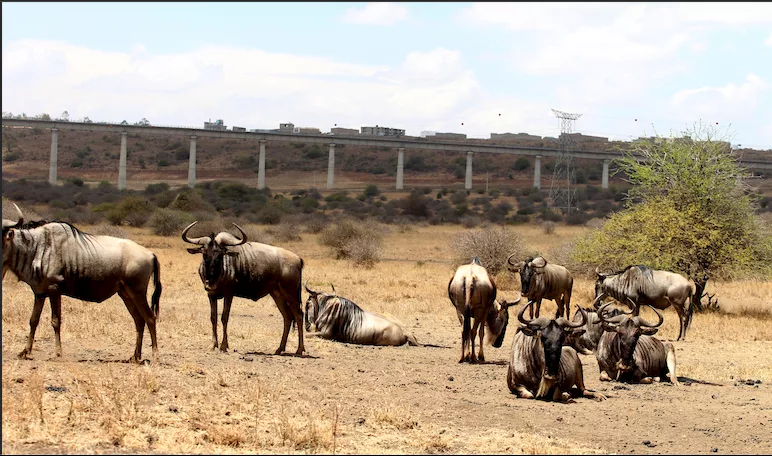
A giraffe does not recognise a title deed. An elephant does not understand a county boundary. And a vulture cannot be expected to know that a wind turbine has been erected along a flight path it has used for years. Yet, as Kenya expands its roads, towns, farms and energy infrastructure, wildlife is increasingly expected to adjust to a world being redesigned almost entirely around human needs.
I was reminded of this during a recent wildlife count at Kapiti Conservancy. What began as an opportunity to observe wildlife and engage with conservationists soon became a reflection on a fundamental question: When we claim land for development, whose home are we taking over?
During the count, a colleague jokingly wondered whether a gazelle entering his home could be interpreted as God sending him a meal. We laughed, but the question stayed with me. How certain are we that the place we call our home was not once the ancestral home of that gazelle?
"Actually, elephants cry and gazelles remain single forever when they lose their mate," Peter, the warden, interrupted the laughter. This reminds us that animals are not merely objects moving across a landscape. They are living creatures whose survival depends on their environment, social relationships and freedom to move.
That encounter brought into sharp focus a question Kenya can no longer afford to ignore: Are we planning development around the realities of our natural environment, or are we expecting nature to make way for us at any cost?
Kenya’s development ambitions are understandable. We need roads, housing, electricity, industries, agricultural production and expanding urban centres. These are essential to economic growth and improved livelihoods. But development becomes shortsighted when it treats biodiversity as an inconvenience to be addressed after the location has been selected, the designs completed and the investment committed.
Before approving a major project, how often do we ask which species inhabit the proposed site? Do we understand the wildlife corridors, breeding grounds, feeding areas and bird flight paths that could be affected? Have we considered the less visible species, including insects and other organisms that sustain ecosystems?
Too often, biodiversity risks receive attention only after key decisions have already been made. At that stage, avoiding environmental damage becomes difficult, more expensive and sometimes impossible. This is not simply a conservation challenge. It is a failure of development planning.
Kenya’s biodiversity is not separate from the economy. It supports livelihoods, tourism, water security, agricultural productivity and ecological stability. We cannot continue to measure development solely by Kilometres of road constructed, megawatts generated, buildings completed or investments attracted. We must also measure biodiversity lost, protected and conserved.
Consider Kenya’s renewable energy. Even green energy projects carry ecological risks if improperly sited. For instance, placing wind turbines along Kenya's vulture flight corridors introduces severe collision hazards and disrupts established wildlife movements, proving that engineering feasibility must be balanced with environmental impact. The solution is not to abandon renewable energy. It is to plan it better.
Environmental assessments must provide credible evidence to guide decisions about where projects are located, how they are designed and what safeguards are necessary. This requires appropriate ecological surveys, reliable baseline information and meaningful consideration of cumulative impacts across a landscape.
Where significant risks are identified, developers and decision-makers should consider alternatives, redesign infrastructure, avoid sensitive areas and implement effective mitigation measures. Where necessary and feasible, operations can also be adjusted when biodiversity faces heightened risks. The principle is: environmental assessment should influence development decisions, not justify decisions that have already been made.
Kenya already demonstrates that infrastructure can be designed with safety in mind. Where wildlife crosses roads, appropriate crossings and warning measures help reduce collisions. Where dangerous road sections are identified, speed restrictions and other interventions protect human life. Why should similar foresight not inform other forms of infrastructure?
Such measures are not unreasonable demands by conservationists. They are practical expressions of responsible planning. Kenya needs to make biodiversity mainstreaming a practical reality and we are not starting from zero.
As a party to the Convention on Biological Diversity (CBD), Kenya has committed to Decision 16/13 and has revised its National Biodiversity Strategy and Action Plan (NBSAP) to align with the Kunming-Montreal Global Biodiversity Framework (KM-GBF).
Central to this framework is to move beyond treating biodiversity as the sole concern of environmental agencies and instead institutionalise a “whole-of-government, whole-of-society” approach. The NBSAP and the CBD commitments provide the mandate; what remains is to ensure they shape the next road, wind farm and housing estate before the bulldozers arrive, not after.
This means integrating biodiversity considerations into decisions across sectors: national and county governments, infrastructure planners, energy developers, agricultural institutions, urban authorities and private investors.
Biodiversity must be considered when county development plans are prepared, roads are routed, housing estates are approved, energy projects are assessed and agricultural landscapes are transformed. It should be part of the initial decision-making process, not an additional requirement introduced when objections arise.
Kenya does not have to choose between economic growth and biodiversity conservation. The real choice is between development that recognises ecological limits and development that undermines the natural systems on which future prosperity depends.
Before approving the next road, wind farm, housing estate or major infrastructure project, decision-makers must look beyond what the investment promises and examine what already exists on the land. Developers must take ecological risks seriously, while government institutions must ensure that environmental safeguards shape decisions and are enforced.
The wildlife count at Kapiti Conservancy reminded me that we are not the only inhabitants of this country. The landscapes we call home are also feeding grounds, breeding areas, migration routes and habitats for countless other species. Our laws, policies and planning must reflect that reality.
Ultimately, the question is not whether Kenya should develop. It is whether we can develop without systematically displacing the other forms of life with which we share this country. A development model that repeatedly places people and biodiversity in avoidable conflict is neither socially responsible nor environmentally sound.
Our ambition must be to create a country where people can prosper, infrastructure can expand and biodiversity can continue to live and move through the landscapes that sustain it.
Policy and advocacy manager, Nature Kenya, the EANHS