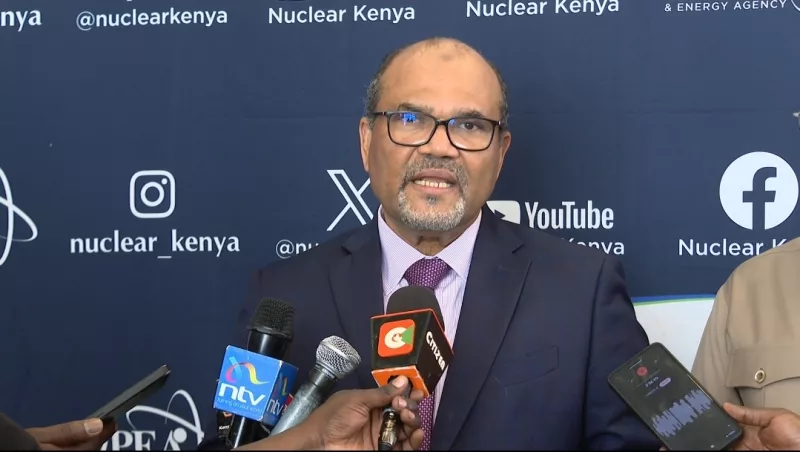
 Science, Research and Innovation Principal Secretary Shaukat Abdulrazak addresses the press in Nairobi on October 16, 2026/THE STAR
Kenya is planning to establish a Sh36.7 billion nuclear research reactor at Konza Technopolis, a facility expected to support cancer diagnosis and treatment, agricultural research, industrial testing and training of specialists for the country’s proposed nuclear power programme.
The proposed 10-megawatt thermal (MWth) multipurpose open-pool reactor will complement plans to develop a nuclear power plant in Siaya County, with the government targeting groundbreaking for the electricity-generation project in 2027.
Unlike a commercial nuclear power plant designed primarily to generate electricity, the research reactor will produce neutrons for scientific experiments, testing materials and producing medical isotopes used in nuclear medicine.
Science, Research and Innovation Principal Secretary Shaukat Abdulrazak said Friday that the government was pursuing the two projects simultaneously to build the scientific infrastructure and technical expertise required to advance Kenya’s nuclear ambitions.
“The research reactor is basically a source of neutrons. While we are developing the nuclear power programme, this is a facility where we can conduct research in different areas, including non-destructive testing, material science, medical sciences and agriculture,” Abdulrazak said.
He said the facility would also provide a training ground for Kenyan scientists, engineers and technicians who would eventually support the country’s nuclear energy programme, including the development of small modular reactors.
The project is among the initiatives through which the government hopes to position science, technology and innovation at the centre of industrialisation.
Abdulrazak said the proposed investment should be assessed against its potential benefits to healthcare, industry and research rather than its upfront cost alone.
“It looks as if it is a big amount of money, but you can see the dividends that we are going to get out of it,” he said, pointing to the prospect of establishing domestic production capacity for medical isotopes.
Kenya currently relies on imports for some radioactive materials used in medical diagnosis and treatment, exposing healthcare providers to supply-chain challenges and the time-sensitive nature of the products.
NuPEA CEO Jusus Wabuyabo said local production of medical isotopes would improve their availability and support specialised cancer care.
He said some isotopes lose their effectiveness over time because of radioactive decay, making proximity to production facilities important in ensuring they are used efficiently.
“Kenya currently imports these medical isotopes from South Africa, and sometimes, because of the importation, the half-life of that product is affected. But if we are going to produce it in our country, we will be able to utilise it more usefully,” Wabuyabo said.
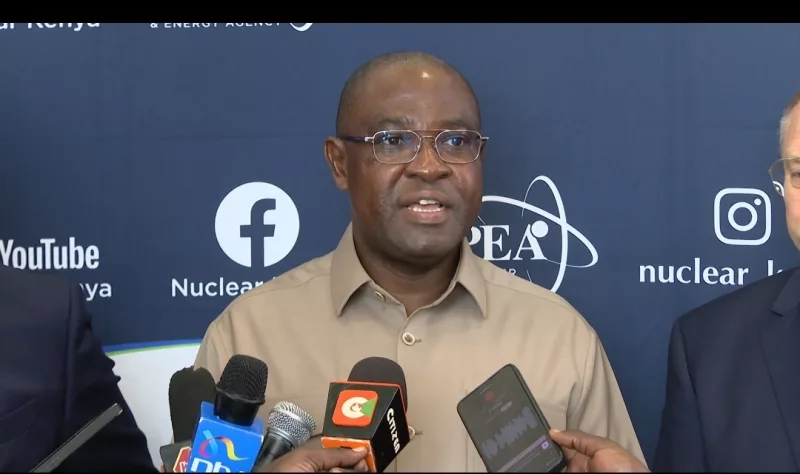 NuPEA CEO Justus Wabuyabo addresses the press in Nairobi/THE STAR
He added that domestic production could help attract patients from neighbouring countries, including Uganda, Tanzania, Rwanda and Ethiopia, who currently travel abroad for specialised treatment.
Wabuyabo likened the research reactor to other major infrastructure investments whose benefits may not be immediately apparent but become evident through the services they enable.
“A research reactor could be seen as an infrastructure project, like building a road. You may not see the benefit of it upfront, but having a good road ensures smooth movement of goods and services,” he said.
They spoke during the International Atomic Energy Agency (IAEA) Integrated Nuclear Infrastructure Review Mission for a New Research Reactor (INIR-RR) Phase Two in Nairobi, which is assessing Kenya’s preparedness to develop the proposed facility and identifying gaps that must be addressed before the project proceeds.
Beyond healthcare, the reactor is expected to support research in agriculture, materials science and semiconductor-related applications, widening the range of domestic institutions able to undertake specialised scientific work.
The facility would also strengthen Kenya’s capacity to train personnel locally instead of relying heavily on overseas institutions as the country prepares for its proposed 2,000-megawatt nuclear power plant in Siaya.
Wabuyabo said the research reactor would be an important training facility for engineers and scientists who will be required to operate and support the future power plant, which is expected to begin supplying electricity to the national grid in 2034.
Kenya has been a member of the International Atomic Energy Agency (IAEA) since 1965, and Abdulrazak said the country had already developed a pool of professionals with nuclear-related training in agriculture, health, standards and energy.
However, he said the country needed to build a larger pool of specialists and develop the necessary infrastructure at home to sustain the programme.
“We do not want to rely on sending Kenyans abroad. That is why we are advocating building capacity and keeping expertise in the country. We must be able to have our own infrastructure,” Abdulrazak said.
The project, however, remains at the preparatory stage, with key decisions on procurement, institutional responsibilities and staffing still pending before the government can move towards selecting a supplier.
NuPEA anticipates being designated as the owner-operator of the Kenya Nuclear Research Reactor (KNRR) project, but the appointment is yet to be made by the Ministry of Energy.
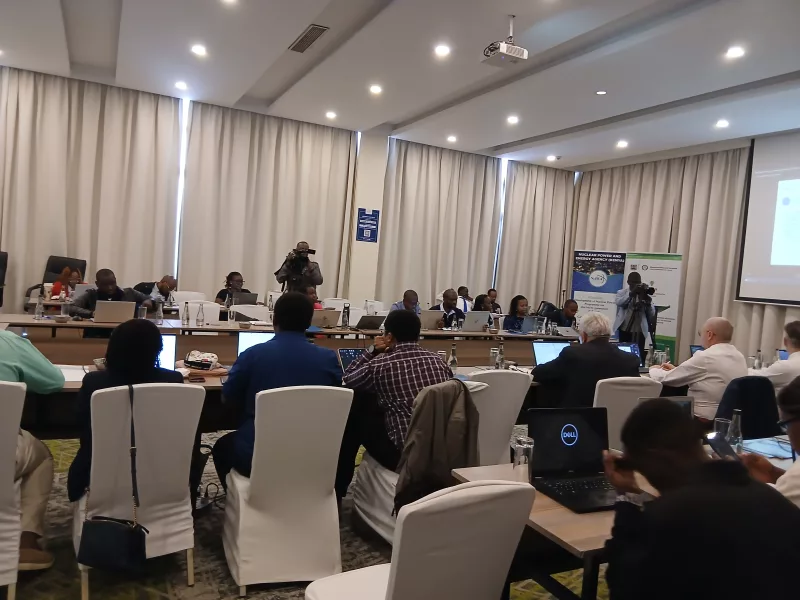 A section of participants during the IAEA review mission in Nairobi on October 16, 2026/THE STAR
According to NuPEA Director, Strategy and Planning Winfred Ndubai, the agency has established a nuclear research reactor department intended to lay the groundwork for the future operating organisation.
In her presentation during the meeting, Ndubai said the structure has been approved, but only five of the proposed 25 positions have been filled.
The agency envisages eventually recruiting about 110 staff to support the project and its operations.
She said the government must also settle on a procurement approach, establish a negotiating team and develop clear criteria for evaluating potential suppliers before invitations to tender are issued.
Options under consideration include open international competitive tendering, specially permitted procurement, government-to-government arrangements and a public-private partnership.
The choice will determine how the project is financed, how suppliers are selected and the legal framework governing negotiations.
A public-private partnership is among the options being explored, with Abdulrazak saying the government was committed to pursuing the project while considering arrangements that could bring in private-sector investment.
NuPEA said the project would require an experienced owner’s engineer or technical support organisation to guide procurement and implementation, given that Kenya has not previously undertaken a nuclear research reactor project of this scale.
"The agency is also developing management systems and procedures covering safety, security, procurement, contract management, commissioning and vendor oversight," Ndubai said.
The Kenya Nuclear Regulatory Authority (KNRA), which will provide independent regulatory oversight, has its own management systems and licensing framework to develop.
Ndubai said the regulator must remain separate from the project’s procurement negotiations to preserve its independence.
The preparations are being assessed by an IAEA team.
The review examines Kenya’s progress in developing the infrastructure needed for the research reactor programme, including nuclear safety, regulatory arrangements, radioactive waste management, emergency preparedness, security, human resources, financing and site selection.
The mission is expected to identify outstanding gaps, assess implementation of earlier recommendations and provide guidance on the steps required before the project advances.
Wabuyabo said the findings would help Kenya strengthen its readiness to develop the facility and establish the institutional capacity necessary for its safe operation.
The proposed reactor at Konza is therefore expected to serve not only as a scientific facility but also as a foundation for developing domestic expertise in nuclear technology as Kenya advances plans for electricity generation.
Its eventual implementation will depend on completing the outstanding institutional, regulatory, procurement and financing arrangements.