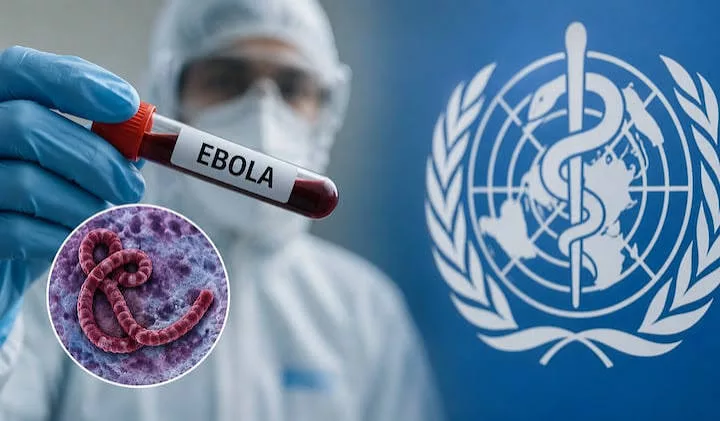
 Ebola virus and WHO logo/HANDOUT
The Ministry of Health has urged Kenyans not to stigmatise people identified as contacts of Ebola patients, clarifying that being placed under monitoring does not mean someone has contracted the disease.
The ministry said contact tracing and quarantine were preventive measures intended to identify infections early, protect families and communities, and prevent further transmission.
“Being identified as a contact does not mean someone has Ebola. Contact monitoring helps identify illness early and protects families and communities. Support, don't stigmatise,” the ministry said in a public awareness message.
The clarification comes as Kenya intensifies surveillance following confirmation of a third case of Ebola Bundibugyo virus disease, involving a 65-year-old woman who was already in quarantine after being identified as a close contact of the first two patients.
The woman developed a fever, sore throat and general weakness while in quarantine, prompting health workers to isolate her and collect samples for testing.
She subsequently tested positive at the National Virology Reference Laboratory and the Kenya Medical Research Institute laboratory.
Health authorities say identifying and monitoring people who have been exposed to an infected person is critical because symptoms may develop during the monitoring period.
The ministry has urged members of the public to support people undergoing monitoring rather than subjecting them to discrimination or treating them as confirmed cases.
Ebola is a severe and potentially fatal disease that spreads through direct contact with the blood or body fluids of an infected person, or someone who has died from the disease.
The ministry advises the public to avoid contact with body fluids of anyone suspected to have Ebola and to wash their hands thoroughly with soap and water after any possible exposure.
Anyone required to handle or support a suspected patient should use appropriate personal protective equipment to minimise the risk of infection.
The ministry has also warned against touching the bodies of people who die from Ebola, saying burials should be conducted safely and with dignity by trained burial teams.
Male survivors of Ebola are advised to abstain from sexual activity or practise safe sex by using condoms until they test negative for the virus, because Ebola can persist in semen after recovery.
Hand sanitiser containing at least 70 per cent alcohol can also be used as an additional hygiene measure.
The ministry has encouraged anyone experiencing symptoms associated with Ebola, including fever, unusual tiredness, muscle or joint pain, vomiting, diarrhoea or unexplained bleeding, to seek medical attention immediately.
Members of the public can obtain information or report suspected cases by calling the toll-free number 719, dialling *719#, or contacting Jali on WhatsApp through 0700 719 719.
The ministry maintains that early reporting, contact monitoring and adherence to prevention measures remain essential to containing the outbreak and protecting communities.