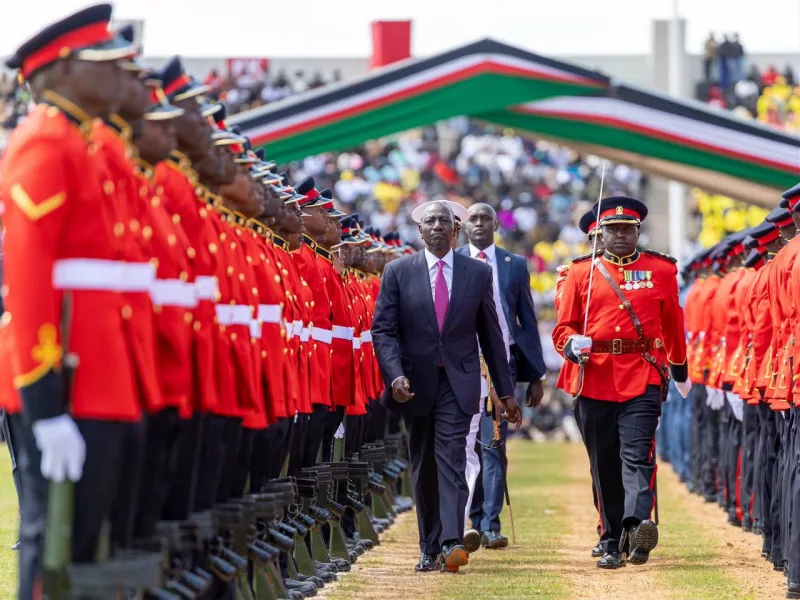
 A past police recruitment drive./FILE
The Court of Appeal has upheld a decision barring the National Police Service Commission (NPSC) from recruiting uniformed police officers, affirming that the mandate rests with the National Police Service under the Inspector-General’s command.
In a judgment delivered on October 16, 2026, a three-judge bench dismissed appeals by the commission and the Law Society of Kenya (LSK) challenging a ruling by the Employment and Labour Relations Court.
The appellate court upheld the decision by Justice Wasilwa, who had declared unconstitutional the NPSC recruitment regulations issued in 2025 and permanently barred the commission from recruiting, training and undertaking specified personnel functions relating to members of the National Police Service.
The dispute arose after the commission advertised vacancies for police constables in September 2025, prompting lawyer John Harun Mwau to move to court.
In his case, he argued that the Constitution did not give the NPSC the power to recruit uniformed officers.
The Commission and the LSK, in their case, contended that Article 246 gives the NPSC broad human-resource management powers over the National Police Service, including recruitment of uniformed officers.
They also maintained that the Inspector-General’s independent command under Article 245 primarily concerns operational matters.
In dismissing the appeals, the Court of Appeal said the Constitution clearly distinguishes between uniformed police officers and civilian personnel working within the Service, assigning different responsibilities to the Commission and the Inspector-General.
“Having immersed ourselves in the text of the Constitution in so far as it relates to the dispute at bar, we see no ambiguity therein,” Justices Patrick Kiage, Jamila Mohammed and Jessit Lesiit stated.
The court observed that the NPSC’s mandate under Article 246(3) to recruit, appoint, promote and transfer persons holding or acting in offices within the Service applies to civilian staff, rather than uniformed police officers.
The recruitment and training of uniformed officers, it held, fell within the responsibilities of the National Police Service, with the Inspector-General exercising independent command over its members.
The judges also rejected arguments that limiting the commission’s role would undermine accountability and revive past abuses associated with police recruitment and management.
“We do not accept the notion propounded by the appellants that to confine the commission within the sphere delineated by the constitution itself is a throwback to the old dark days of unaccountability, impunity and political suppression by a weaponised police,” they said.
Instead, the judges noted that the constitution requires the Inspector-General to remain accountable to its provisions, including those on human rights and the rule of law.
The ruling leaves in place the lower court’s declarations that the NPSC recruitment regulations, contained in Legal Notice No. 159 of 2025, were unconstitutional.