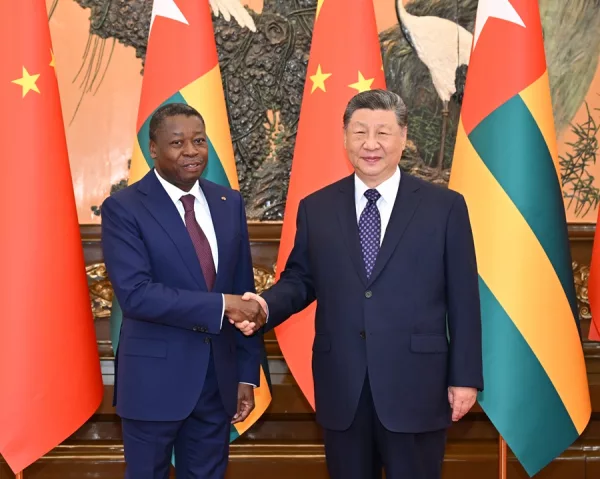
 President Xi Jinping met with President of the Council of Togo Faure Essozimna Gnassingbé during a meeting in Beijing, Oct 13, 2026.
Chinese President Xi Jinping has outlined four principles for resolving conflicts in Africa, calling for African-led solutions, respect for national sovereignty, an end to hostilities and efforts to address the root causes of insecurity.
Xi said African people should remain at the centre of decisions affecting the continent, warning against approaches that sideline them in resolving regional disputes.
He said the international community should support African countries in addressing their challenges while respecting their sovereignty and territorial integrity.
“War and unilateral sanctions are never real solutions to disputes between states,” Xi said, calling on countries to pursue dialogue, consultation and mutual accommodation.
The principles emerged during Xi’s meeting with Togo’s President of the Council, Faure Essozimna Gnassingbé, in Beijing on October 13, where the two leaders also announced the elevation of bilateral relations to a China-Togo community with a shared future in the new era.
Xi said China and Togo shared similar positions on international and regional issues and should strengthen coordination in multilateral forums to promote peace, security and reforms in global governance.
His remarks set out Beijing’s position on how external partners should engage with African conflicts, with an emphasis on African leadership, international law and development as part of efforts to achieve lasting peace.
The first principle is to uphold Africa’s leadership in resolving its conflicts.
Xi said African people were the true masters of the continent and should play a central role in decisions affecting their countries and regions.
The position places responsibility on African governments and regional institutions to lead peace initiatives, while leaving room for international partners to support efforts agreed upon by the countries concerned.
The second principle is safeguarding equity and justice through respect for the United Nations Charter.
Xi called on parties to observe international law and respect the sovereignty and territorial integrity of countries affected by conflicts.
The third principle is to cease hostilities and build peace through dialogue.
Xi said countries should respect one another, engage in extensive consultations and seek common ground despite their differences.
He urged parties to practise mutual understanding and accommodation, arguing that war and unilateral sanctions could not provide lasting solutions to disputes between states.
The fourth principle is to address both the immediate symptoms and underlying causes of conflict.
Xi said efforts to respond to urgent security threats should go hand in hand with long-term development planning.
The approach links peace and security with broader development needs, including the economic and social challenges that can complicate efforts to achieve lasting stability.
Gnassingbé endorsed the principles, saying Togo agreed with Xi’s position on the constructive participation of relevant parties in resolving African conflicts.
The Togolese leader also commended China’s role in maintaining international peace and stability and said his country was ready to strengthen multilateral cooperation with Beijing.
The two leaders pledged to work together to defend multilateralism and safeguard the interests of developing countries.
Beyond security, the meeting focused on strengthening economic relations between the two countries.
Xi encouraged Togo to take advantage of China’s zero-tariff policy for African countries and special channels for African exports to expand access to the Chinese market.
He said China was ready to deepen cooperation with Togo in new energy, digital technology and intelligent industries to support its industrialisation.
Gnassingbé welcomed greater Chinese investment in Togo, particularly in trade, infrastructure, science and technology.
The two countries will mark 55 years of diplomatic relations next year.
Chinese Foreign Minister Wang Yi attended the meeting.