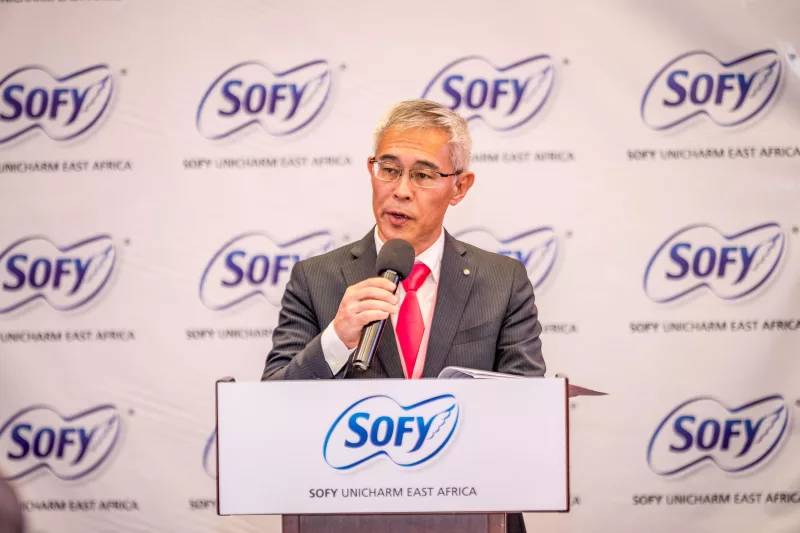
Japanese hygiene products maker Unicharm Corporation, Toyota Tsusho Corporation and CFAO Kenya have launched a Sh2 billion joint venture in Kenya to manufacture and distribute sanitary products across East Africa.
The new company, Sofy Unicharm East Africa Limited, will integrate production, product development, sales and marketing in Kenya, with plans to supply and export sanitary products to neighbouring markets.
The investment comes as manufacturers seek to expand local production of hygiene products while tapping demand for affordable sanitary pads in Kenya and the wider region.
Unicharm President and Chief Executive Takahisa Takahara said the company would initially focus on women's hygiene needs before expanding into other personal care products, including baby diapers.
The venture will draw on Unicharm's product development and manufacturing expertise, alongside the local market knowledge and distribution capabilities of its partners.
President and CEO of Unicharm Corporation Takahisa Takahara said the company would adapt its products and technologies to the needs of consumers in East Africa.
“Starting with women as our focal point, we aim to evolve into a company that supports lifetime value. We look forward to applying the knowledge and technologies Unicharm has cultivated globally, including baby care and diapers tailored to the needs of this region,” said Takahara.
Sofy entered the Kenyan market in 2023 with its Deep Absorb sanitary pads. In January 2025, it introduced locally manufactured Sofy Long Lasting pads, targeting consumers seeking lower-cost alternatives.
The company has also introduced single-pad sachets in response to consumer concerns over the cost of buying sanitary products in larger packs.
Sofy Unicharm East Africa managing director Daigo Fujiwara, said the business would focus on providing affordable feminine care products and supporting menstrual health education.
The company plans to work with community organisations, non-governmental organisations and government institutions on initiatives addressing menstrual hygiene and access to sanitary products.
Investment Trade and Industry Cabinet Secreatry Lee Kinyanjui said the new joint venture, whose operations commenced in September 2026, aims to strengthen the supply of sanitary products and disposable diapers in Kenya and across East Africa.
“Promoting local production is central to our Ministry. We welcome this investment as an opportunity to deepen manufacturing in Kenya and progressively increase the local content of the products made here,” said Kinyanjui.
The firm has previously partnered with the Japan International Cooperation Agency (JICA), the United Nations Population Fund (UNFPA) and UN Women Kenya on menstrual health awareness programmes.
The CS said supplier development, including engagement with Kenyan MSMEs, can build capacity to meet the company’s technical requirements and retain greater value within our economy.
Access to sanitary products remains a challenge for some Kenyan girls, with the company citing estimates that about 54 per cent have experienced difficulties obtaining them.
The new venture also plans to incorporate sustainability into its operations through local manufacturing and measures targeting responsible product use and waste management.