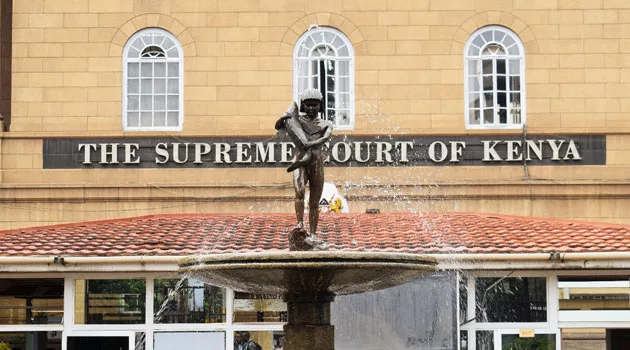
 The Supreme Court
 will today begin hearing a case pitting the Salaries and Remuneration Commission (SRC) against judges over a Sh10 million taxable car allowance.
The dispute has potential implications for thousands of state officers and the public wage bill, and could trigger demands that could see taxpayers foot tens of billions.
The case follows SRC's move to withdraw the allowance with the commission arguing it was introduced and increased outside its mandate to set and review pay and perks for state officers.
Advocate Peter Mwangi Gachuiri moved to court to challenge the withdrawal and has since been supported by the Kenya Judges Welfare Association and the Judicial Service Commission.
The High Court ruled in favour of the petitioner in May 2024 and the Court of Appeal dismissed SRC’s challenge in March, setting the stage for the latest battle at the apex court.
Beyond the legal questions, the dispute has drawn attention to the potential cost of the allowance, which could reach about Sh45 billion.
There are 4,543 state officers in the categories identified, with each eligible for Sh10 million in car allowance, should the petition succeed.
The estimate - of the potential exposure - is based on the number of officers multiplied by the current value of the disputed allowance.
The implications arise from the fact that the original arrangement covered other public officers besides judges, including senior officials in the Executive and Parliament.
The categories identified include 86 state officers in the Executive, 422 in Parliament, 91 in commissions and independent offices, 912 in the Judiciary, 130 in the military and 2,902 in county governments.
SRC, in a statement in March when it launched the current appeal, warned that the decision of the Court of Appeal placed an undue burden on Kenyan taxpayers.
It held that the orders, if left unchallenged, risked triggering a ripple effect as other state officers seek similar equity-based benefits.
Yesterday, a group of religious leaders and civil society organisations protested the allowance push, and called on the court and all constitutional institutions to uphold the Constitution.
The CSOs coalition warned in a press briefing that “Kenyans risk being fleeced by an unholy union of Parliament, the Executive and the Judiciary".
"No institution is above the Constitution. Judicial independence is indispensable, but it must never become judicial exceptionalism,” the group said.
“Let the Constitution bind everyone equally. Let public money serve the public good. Let no institution place itself above the people whose sovereignty gives it authority."
The allowance dates back to July 2011, when the Head of Public Service issued a circular providing for a taxable car allowance of up to Sh2 million for judges of the High Court.
It also covered permanent secretaries or accounting officers, the Clerk to the National Assembly and provincial commissioners.
The arrangement was introduced in place of a duty-free facility that had allowed certain constitutional office holders to purchase vehicles without paying the applicable duties.
The allowance was increased to a maximum of Sh5 million in June 2015 and Sh10 million in June 2018.
SRC said it became aware of the circulars in 2021 and questioned the authority under which the benefit had been introduced and revised.
On July 12, 2021, the commission wrote to the Head of Public Service seeking revocation of the circulars, arguing it had the sole mandate to set and review state officers’ salaries and benefits.
The commission maintained that continued payment of the allowance affected the affordability and sustainability of the public wage bill.
The withdrawal was subsequently challenged through a constitutional petition filed by Gachuiri in August 2023.
The petitioner argued that withdrawing the allowance meant violating the constitutional protections against varying judges’ remuneration and benefits to their disadvantage.
KJWA and JSC maintained that the benefit had existed before the 2010 Constitution and could not be withdrawn in the manner proposed by SRC.
The High Court agreed with the petitioner and quashed the decision to withdraw the allowance.
SRC appealed, but the Court of Appeal dismissed its challenge on March 25, 2026, leaving the commission to pursue the matter before the Supreme Court.
In its court papers, SRC warned that restoring the allowance could have wider consequences for the public wage bill if other state officers sought comparable benefits.
SRC also argued that judges already receive official transport, including government-provided vehicles, and said the additional allowance amounted to double compensation.
The commission’s position is that public transport benefits should be harmonised across state institutions to ensure fairness and fiscal sustainability.
The Judiciary’s transport arrangements also include retirement benefits.
The Judges’ Retirement Benefits Act, 2026, provides qualifying retired judges with a lump-sum transport allowance equivalent to one-seventh of their basic salary at retirement, payable for 120 months.
The law, enacted recently, also provides additional benefits for retired judges of the Supreme Court, including a driver and fuel allowance.
These benefits are separate from the taxable car allowance at the centre of the dispute.
INSTANT ANALYSIS
The Supreme Court hearing will therefore bring renewed attention to the framework governing public-sector remuneration, the cost of allowances and the potential implications for other state officers. The proceedings will determine the next stage in a dispute that has passed through two courts and now awaits consideration by top court in the land.