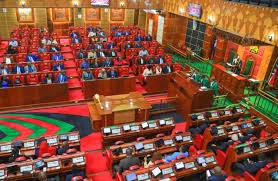
 MPs in session at Parliament Buildings
In its Budget Watch 2026 report, PBO says a multi-agency task force has already reconciled the liabilities and proposed a repayment framework, but its recommendations are yet to be implemented.
It cited the pending Senate action, saying the delay has allowed pension arrears to persist, exposed county governments to mounting liabilities and left employees uncertain about benefits earned during their working lives.
The report says administrative interventions alone cannot resolve the problem, calling for parliamentary consideration of the task force’s proposals and stronger enforcement of pension remittances.
The task force, formed in November 2024, proposed changes to pension calculations, structured repayment plans and legal reforms to ensure counties remit deductions collected from workers.
PBO wants the Senate to expedite consideration of the report and monitor implementation, including proposed amendments to the Public Finance Management Act and the Kenya Revenue Authority Act.
"The Senate should expedite the tabling and consideration of the Multi-Agency Taskforce Report on County Pension Arrears and monitor the implementation of its recommendations," PBO led by Martin Masinde said.
The pension crisis comes amid concerns over counties’
failure to remit statutory deductions, even as the money is deducted from
employees’ salaries.
As at December 2025, county governments owed Sh115.9 billion in pension contributions, including principal, interest, penalties and actuarial deficits.
County executive departments accounted for Sh103.2 billion, while water service providers owed Sh9.3 billion and county assemblies Sh3.2 billion.
The debt includes Sh94.6 billion accumulated after devolution began in 2013 and Sh21.3 billion inherited from defunct local authorities.
Nairobi is the biggest defaulter, owing Sh48.2 billion, followed by Mombasa at Sh19.1 billion.
The arrears are spread across three pension schemes notably LAPFUND, which is owed Sh57.9 billion, LAPTRUST at Sh48.5 billion, and CPF at about Sh9.5 billion.
Nyeri and Lamu have the lowest recorded liabilities, at Sh20.2 million and Sh23.1 million respectively.
The scale of the debt raises concerns about whether workers will receive their full retirement benefits when they leave public service.
PBO warns that pension deductions belong to employees and should be remitted to the relevant schemes. Failure to do so undermines their constitutional right to social security.
The budget team's report also highlights the risks facing pension schemes if county governments fail to settle their obligations.
They hold that pension schemes could rank as unsecured creditors, therefore exposing members to the risk of recovering only part of their benefits.
The concern is particularly significant for LAPTRUST, the only defined-benefit scheme among the three.
Such schemes are required to maintain full funding, making persistent shortfalls a threat to promised retirement benefits.
The report further cites Sh43.64 billion in unpaid salaries and unremitted statutory deductions that had remained outstanding for more than three years as of quarter three of 2025/26 financial year.
Nairobi City County accounted for more than 93 per cent of this backlog, pointing to the concentration of payroll-related liabilities in the capital.
PBO says delayed remittances have left some employees approaching retirement facing uncertainty over savings they contributed throughout their careers.
The task force proposed a repayment system based on the size of each county’s outstanding debt.
Under the plan, counties owing Sh300 million or less would clear their arrears within one year. Those owing between Sh300 million and Sh1.5 billion would pay through annual instalments over five years.
Nairobi and Mombasa, whose liabilities are significantly larger, would receive tailored repayment schedules.
The task force also proposed using the average annual 91-day Treasury bill rate to calculate interest and penalties, replacing the varying rates previously applied by pension schemes.
The changes were intended to standardise calculations and reduce the liabilities facing county governments.
Another proposal is to amend Section 109 of the Public Finance Management Act to make pension contributions a first charge on the County Revenue Fund.
The task force further recommended harmonising pension records into a single verified database and strengthening coordination among government agencies to improve monitoring and enforcement.
PBO wants the Senate to require regular reports from the National Treasury, the Controller of Budget, the Retirement Benefits Authority and county governments on remittances and progress in clearing arrears.
The proposed reforms would also support automatic remittance of pension deductions through integrated payroll systems, reducing the risk of money being withheld after it has been deducted from workers’ salaries.
Instant Analysis
The report warns that the growing arrears are not just a financial management problem, but a threat to the dignity and welfare of public servants in retirement. Without MPs' action and enforcement, counties could continue accumulating liabilities while employees bear the consequences of deductions that never reach their pension schemes.