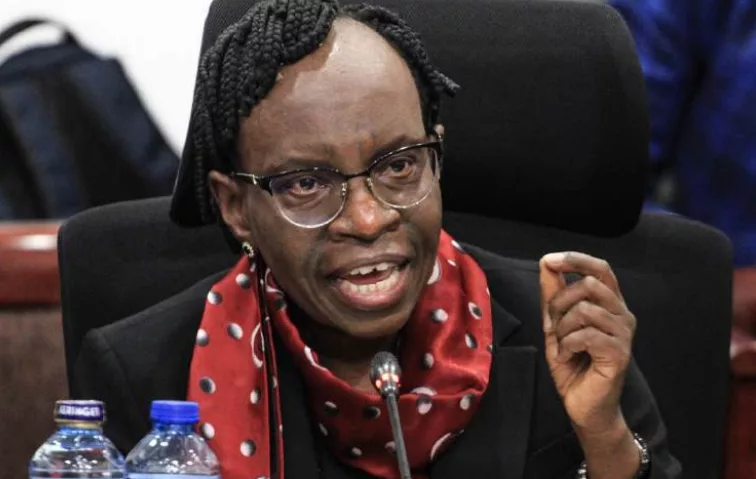
 Auditor General Nancy Gathungu appears before the Senate Committee on County Public Investments and Special Funds /HANDOUT
Auditor General Nancy Gathungu has flagged the Public Procurement Regulatory Authority (PPRA) over Sh911.1 million spent on training teachers and staff of public learning institutions.
The auditor has cast doubt on value for money in the expenditure after it emerged that the training programme covered only 34 constituencies, which is just a fraction of the country’s 290 constituencies.
Details show that PPRA trained 9,136 stakeholders and procurement practitioners in primary and secondary schools during the financial year ended June 30, 2025.
Gathungu said it was unclear whether the authority had adequate measures to extend the programme to the remaining constituencies “to ensure equity in capacity building”.
The concerns are contained in the Auditor-General’s report on the PPRA for the year ended June 30, 2025.
The training programme was introduced following concerns over increasing non-compliance with procurement laws in public learning institutions.
PPRA, in a circular dated November 9, 2023, directed all head teachers, principals and other officers performing accounting officer functions to ensure full compliance with procurement laws.
The National Treasury subsequently wrote to the PPRA on October 31, 2024, directing it to immediately commence capacity building for all stakeholders in public learning institutions.
The directive sought to ensure schools adhered to the Public Procurement and Asset Disposal Act and the accompanying regulations.
In response, the procurement authority embarked on training programmes targeting primary and secondary schools.
Documents reviewed by auditors showed that 9,136 stakeholders and procurement practitioners were trained at a total cost of Sh911,108,000.
This translates to an average expenditure of about Sh99,713 per participant.
However, the audit found that participants were drawn from only 34 constituencies, leaving most constituencies outside the programme, raising questions about the geographical reach of the initiative.
“In the circumstances, the effectiveness and value for money on capacity building undertaken on primary and secondary schools at a cost of Sh911,108,000 cannot be confirmed,” Gathungu said.
The finding raises questions about how the authority intended to ensure all public learning institutions got a chance to benefit from the training.
Schools are required to comply with the legal framework governing public procurement and disposal of assets when spending public funds.
Head teachers, principals and other designated accounting officers play a central role in ensuring procurement decisions and processes comply with the law.
The training was intended to equip these officials and other practitioners with the knowledge needed to apply procurement requirements in their institutions.
However, the limited coverage raises concerns about whether the programme reached enough schools to address the compliance challenges that prompted the intervention.
As many as 256 constituencies were not represented in the training during the period under review, amid uncertainty of plans to extend the initiative nationwide.
The report did not establish whether a subsequent programme had been planned or funded to reach the uncovered constituencies.
The limited coverage comes against the backdrop of growing scrutiny of how public schools manage taxpayers' money, with principals of some of the country's leading institutions appearing before MPs to answer audit queries.
In September, the National Assembly's Public Investments Committee on Governance and Education questioned principals of Alliance High School, Mang'u High School and Limuru Girls High School over additional charges imposed on parents without the required government approval.
Alliance High School was flagged for collecting Sh17.6 million in additional fees, while Mang'u High School charged Sh46,082 per student under its Parent Association Support Programme without approval.
At Limuru Girls, MPs questioned a Sh785,946 capitation discrepancy arising from differences between student enrolment records and figures captured in the National Education Management Information System.
The schools defended their decisions by citing funding shortfalls and the need to maintain standards, while legislators insisted that public institutions must comply with the law.
In another case, the Auditor-General questioned Asumbi Girls High School's transfer of Sh1.247 million to the Kenya Secondary School Heads Association, citing a lack of assurance over the recipient's financial controls.
The cases point out the financial management, documentation and compliance questions that school administrators are expected to address.
They also raise questions about whether the Sh911.1 million training programme reached enough institutions to strengthen compliance with procurement and public finance laws.
Schools receive public funds for teaching and learning materials, infrastructure, equipment and other operational needs.
Their spending is subject to procurement rules and public financial management requirements.
Head teachers and principals, as accounting officers or officials performing those functions, are expected to ensure that procurement decisions comply with the law and that expenditure is properly documented.
Failure to meet these requirements and discrepancies can
result in audit queries that school managers must explain and resolve.
INSTANT ANALYSIS
With only 34 of Kenya’s 290 constituencies represented, the programme left most schools outside the initiative meant to improve procurement compliance. The concerns are amplified by parliamentary hearings in which principals of leading schools have faced questions over unauthorised charges, capitation discrepancies and transfers of public funds.