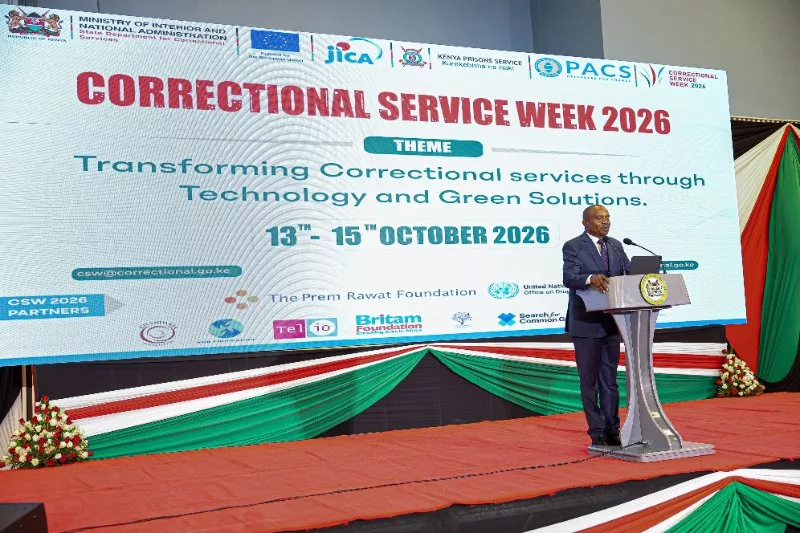
 DP Kithure Kindiki while opening the fourth Correctional Service Week in Nairobi/DPCS
Deputy President Kithure Kindiki has urged the State Department for Correctional Services to accelerate the adoption of artificial intelligence and other modern technologies to improve efficiency, rehabilitation and service delivery in prisons.
Kindiki said technologies such as artificial intelligence and secure digital communication could help correctional institutions improve operational planning, identify gaps in service delivery and allocate limited resources more effectively.
“Artificial intelligence, data analytics, secure digital communication and other emerging technologies offer significant opportunities to improve operational planning, identify service delivery gaps, support rehabilitation programmes and deploy limited resources more effectively,” he said.
The Deputy President spoke on Tuesday in Nairobi when he officially opened the fourth Correctional Service Week, calling for innovation in correctional institutions that is guided by the law and respects the rights of people under correctional supervision.
He cautioned that the adoption of new technologies must not undermine inmates' dignity, privacy or welfare, urging the department to ensure that digital initiatives are implemented responsibly.
“These technologies must be adopted responsibly. Innovation within correctional institutions must uphold human dignity, protect personal information, guard against discrimination and preserve the rights and welfare of people under correctional supervision,” Kindiki said.
He further called on the department to align its digital initiatives.
Among them are the National Digital Master Plan 2022–2032, the National E-Commerce Strategy 2023 and the National Artificial Intelligence Strategy 2025–2030, as well as applicable cybersecurity and data-protection frameworks.
The DP said technological improvements should go hand in hand with rehabilitation programmes designed to equip inmates with skills and support their reintegration into society.
Correctional institutions were urged to strengthen education, vocational training, psychosocial support, restorative justice and family participation, while expanding community-based alternatives to imprisonment.
“Our correctional institutions must therefore become not only centres of rehabilitation, but also platforms for skills development, innovation and sustainable production,” he said.
The Deputy President also called for correctional facilities to adopt environmentally friendly approaches in their operations, citing renewable energy, water harvesting, efficient waste management, climate-smart agriculture and tree growing as areas requiring attention.
His remarks were delivered under the theme of this year's Correctional Service Week, “Transforming Correctional Services through Technology and Green Solutions”.
Kindiki urged the department to develop productive farms, improve irrigation systems, promote agricultural mechanisation and expand waste-recycling initiatives, alongside increasing the use of clean energy.
“I urge you to develop productive farms, strengthen irrigation and agricultural mechanization, promote appropriate waste-recycling initiatives and expand the use of clean energy,” he said.
The proposals seek to combine digital innovation with sustainable practices in correctional facilities, while maintaining a focus on rehabilitation and the welfare of inmates.
Kindiki's call places emphasis on using emerging technologies not only to improve the administration of correctional institutions but also to support rehabilitation programmes and the efficient use of public resources.
He said innovation should remain anchored in legal safeguards and responsible practices as correctional services pursue technological and environmental improvements.