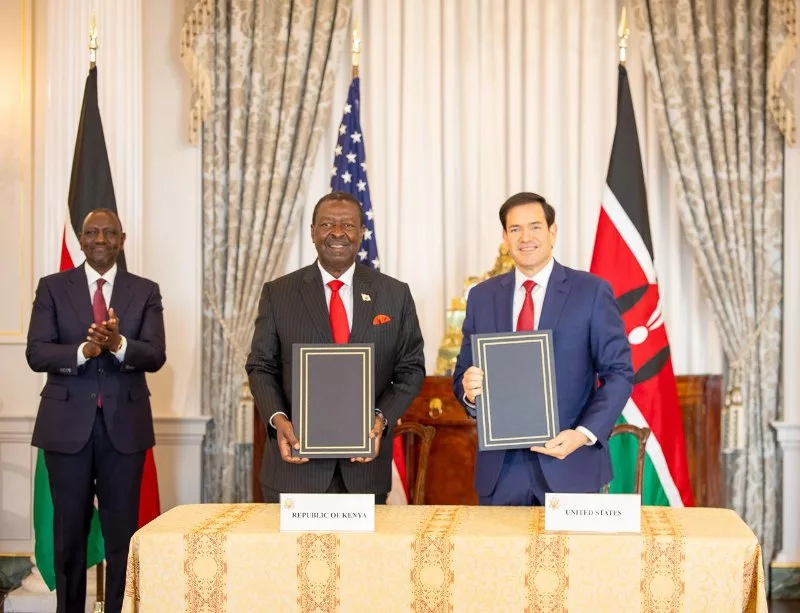
 President William Ruto last year, during the signing of the agreement with the US Government for Sh208bn over the next five years/PCS
The Court of Appeal has lifted orders blocking the implementation of the health cooperation framework between Kenya and the United States, allowing the programme to proceed pending the hearing and determination of an intended appeal.
Justices Luka Kimaru, Munyao Sila and Dr Johnson Okello set aside conservatory orders issued by the High Court in December 2025, which had stopped the government from implementing the agreement signed on December 4, 2025.
The $1.6 billion (Sh208 billion) health cooperation deal was signed by Kenya and the United States last year, with President William Ruto witnessing the signing in the United States.
The Attorney General and the Cabinet Secretary for Health, who challenged the High Court decision, argued that suspending the framework would disrupt critical treatment for about 1.4 million Kenyans receiving support for HIV, tuberculosis (TB), malaria and other infectious diseases.
They warned that the suspension could affect essential health interventions, including immunisation, and expose patients receiving HIV and TB treatment to drug resistance if their medication was interrupted.
The government also argued that the High Court had issued the orders despite a similar petition in which conservatory orders had already been granted, raising concerns about the sub judice rule.
However, Busia Senator Okiya Omtatah Okoiti and Katiba Institute opposed the application, contending that implementing the framework would raise constitutional concerns relating to data protection, public finance, devolution and Parliament’s oversight of international agreements.
Omtatah maintained that the deal created financial commitments and regulatory obligations requiring parliamentary scrutiny and approval.
He also questioned whether a data protection impact assessment had been conducted before the agreement was signed and implemented.
In their ruling, the appellate judges found that the government had raised arguable grounds of appeal.
The judges also gave significant weight to the potential impact on patients who depend on the programme, finding that public interest favoured allowing implementation while the appeal was pending.
“If you balance the arguments of the 1st and 4th respondents (Omtatah and Katiba Institute), and balance that with the health concerns of the citizens who will benefit under the Framework and whose health will be adversely and negatively affected, we are of the considered view that public interest favours the implementation of the programme pending hearing of the appeal,” the court stated.
The judges warned that continued suspension could have irreversible consequences for patients relying on treatment under the arrangement.
“The lives of citizens who depend on treatment for HIV, TB, and malaria, provided under the Framework risk being negatively and irredeemably impacted. Some even risk losing their lives, which is an irreversible consequence,” the ruling stated.
The court noted that the High Court had not declared the framework unconstitutional but had stopped its implementation pending determination of that question.
“What the High Court did was to stop its implementation pending hearing of the question whether or not the same was unconstitutional,” the judges observed.
The appellate court did not determine the constitutionality of the agreement, leaving those issues for consideration in the intended appeal or the substantive petition pending before the High Court.
The ruling allows implementation to proceed while the legal challenge remains unresolved.