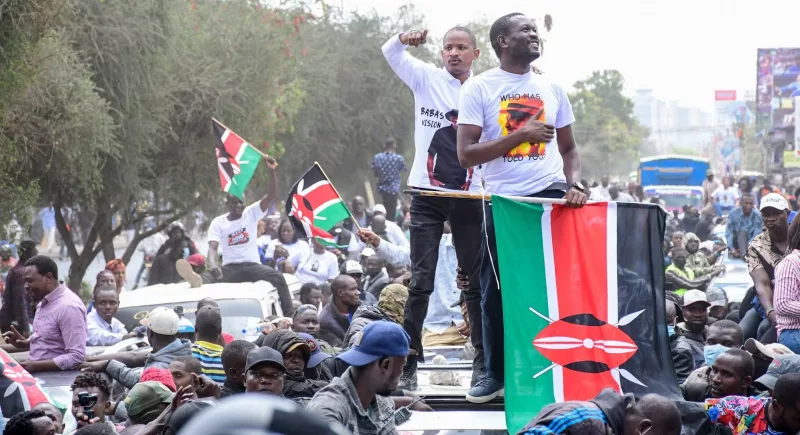
 Nairobi Senator Edwin Sifuna and Embakasi East MP Babu Owino at a past political rally /HANDOUT
The endorsement of Nairobi Senator Edwin Sifuna as the 2027 presidential flagbearer of The Equitable Party (TEP) has opened a new chapter in his political career, placing him in the spotlight as he seeks to transform his growing national popularity into a sustainable political movement.
For the first-term senator and lawyer, the endorsement marks a significant shift from his role as a vocal opposition figure to that of a potential presidential contender.
However, whether he can translate his newfound prominence into lasting political influence remains an open question.
Sifuna’s national profile grew following the death of Orange Democratic Movement (ODM) leader Raila Odinga on October 15, 2025, after months of internal party disagreements over the direction of its relationship with President William Ruto’s administration.
When Raila entered into a political pact with Ruto on March 7, 2025, Sifuna was among his allies who opposed the arrangement.
Others were MPs Babu Owino (Embakasi East), Caroli Omondi (Suba South), Caleb Amisi (Saboti), Siaya Governor James Orengo among other leaders.
Their position contrasted with that of leaders who backed Raila’s partnership with Ruto, which paved the way for the formation of the broad-based government.
Among those who supported the arrangement are National Assembly Minority Leader Junet Mohamed, Nyando MP Jared Okello, Siaya Senator Oburu Oginga (who would later become ODM leader) and Lang’ata MP Felix Odiwuor (Jalang’o) among others.
Following Raila’s death, the differences deepened, splitting ODM into two rival political formations: the Sifuna-led Linda Mwananchi faction and the Oburu-led Linda Ground camp.
Sifuna and his allies have maintained that Raila never committed to supporting Ruto’s re-election in 2027, while Oburu’s faction insists that the late opposition leader had agreed to back the President until the next general election.
Oburu’s camp also includes Cabinet Secretaries Opiyo Wandayi (Energy), Hassan Joho (Mining), Wycliffe Oparanya (Co-operatives) and John Mbadi (Finance).
Against this backdrop, Sifuna and his allies embarked on countrywide political rallies critical of Ruto’s administration, presenting themselves as defenders of Raila’s political legacy and insisting that the former Prime Minister’s ideals remain alive.
The divisions have occasionally drawn in Raila’s family, including his eldest daughter, Winnie Odinga, an East African Legislative Assembly (EALA) MP.
She initially appeared sympathetic to the younger politicians before eventually declaring support for the President, although some observers have characterised her position as half-hearted.
The Linda Mwananchi faction has expanded its presence through rallies in several parts of the country, seeking to establish a following beyond its traditional political strongholds.
Its activities have included gatherings in Nairobi, including Jacaranda Grounds, as well as Mombasa, Nakuru, Vihiga, Kisumu, Machakos and Kiambu counties, where it has held meetings in Thika.
The group has also visited Kisii and Keroka, Nyahururu in Laikipia County, and several locations in Taita Taveta, including Mwatate, Wundanyi and Voi.
In western Kenya, the rallies have extended to Kitale in Trans Nzoia County, Posta Grounds in Bungoma, Amalemba Grounds in Kakamega, Busia County and parts of Homa Bay County, including Homa Bay Town, Nyandiwa and Sindo.
The faction has also held political meetings in Meru county, reflecting its efforts to reach audiences outside the constituencies traditionally associated with ODM.
However, the growing geographical reach of the rallies does not necessarily translate into a firm electoral base.
Sifuna’s challenge will be to convert attendance at political gatherings and public visibility into an organised movement capable of sustaining itself beyond the current divisions within ODM.
Political analysts caution that sudden national prominence does not always translate into enduring political influence.
Several politicians have previously attracted considerable public attention before struggling to maintain the same level of visibility or translate it into a lasting political following.
They include People's Liberation Party leader Martha Karua, whose national profile received a boost when she became Raila’s running mate in the 2022 presidential election; Charity Ngilu, who contested the presidency in 1997; and Peter Kenneth, who ran for the top seat in 2013.
Others include former Nandi Hills MP Alfred Keter, who gained prominence through his opposition to Ruto in the Rift Valley; and former Cabinet Minister Raphael Tuju, who was associated with former President Mwai Kibaki’s political camp in 2007 despite Raila enjoying considerable support in Luo Nyanza.
Sifuna’s endorsement as TEP’s presidential flagbearer also places him among the opposition figures seeking to shape the political contest ahead of 2027.
The opposition’s leading figures include Wiper Patriotic Front leader Kalonzo Musyoka, Democracy for the Citizens Party leader Rigathi Gachagua, Karua, Democratic Party leader Justin Muturi, Jubilee Party presidential hopeful Fred Matiang’i and Democratic Action Party-Kenya leader Eugene Wamalwa.
His new position could broaden his political profile, but it also raises questions about how he intends to distinguish himself from the other opposition leaders and establish a clear political identity.
Political analyst Jeff Machira says Sifuna must focus on grassroots mobilisation rather than relying heavily on the attention generated by social media.
“Sifuna has to be a ground politician. He has to avoid the social media hype to ensure that he reaches both the elites and the commoners at the grassroots,” says Machira.
Machira argues that politicians who experience a sudden surge in popularity often struggle because they fail to develop strategies for sustaining public interest.
“Most politicians are hypnotised by newfound fame and forget that they have to cultivate it over time. That’s the real task ahead for Sifuna,” he says.
Another analyst, Kipkorir Mutai, says Sifuna needs to build a solid political base that gives him a distinct identity beyond his association with Raila and the youth movement.
“To maintain his political fame, Sifuna has to identify and build a political base, as Raila Odinga did with Luo Nyanza, Kalonzo with Ukambani or Ruto with the Rift Valley. While his current political identity is the youth, he needs to build and command it,” he says.