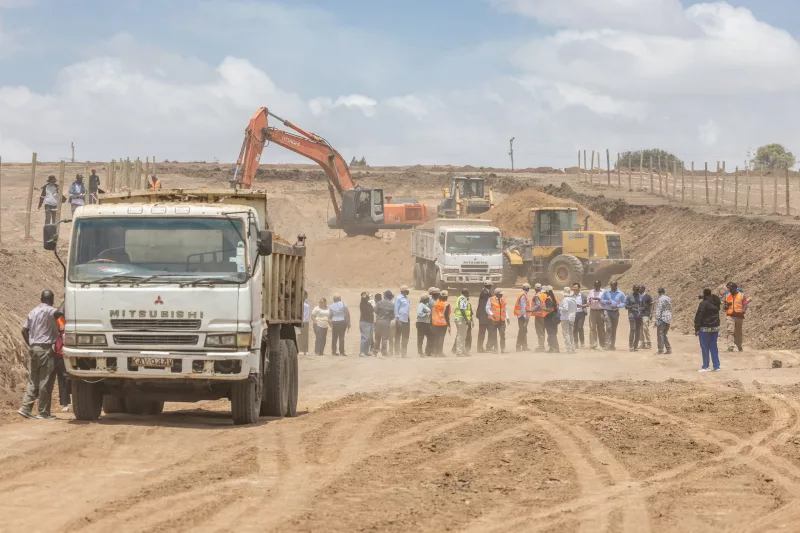
 Ongoing construction works in Narok/PCS
The government has set aside Sh25 billion to compensate landowners affected by the construction of the Narok-Bomet-Kisumu section of the Naivasha-Kisumu-Malaba Standard Gauge Railway (SGR).
Kenya Railways Corporation managing director Philip Mainga said the National Land Commission was conducting public participation ahead of compensation negotiations with affected landowners.
Mainga, who spoke during an inspection tour of Narok on Friday, said the commission had also granted Kenya Railways early access to some sections of land to allow construction to proceed as valuation and compensation negotiations continue.
“The National Land Commission is conducting public participation with affected communities as we prepare for compensation and the next phase of construction,” Mainga said.
Affected landowners have expressed willingness to participate in the process, raising hopes for smooth negotiations as the government advances the railway project.
Speaking during a public participation session, Mzee Stephen Ruto, a resident of Kapkesosio village, said the community welcomed the railway, saying it would open up the region to new economic opportunities.
“We welcome this project because it will connect Bomet to the rest of the country, the East African region and beyond,” Ruto said.
Construction of the SGR Phase 2B is picking up pace, with Narok among the areas where works started early.
The railway will cover approximately 98 kilometres in Narok County, while the wider corridor will pass through Bomet, Nyamira, Kericho, Homa Bay and Kisumu counties.
Mainga said the project is being developed as an economic belt, with logistics hubs and value-addition facilities planned along the railway corridor to support local industries and improve market access.
In Narok, the focus will be on agriculture, livestock and tourism, while Bomet and Kericho are expected to benefit from logistics hubs targeting the tea sector.
Kisumu will have a logistics hub focused on fish, including facilities to support storage and transportation to other markets.
The railway is also expected to ease the movement of locally produced commodities, including tea, coffee and sugar, to the Port of Mombasa for export.
The government is banking on the project to stimulate economic activity along the route, create employment opportunities and support small businesses under its Bottom-Up Economic Transformation Agenda.
The compensation process is expected to be a key step in securing the land needed for construction while addressing the interests of communities affected by the project.
President William Ruto launched construction of the railway on March 19, 2026, with the project expected to take approximately two years to complete.
The Narok railway station is expected to be partially complete by June next year, as construction progresses along the corridor.
Once completed, the line is expected to strengthen transport links between western Kenya and the coast, providing an alternative for moving goods and supporting trade within the region.