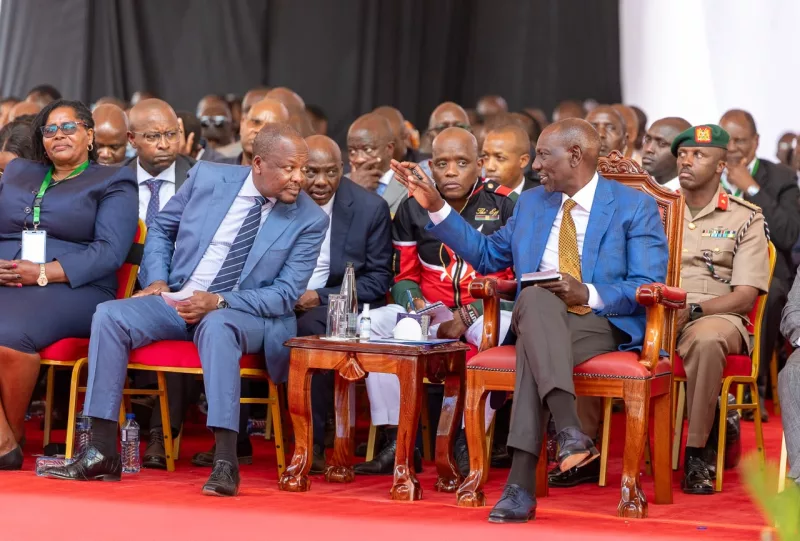
 President William Ruto talking to Agriculture Cabinet Secretary Mutahi Kagwe during the Agriculture and Food summit at Jamhuri park/PCS
President William Ruto has defended changes to the management of state corporations, saying separating politicians from profit-making government enterprises will help shield businesses from political interference and improve performance.
Ruto said the government had changed the law to prevent politicians from serving as directors of commercial state-owned enterprises, arguing that political interests often complicate decisions that should be guided by business objectives.
Speaking during the Agriculture and Food Security Summit at Jamhuri Park in Nairobi, the President said appointments to state corporations should not be used to accommodate politicians who lose elections.
“Shida ya serikali saa zingine ni kufanya watu wameanguka kura wakuwe directors. Wale wanafanywa directors huko ni wanasiasa,” Ruto said.
He questioned whether losing an election automatically made someone suitable to manage a commercial enterprise, saying the government needed to prioritise competence and the interests of the business.
“Mtu ameanguka kura kweli anaweza kufanya biashara ifaulu?” he posed.
Ruto said the changes were intended to distinguish political leadership from the management of government-owned enterprises whose primary objective is to generate profits.
“Tumeweka government-owned enterprises na tumesema huko kwa profit-making enterprises za serikali mwanasiasa hawezi kuwa director,” he said.
The President defended the decision against criticism that it unfairly targets politicians, saying the concern was not their professional abilities but the competing interests that could arise when political loyalties influence corporate decisions.
“Sio ati tunasema wanasiasa wako na shida, they are professionals, lakini interests inasumbua,” he said.
He explained that politicians serving on company boards could face pressure from supporters seeking favours or decisions that might compromise the commercial interests of the enterprises.
“Mtu alimpigia kura anakuja hapo anamwambia fanya hivi, fanya namna hii, halafu nitakupigia kura siku ingine,” Ruto said.
The President argued that such demands could interfere with the independent decisions required to run businesses successfully, creating challenges for institutions expected to operate efficiently and account for public resources.
The reforms are part of efforts to change how government-owned enterprises are managed, with a greater emphasis on commercial performance and professional decision-making.
State corporations operate across key sectors of the economy, including agriculture, energy, transport and finance.
Their performance can affect government finances, service delivery and the availability of resources for development.
Ruto's defence signals his administration's intention to limit political considerations in appointments to profit-making state enterprises.
However, the impact of the changes will depend on how the new legal provisions are implemented and whether board appointments consistently prioritise relevant expertise, accountability and the commercial objectives of the institutions.