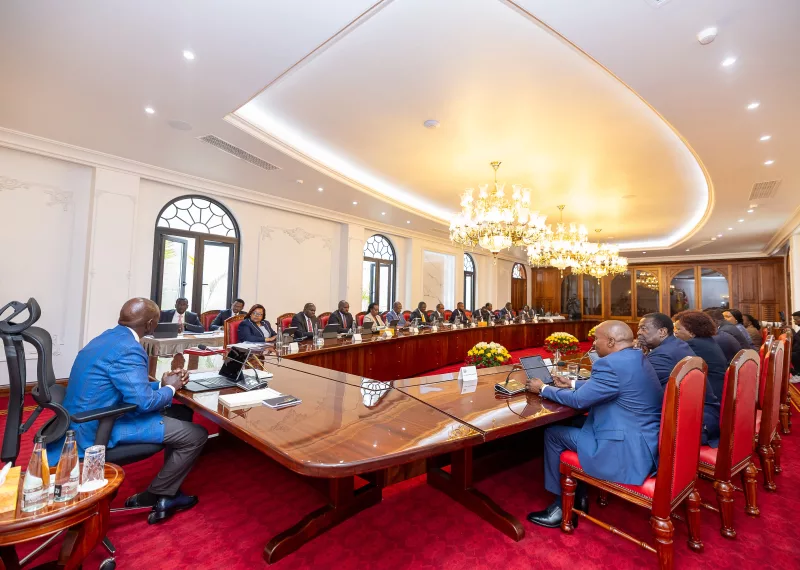
 President William Ruto chairs a Cabinet meeting at State House, Nairobi on October 9, 2026/PCS
The Cabinet has approved a raft of legislative and policy proposals targeting prison overcrowding, construction safety, farmers’ earnings and access to insurance as the government seeks to strengthen regulation and improve service delivery.
Among the measures endorsed are the Prisons Bill, 2026, the Probation of Offenders Bill, 2026, and the Architectural and Quantity Surveying Practitioners Bill, 2026, which seek to modernise correctional services and tighten oversight of construction professionals.
The proposed prison laws seek to safeguard prisoners’ rights and expand rehabilitation programmes.
"It sets the stage for an overhaul of Kenya’s correctional system to align it with the Constitution, safeguard prisoners’ rights and tackle overcrowding," the Cabinet dispatch reads in part.
The reforms will also promote alternatives to imprisonment for eligible offenders, shifting the focus from punishment alone to rehabilitation and reintegration into society.
The Cabinet said the measures would help address overcrowding while improving prison conditions and strengthening the rehabilitation of offenders.
The proposed changes come amid efforts to reform the justice system by promoting approaches that support the reintegration of offenders into society while safeguarding public safety.
On construction safety, the Architectural and Quantity Surveying Practitioners Bill, 2026, seeks to replace the existing law dating back to 1934 and introduce stricter controls on professional practice.
The Bill proposes mandatory annual practising licences and gives a new regulatory board powers to inspect construction sites and strengthen professional oversight.
It also extends regulation to landscape architects, interior designers and construction project managers.
Unqualified practitioners and those who make false registration or licensing claims could face penalties of up to Sh2 million or two years in prison.
The measures are intended to strengthen accountability in the construction industry and protect the public from risks associated with unqualified professionals.
Farmers’ earnings
The Cabinet also approved the Geographical Indications Bill, 2026, and the Warehouse Receipt System (Amendment) Bill, 2025, in a move aimed at improving farmers’ earnings and access to markets.
The Geographical Indications Bill seeks to protect distinctive Kenyan products from imitation, allowing producers to build market recognition and potentially secure better prices locally and internationally.
The warehouse receipt reforms will strengthen certified storage systems, reduce post-harvest losses and enable farmers to use stored produce as collateral when seeking credit.
The changes are also intended to reduce pressure on farmers to sell their harvests immediately after harvesting, when prices may be unfavourable.
Under the proposed framework, farmers could store their produce in certified facilities and use warehouse receipts to access financing while waiting for better market conditions.
The reforms are expected to strengthen agricultural value chains and improve access to formal financing for producers.
Insurance reforms
On financial protection, the Cabinet adopted the National Insurance Policy, 2026, which seeks to make insurance more affordable and accessible, particularly for farmers, informal sector workers and small businesses.
The policy comes against a backdrop of low insurance penetration, estimated at 2.45 per cent.
It proposes stronger consumer protection, tighter oversight of insurers, fairer business practices and measures to combat insurance fraud.
The government also plans to expand digital insurance services and strengthen the industry’s capacity to cover climate-related disasters and other emerging risks.
The policy is intended to help households and businesses manage financial shocks that could otherwise undermine their livelihoods and operations.
By broadening access to insurance, the reforms seek to increase the number of Kenyans protected against unexpected losses while strengthening confidence in the sector.
Business and investment
The Cabinet further endorsed measures to simplify business licensing, reduce unnecessary regulatory barriers and improve the environment for investors.
It also supported the establishment of a European Bank for Reconstruction and Development office in Nairobi, a move expected to expand access to investment financing and strengthen economic cooperation.
Other decisions included double taxation agreements with Belgium and the Czech Republic, alongside proposed space cooperation with South Africa and Kazakhstan.
The tax agreements are intended to strengthen economic ties and provide a framework for addressing tax issues affecting cross-border business and investment.
The space cooperation arrangements are expected to create opportunities for collaboration in the growing space sector.
The measures form part of a broader package of legislative, regulatory and policy decisions spanning justice, construction, agriculture, financial services and investment.
The proposed Bills will be subject to the relevant legislative processes before becoming law.