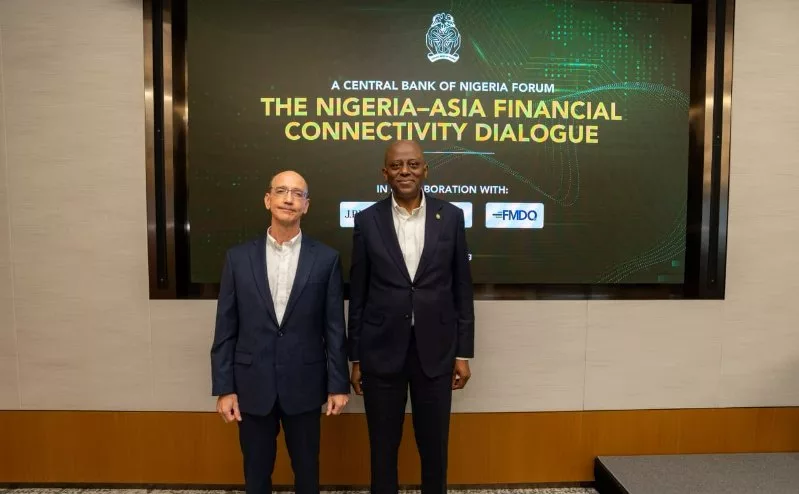
 L-R: Randall Duran, CEO of Catena Technologies and Senior Lecturer of Information Systems at Singapore Management University; Dr Olayemi Cardoso, Governor of the Central Bank of Nigeria/HANDOUT
Nigeria’s recovery from a foreign exchange crisis offers Kenya a lesson in rebuilding investor confidence that financial stability requires strong reserves, credible reforms and predictable policies.
The country’s net foreign reserves have risen to $46 billion from less than $1 billion at their lowest point, while inflation has fallen from above 30 per cent in 2023 to about 15 per cent, according to Central Bank of Nigeria Governor Olayemi Cardoso.
“The gains reflect reforms aimed at restoring stability after years of foreign exchange shortages and declining investor confidence,” Cardoso said at the Nigeria-Asia Financial Connectivity Dialogue in Singapore on October 8.
For Kenya and other African economies competing for global capital, Nigeria’s recovery raises a critical question: can economic reforms deliver lasting stability and convince investors that the risks of doing business are manageable?
Cardoso said the turnaround had been supported by tighter monetary policy, changes to the foreign exchange market and reforms to strengthen commercial banks.
The experience underscores the importance of predictable regulations and functioning currency markets, which allow businesses to plan and investors to commit capital with greater confidence.
Nigeria also demonstrated the importance of domestic financing. Cardoso said about 72 per cent of funds raised by Nigerian banks during a recapitalisation exercise came from local sources.
For Kenya and its East African neighbours, strengthening domestic capital markets and mobilising local savings could reduce reliance on foreign financing and protect businesses from sudden shifts in international investment flows.
Nigeria is also seeking Asian investment in financial technology and digital services, an area where Kenya has established a strong presence. Cardoso said regulators must encourage innovation without compromising financial stability.
“We don’t go too far as to stifle innovation, and at the same time, we don’t go too far in the other direction to find that regulation is lax,” he said.
The message is relevant to Kenya’s digital finance sector, where clear regulations that protect consumers while allowing businesses to innovate could sustain investor interest.
Cardoso also urged governments to maintain consistent policies, arguing that Nigeria’s population and access to African markets offered opportunities for foreign businesses.
“What we bring to the party is scale,” he said.
However, market size alone does not guarantee investment. Kenya and other East African economies must combine regional market potential with reliable institutions, efficient cross-border transactions and fewer barriers to trade.
Deeper regional integration could make East Africa more attractive to investors seeking opportunities across multiple markets, particularly in manufacturing, energy, transport and digital services.
Cardoso also highlighted coordination between monetary and fiscal authorities, noting that Nigeria’s central bank and Ministry of Finance had signed a memorandum of understanding to strengthen cooperation.
For Kenya, the lesson is not to copy Nigeria’s reforms wholesale, but to build credible institutions, maintain policy consistency and strengthen financial buffers.
Nigeria is using its improved reserves to persuade Asian investors that it offers a more stable business environment.