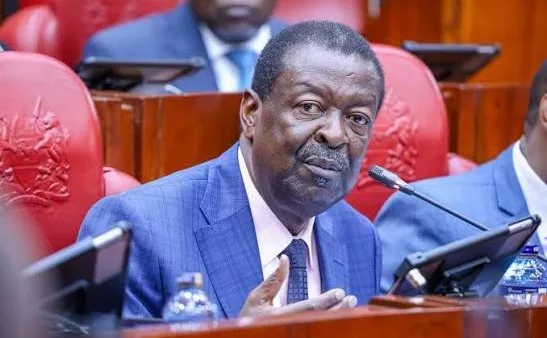
Prime Cabinet Secretary Musalia Mudavadi/ FILE
Prime CS Musalia Mudavadi yesterday clashed with families of Kenyans trapped in the Russia-Ukraine war over the number of citizens caught up in the conflict.
This is even as Mudavadi, who doubles up as Foreign Affairs CS, lifted the lid on the challenges the government faces in tracing and bringing them back home.
Appearing before a joint sitting of the Senate Security and Labour committees, Mudavadi said the government had records of 354 Kenyans involved in the conflict.
But the families who petitioned the Senate, led by Peter Kamau, said they had compiled a list containing 841 names.
“There is enough information that is available to prove that the numbers from the Ministry of Foreign Affairs are grossly understated,” Kamau told the senators.
However, the PCS admitted that the number could be higher than the formal figures, given the challenges the State faces in tracing the citizens.
The confrontation came as senators demanded answers on the whereabouts of Kenyans who travelled to Russia after being promised jobs but ended up in military operations.
Some have been killed, others are missing and at least five are being held as prisoners of war in Ukraine.
Isiolo Senator Fatuma Dullo and Murang’a Senator Joe Nyutu chaired the joint meeting at Parliament Buildings on Thursday.
The lawmakers heard that the government’s figure could be significantly lower because many Kenyans travelled without informing either their families or authorities.
Mudavadi said the government’s records showed that 77 Kenyans are on the frontline, 38 in camps, 52 in unknown or unclassified locations and 84 killed or missing in action.
Another 34 Kenyans are hospitalised, 60 have been repatriated, one is in detention and five are prisoners of war.
“Those are the ones who have been established. That brings the figure to 354,” Mudavadi said.
But Kamau challenged the government’s records, triggering heated exchanges during the meeting.
Mudavadi said the petitioners' list had not been furnished to his ministry, making it impossible for him to authenticate the names.
“We need to check with embassies. We need to check with immigration. Did these people leave or did not leave? Did they leave through the Kenyan ports or are they in another country and then moved from another country?” the CS said.
“We want to give an honest, candid and verifiable response,” he said, offering to return before the committee after examining the list.
Nairobi Senator Edwin Sifuna opposed delaying the petition, saying families were suffering while Parliament debated procedure.
“The Prime Cabinet Secretary has told us that there could actually be deceased Kenyans rotting somewhere in a field,” Sifuna said.
“These petitioners are agonising every single day. I know where my daughter is right now. I’ll go home and I’ll find her there. These petitioners are asking Parliament to help them find where their children are.”
Dullo ruled that the petition would proceed, while the additional documents submitted by the petitioners would be forwarded to Mudavadi’s ministry for verification.
Mudavadi went ahead to give a grim reality of the challenges the government faces in tracing Kenyans inside the war zone.
He said some recruits travelled without notice, leaving officials to “chase after the event”.
“Some of the people we are dealing with left even without informing their own families where they were going. Let alone informing the government of Kenya,” he said.
“These are the painful truths. But they are our citizens. We still have to look for them.”
He said Kenya had no military capacity to enter Russian or Ukrainian territory to rescue its citizens, and was, therefore, dependent on diplomatic channels.
He said the geographical scale of the conflict was another major obstacle, noting that the fighting was taking place far from Moscow, where Kenya’s embassy is located.
"The size of Africa is 30 or 32 million square kilometers. The size of Russia is 17.2 million square kilometers. The battle that is taking place is not taking place in Moscow," Mudavadi said.
"It's taking place thousands of kilometers away from Moscow, where our embassy is. These are the difficulties. But we are not abandoning our role."
The government has also struggled to establish the fate of Kenyans reported missing in action because Ukrainian authorities cannot provide information about people in territories outside Kyiv’s control.
Mudavadi said there were fears that more Kenyan remains could be lying in combat zones in the Donetsk region.
He also disclosed that Russia had told Kenya it could not meet the cost of repatriating the remains of deceased Kenyans.
This has forced the government to handle repatriation and burial arrangements on a case-by-case basis, including obtaining DNA samples from relatives where bodies have been badly mutilated.
Mudavadi said Kenya had so far facilitated the return of 62 Kenyans involved in Russia’s military operation.
Those brought back are accommodated at the Kenyan embassy in Moscow, provided with food and assisted with air tickets home.
However, he acknowledged that the country lacks a dedicated fund to deal comprehensively with such emergencies.
“There’s no law, no fund that is designated for this,” Mudavadi said.
He said the government was proposing a welfare fund under a new legal framework to enable Parliament to allocate resources for future interventions.
The government has also sought to prevent further recruitment through diplomatic pressure.
Mudavadi said his March 2026 visit to Moscow secured Kenya’s inclusion on Russia’s 'Stop List', which prevents further enlistment of Kenyan nationals into the country’s military operations.
He said Russia had confirmed that no additional Kenyans had been enlisted since the measure was implemented.
For Kenyans already serving, however, the Russian authorities have said requests to terminate military contracts would be considered individually by military commanders.
This has frustrated efforts to secure the mass release of Kenyans wishing to leave the conflict.
Mudavadi said Kenya was also seeking the release of the five Kenyans being held as prisoners of war in Ukraine through diplomatic negotiations and possible prisoner exchanges.
Four other Kenyan remains are reportedly in Ukrainian custody, although officials fear there could be more in areas controlled by Russian forces.
Petitioners have argued that some Kenyans were recruited through false promises of civilian employment and should be treated as victims of human trafficking rather than simply as combatants.
The government is also pushing legislation to tighten regulation of recruitment agencies, including stronger penalties and registration of legitimate recruiters.