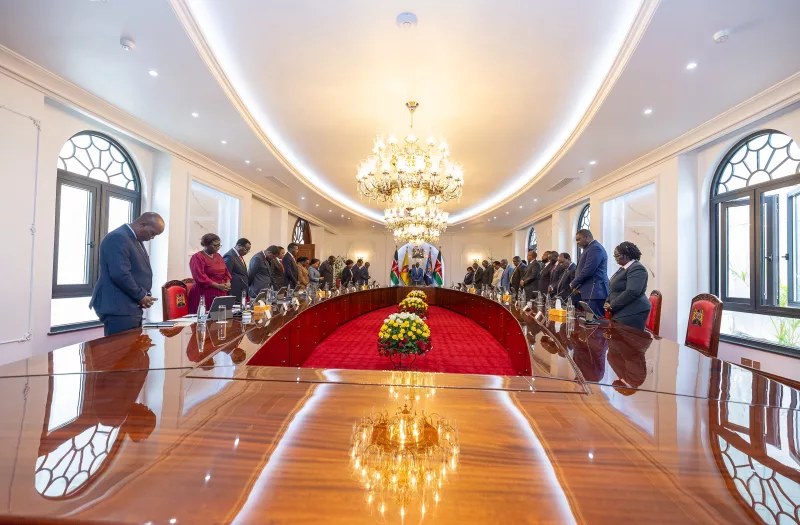
 Cabinet meeting chaired by President William Ruto at State House on October 9, 2026/PCS
The Cabinet has approved a major hospital infrastructure programme that will see the construction of a new 2,000-bed Moi Teaching and Referral Hospital and a 1,000-bed Level Six hospital in Mombasa as the government moves to expand access to specialised healthcare.
The programme will also see 13 Level Five hospitals expanded by an additional 300 beds each, in an investment aimed at easing congestion in referral facilities and bringing specialised treatment closer to patients.
According to a Cabinet dispatch, the expansion is intended to strengthen referral services, increase hospital capacity and accelerate the delivery of Universal Health Coverage.
“The investment will significantly expand hospital capacity, reduce congestion at referral facilities and bring specialised healthcare closer to Kenyans,” the dispatch stated.
The 13 counties targeted for the Level Five hospital expansions are Mandera, Marsabit, Turkana, Kilifi, Embu, Nakuru, Laikipia, Migori, Nyamira, Baringo, Bomet, Narok and Kisii.
The planned expansion will add 3,900 beds across the 13 facilities, increasing their capacity to accommodate more patients and support the delivery of specialised services at county level.
The new Moi Teaching and Referral Hospital is expected to provide additional capacity for specialised treatment, while the proposed Level Six facility in Mombasa will strengthen referral services along the Coast.
The programme comes amid efforts to reduce pressure on major referral hospitals, where demand for specialised services can strain available beds, equipment and personnel.
Cabinet also endorsed a separate Sh8 billion healthcare programme to be implemented in partnership with France, focusing on specialised head and neck surgical services.
The initiative will establish and equip specialised surgical units at Kenyatta National Hospital, Moi Teaching and Referral Hospital and the University of Nairobi Dental Hospital.
The programme is expected to strengthen the country's capacity to diagnose and treat head and neck conditions, including cancers requiring specialised surgical intervention.
“The initiative will strengthen cancer treatment and train 5,000 community health workers, reinforcing Kenya’s Universal Health Coverage efforts,” the dispatch stated.
The training component is expected to support community-level healthcare by equipping health workers with additional skills to assist in the delivery of services and strengthen links between communities and referral facilities.
The two programmes form part of the government's broader healthcare expansion agenda, which seeks to improve access to specialised treatment while strengthening services at different levels of the health system.
However, the Cabinet announcement did not specify the construction timelines, implementation schedules or completion dates for the planned facilities and expansions.
The delivery of the projects will depend on implementation arrangements, funding and the availability of healthcare personnel and equipment to support the additional capacity.