
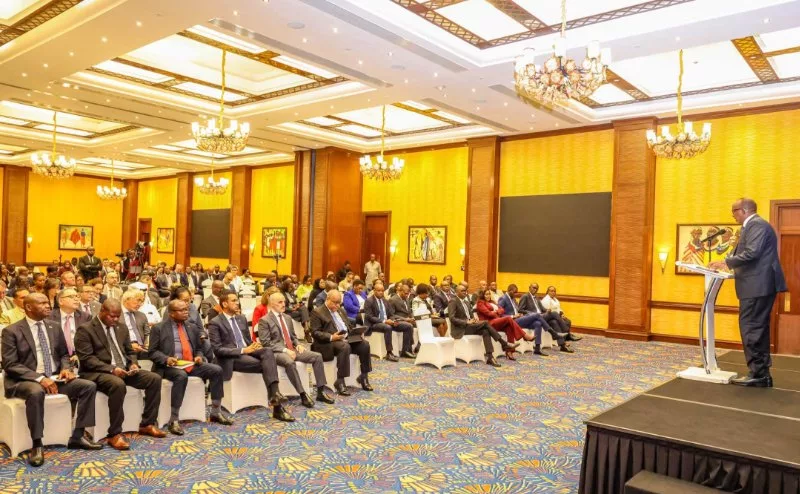
 Health CS Aden Duale with diplomats in Nairobi.
Health CS Aden Duale has asked foreign governments not to impose any travel restrictions on Kenya, saying the single ebola infection was an imported case and there is no outbreak in the country.
Duale said Kenya remained safe for travel, tourism, trade and investment and urged other countries to base their decisions on scientific evidence rather than fear.
“I urge the international community to base its decisions on verified epidemiological information, science and established international public health principles," he said.
The CS said disproportionate restrictions on travel and trade can cause significant social and economic disruption without necessarily providing additional public health protection.
"I encourage airlines to continue operating, tourists to continue visiting Kenya, businesses to maintain their operations and our regional and international partners to sustain normal trade and investment," Duale said.
"We will remain transparent and continue sharing verified information with the public, neighbouring countries and international partners as the situation evolves.”
Duale’s appeal came after several foreign governments updated travel advice following confirmation of Kenya’s first imported ebola case.
The UK Foreign, Commonwealth and Development Office updated its Kenya travel advice on October 6 to include information on the ebola case.
It advises travellers to follow Kenyan health authorities and monitor updates from the Ministry of Health.
The UK notice does not advise against travel to Kenya because of ebola.
Canada has also added an ebola outbreak-monitoring notice to its travel information for Kenya.
Its overall advice remains for travellers to exercise a high degree of caution because of terrorism and crime, rather than an ebola-related travel ban.
The US travel advice for Kenya also contains information on ebola screening and health requirements for some travellers.
Its Kenya advisory remains at its existing level and is not a new blanket warning against travel to the country because of the Ebola case.
The World Health Organization on Wednesday also warned against any travel or trade restrictions.
“WHO advises against any restriction of travel to, or trade with, the Democratic Republic of the Congo, Uganda or Kenya based on the currently available information,” the agency said.
“WHO continues to closely monitor and, where necessary, verify travel and trade measures in relation to this event.”
Duale told the diplomatic community Kenya had strengthened its response and had systems in place to detect and manage any further cases.
“Treatment and isolation capacity is available, health workers have been trained and screening at Points of Entry continues,” he said.
Kenya confirmed its first imported ebola case after a patient who had travelled from the DR Congo arrived in Nairobi.
He was admitted to Nairobi Hospital on Saturday, where he was diagnosed and later died on Monday 11pm.
The government has said the case does not by itself mean that ebola is spreading in Kenya.
Health officials are continuing to trace people who may have had contact with the patient.
Duale said 57 contacts had been identified, with those already located placed under monitoring or quarantine.
Teams are still working to trace the remaining contacts.
“Following confirmation of the imported case, the President directed the intensification of contact tracing and response operations. Fifty-seven contacts have been identified, and those already accounted for are under appropriate monitoring and quarantine,” Duale said.
“Our teams are working continuously to trace the remaining contacts and ensure anyone who develops symptoms is rapidly identified, isolated, tested and managed.”
Kenya has also increased screening at its points of entry. Travellers from 10 countries linked to the regional ebola situation are facing enhanced checks.
At Jomo Kenyatta International Airport, passengers arriving from the affected countries are being directed to Gate 16 for additional health screening.
The government has designated five facilities to isolate and treat ebola patients.
They are Kenyatta National Hospital, Moi Teaching and Referral Hospital, National Police Service Hospital, Port Reitz Hospital and Nairobi Hospital.
Together, the facilities have 241 beds for ebola response, according to Duale’s briefing to diplomats.
The Health ministry has also trained 4,971 health workers in ebola preparedness and response.
Screening is taking place at 15 points of entry, where more than 652,000 travellers have been screened, according to the CS’s speech.
Duale said Kenya’s laboratory system was also ready to test suspected cases, with five designated laboratories supporting the response.
Meanwhile, the government is moving to create a national ebola task force to improve coordination of the response.
Public Health and Professional Standards PS Mary Muthoni on Thursday chaired a meeting of the Ebola Incident Management Support Team to review the proposed structure of the task force.
The meeting was attended by Health director general Dr Patrick Amoth and acting director general of the Kenya National Public Health Institute Dr Maureen Kimenye.
Duale said Kenya’s response would continue to focus on finding cases early, isolating patients, testing quickly and tracing contacts.
“Our approach is clear: detect early, isolate safely, test rapidly, trace comprehensively and respond decisively. I ask our partners to continue standing with Kenya as we protect lives, safeguard livelihoods and maintain regional and international connectivity,” he said.
The government has urged Kenyans to remain vigilant but avoid panic and to rely on official health information.
Members of the public can call the Ministry of Health toll-free line 719 for information and guidance.