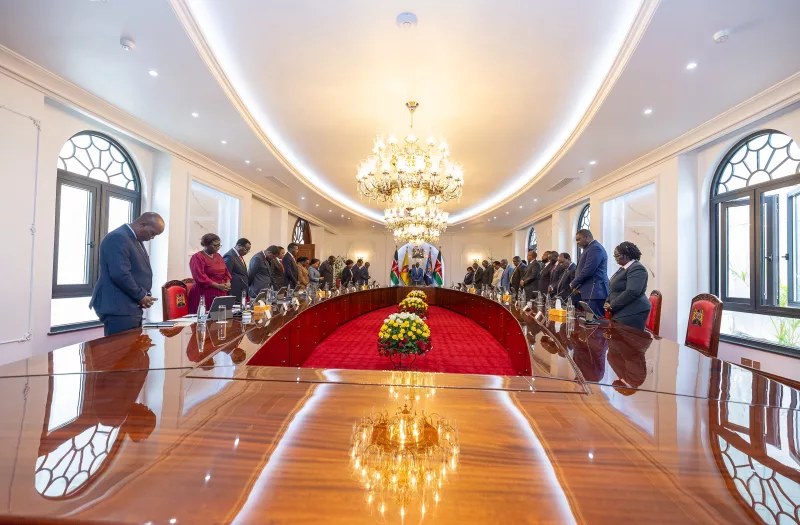
 Cabinet meeting chaired by President William Ruto at State House on October 9, 2026/PCS
The Cabinet has adopted a national energy plan seeking to mobilise Sh2.47 trillion in investment and connect an additional 5.1 million households to electricity by 2030.
The Kenya National Energy Compact is expected to expand electricity access in underserved communities, support enterprise growth and create opportunities for industrial development and employment.
The plan was announced in a Cabinet dispatch issued by State House, Nairobi, on October 9, 2026.
The government said the initiative would help extend power access to more households while supporting economic activity and creating opportunities for businesses and industries.
Alongside the electricity expansion plan, Cabinet endorsed a separate USD8.8 million (approximately Sh1.1 billion) electric cooking programme targeting 100,000 appliances in four counties.
The programme will cover Nairobi, Kiambu, Machakos and Kajiado counties as the government seeks to promote cleaner cooking and accelerate the shift to modern energy.
According to the Cabinet dispatch, the initiative is intended to reduce household exposure to harmful smoke while supporting the uptake of electric cooking appliances.
The two energy initiatives form part of the government's wider development agenda, which also includes investments in roads and water infrastructure.
Cabinet cleared three strategic road corridors for advancement under the Roads for Rural Economic Development Programme.
The projects comprise the 253-kilometre South Rift–Lake Region Gateway Corridor, the 256-kilometre Great Highlands Connectivity Corridor and the approximately 400-kilometre Lake Victoria Ring Road.
The roads are expected to connect agricultural production areas, fishing communities and trading centres to wider markets.
The government said the projects would help cut transport costs, reduce travel times and improve access to economic opportunities.
On water infrastructure, Cabinet approved an additional Sh12.83 billion to complete the Thwake Multipurpose Dam.
The project is expected to supply 150,000 cubic metres of water daily to about 1.3 million people in Makueni and Kitui counties, including Wote town and surrounding areas, as well as Konza Technopolis.
Beyond supplying water for domestic use, the dam is expected to support irrigation and future hydropower generation.
The investment is intended to strengthen water security, agricultural production and economic development in the areas served by the project.
The electricity expansion target, electric cooking programme, road corridors and dam financing were outlined as part of the government's plans to improve access to essential infrastructure and support economic growth.