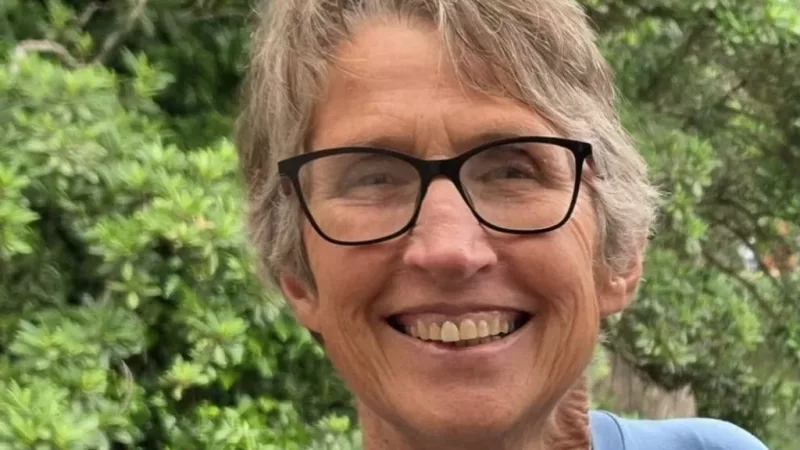
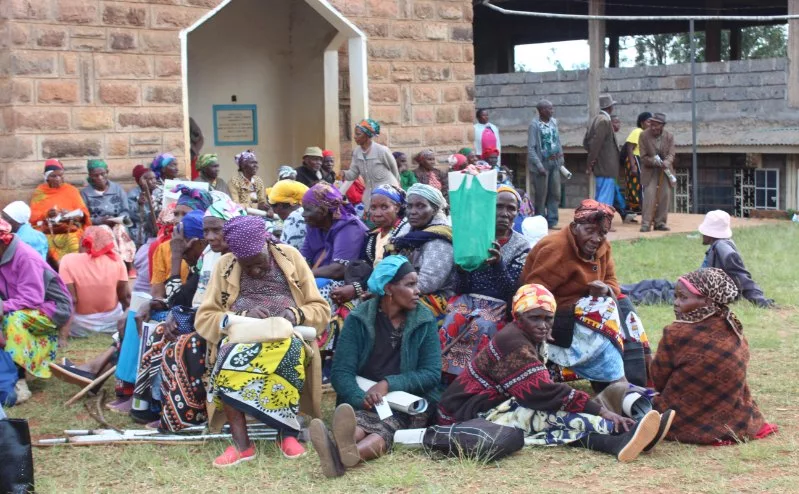
 Elderly persons wait to get registered for the Inua Jamii programme at Karung'e ACK in Mathioya on October 2
By 5 pm, Lilian Maina was still waiting.
The elderly resident had arrived at Karung’e ACK in Mathioya, Murang’a County, at 7am hoping to register for the Inua Jamii programme.
Ten hours later, she was yet to have her details captured.
Around her, hundreds of elderly residents waited in long queues, some having spent the better part of the day without food or drinking water as they waited for their turn.
The residents have asked the government to deploy more registration machines and personnel to speed up the exercise, saying the current arrangements are forcing vulnerable beneficiaries to endure unnecessarily long waits.
At the church, only one registration machine had been provided to serve the hundreds who had turned up.
Jeffrey Kuria, an elderly resident, arrived at the centre at 8am and feared many people would leave without being registered because of the slow pace.
“We want everyone here to be registered and the exercise completed, but with only one machine, it cannot happen,” Kuria said.
He urged the government to provide at least three machines so more people could be registered within a shorter period.
For some of those waiting, the challenge was not only the length of the queue but also the basic needs that went unmet as the hours dragged on.
“We have not eaten. What are we supposed to eat here? There is not even water,” Kuria lamented.
Kenneth Kabue, a philanthropist who visited the elderly during the exercise, said poor registration arrangements should not lock deserving beneficiaries out of a programme intended to support vulnerable households.
He said some residents had spent the entire day at the centre, yet only about 60 to 70 people had been registered out of an estimated 500 who had turned up.
“These people are elderly and they do not have the energy to withstand spending entire days without food. You cannot lock out our elderly from a programme through poor registration,” he added.
Some beneficiaries had resorted to eating sweets to keep their energy levels up while waiting.
Kabue had provided vehicles to ferry some elderly residents to registration centres and return them home, noting that many faced difficulties reaching the centres, particularly those from remote villages.
He urged local leaders to intervene and ensure elderly residents were adequately supported throughout the exercise.
The residents also called for an increase in the monthly Inua Jamii stipend, currently Sh2,000, saying the amount was insufficient to meet their basic needs.
Kabue urged elected leaders to push for an increase to at least Sh5,000, arguing that elderly people had contributed to society and deserved better support in their later years.
Maina said the Sh2,000 stipend was barely enough to cover the needs of elderly people who often rely on medication and support from their families.
She said many elderly people suffer from arthritis, hypertension and diabetes, conditions that require regular and often expensive medication.
“This means the Sh2,000 is barely enough to sustain us in a month. If the government could only raise the amount, it’d help us to be less dependent on our families,” she said.
Mathioya deputy county commissioner Riungu Laikera acknowledged the challenges experienced during the initial registration exercise and said the government had adjusted its approach to take the service closer to beneficiaries.
He said the exercise was also intended to conduct a “proof of life” exercise to establish whether some beneficiaries previously enrolled in the programme had died.
Mathioya has a target of about 7,000 beneficiaries, including about 170 persons with disabilities, Laikera said.
He urged beneficiaries to carry their identification documents when going for registration, while persons with disabilities could be represented by their caregivers.
The deputy county commissioner said registration teams would move to different locations to ease access and reduce congestion at a single centre.
The residents welcomed the decision to decentralise the exercise but maintained that more machines and personnel were needed to prevent elderly people from spending long hours waiting to be registered.
For residents such as Maina, the hope is that the next registration centre will mean less time in the queue, fewer hours without food and a faster route to the support they have been waiting for.