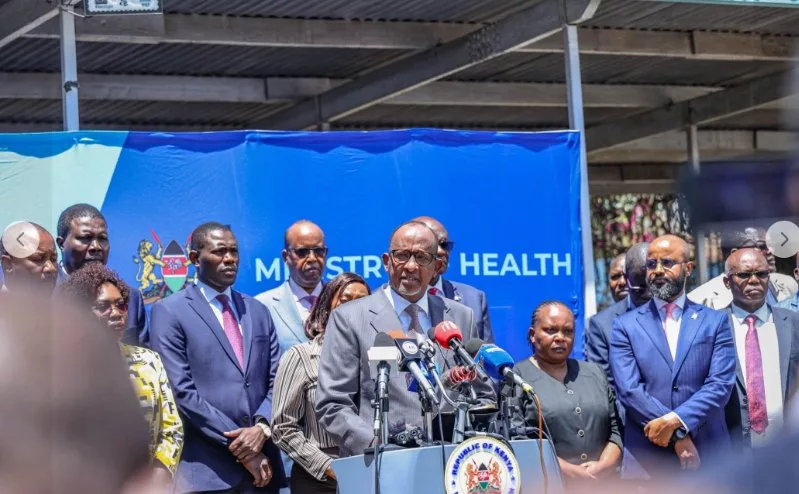
 Health CS Aden Duale at the press conference at Afya House on Tuesday, October 6, 2026. Photo /LEAH MUKANGAI
The Kenyan who died of Ebola was kept waiting for 18 hours at the emergency unit of Nairobi Hospital before the disease was suspected, The Star has learnt.
The man arrived critically ill, but medical staff could not quickly establish what was wrong with him or decide on a course of action, according to hospital sources.
"The patient had many signs and didn't say he came from DR Congo until he started bleeding from all openings," said a medical staff member who was present when he was brought in.
It is understood the hospital had to send samples to the Kenya Medical Research Institute (Kemri) for testing before any further treatment could be given.
"We had no option but to wait for the results. Unfortunately, he may have come into contact with many people," added a nurse.
The nurses and doctors who had direct contact, according to sources, have been told to quarantine themselves for 21days.
The accounts raise fresh questions about how a man who had been sick for about a month, and had passed through three countries' health systems, reached a Nairobi emergency ward without being flagged.
Health Cabinet Secretary Aden Duale announced the case on Tuesday, confirming that the patient had lived in the Democratic Republic of Congo for seven years and had been treated at several hospitals there. He travelled by road to Kampala and flew to Nairobi on Jambojet flight JM 8523, landing at about 1.10pm on October 3.
According to the ministry, a relative and a friend drove him from the Jomo Kenyatta International Airport (JKIA) straight to Nairobi Hospital, where doctors "quickly isolated" him after he presented with fever, chills, severe fatigue, muscle pain, painful swallowing, a sore throat and bleeding under the skin at injection sites. Samples tested positive for Ebola Bundibugyo virus at both the National Virology Reference Laboratory and the Kemri laboratory.
He died at about 11.30pm on Monday and was buried on Tuesday morning under public health protocols. His name has not been released.
The hospital sources' account differs from this timeline. They say the delay between his arrival and the suspicion of a haemorrhagic fever was long, and that the travel history that should have triggered an alert only emerged once his condition had sharply worsened. [Nairobi Hospital had not responded to The Star's request for comment by the time of going to press. No comment had come through by 6.30 pm
The delay matters because of how many people may have been exposed. The ministry says it has identified 28 contacts, including relatives and health workers who attended to the man. It is also trying to trace 23 passengers and four crew members who were on the same flight. All those considered at risk will be monitored or quarantined for 21 days, the upper end of the incubation period.
Health workers who handled the patient before the diagnosis would not have been wearing the full protective gear used for a confirmed case. Infection-control experts say this is the most dangerous window in any Ebola importation.
Director General for Health Dr Patrick Amoth said the patient may have taken medication that lowered his temperature and masked symptoms, producing a false negative at airport screening. JKIA uses thermal scanners to flag travellers with fevers of about 38 degrees Celsius or higher.
Pathologist Dr Ahmed Kalebi, chairman of DKL Laboratories, said the case exposed a gap that needed to be examined in both Kenya and Uganda. "Screening will never be 100 per cent effective, but the principle should be that we would rather investigate more false positives than miss a potentially dangerous case," he said.
Former deputy director of medical services Dr Bernard Muia said the man's travel history to the Ebola-hit DR Congo should have attracted greater attention at JKIA. He said screening cannot depend on temperature alone, since early Ebola symptoms such as tiredness, muscle pain and sore throat resemble many common infections.
Public Health Principal Secretary Mary Muthoni said Kenya strengthened preparedness at JKIA after the World Health Organization declared an outbreak in DR Congo on May 15. Mr Duale said 652,584 travellers have been screened since May, and 267 samples have been tested across five laboratories. This is the only positive result.
The case lands in a country that has spent months arguing about how it should handle Ebola, and not always about its own citizens.
In May, the government agreed to a United States request for a 50-bed quarantine facility at the Laikipia Air Base near Nanyuki. It was meant to hold American nationals exposed to the virus in the DRC outbreak. The plan was announced with few details, and critics said it was developed in secret and without consultation.
The High Court issued conservatory orders suspending the facility and barring the admission of Ebola-exposed people into Kenya under the arrangement, after the Law Society of Kenya and the Katiba Institute went to court. Laikipia MPs unanimously rejected the project, saying they had not been consulted and asking why Laikipia had been chosen.
Protests followed. On June 1, hundreds of Nanyuki residents marched to the air base, where they were blocked by armed air force personnel. Police used tear gas on demonstrators. Three people were killed in unrest near the facility.
President William Ruto defended the plan, saying he approved it at the personal request of US President Donald Trump and that the facility was no different from other health facilities in Kenya. The US had also pledged about $13.5 million to Kenya's Ebola preparedness.
Duale himself was later held in contempt of court for ignoring a stop-work order. He told the court he had directed the immediate end of all construction and site preparation at the base pending a hearing on the petition.
Opponents of the plan argued that Kenya should not take in foreign Ebola-exposed people when it had no cases of its own and when its own readiness was unproven. That argument now looks different. The first confirmed case is not an American evacuee but a Kenyan who walked in through the country's busiest airport.
Kiharu MP Ndindi Nyoro said on Tuesday that the government had been warned against "playing with" the Ebola issue, and repeated his rejection of a quarantine centre in the country.
Kenya is the fourth country to report a confirmed case in the current Bundibugyo outbreak, after the DRC, Uganda and France. The WHO says that by September 23 the DRC had recorded 7,890 confirmed cases and 3,799 deaths, a case fatality ratio of 48.1 per cent. Uganda declared its outbreak over on August 27 after 20 cases and two deaths.
The case does not mean Kenya has an established outbreak. But it means the country must now show that its surveillance, isolation and contact-tracing systems can stop an imported infection from spreading locally. Kenya Red Cross has urged calm and said safe and dignified burial teams and community surveillance volunteers are supporting the response.
Jambojet said it was cooperating with health authorities to trace passengers and crew.